
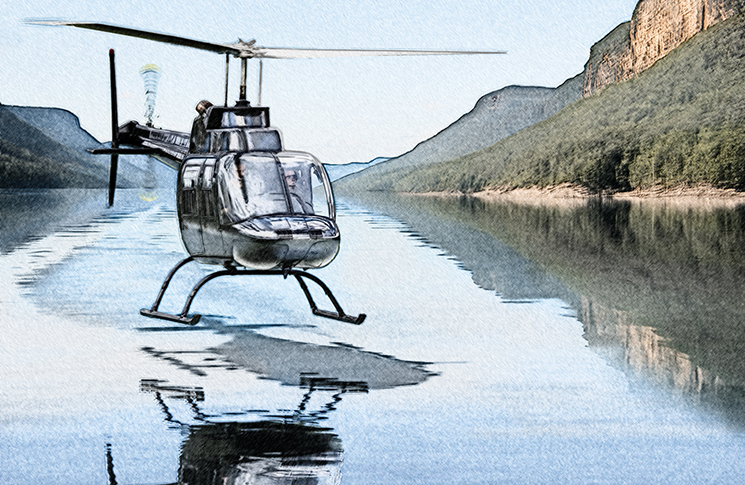
Bell 206B VH-KMX
Lake Burragorang, NSW near Donohoe’s Flat
12:11 pm
Sunday 17 July 1983
Amazing as it seems in the jaded 21st-century, the concept of punk rock inspired survivors of a dying world, fighting running battles in menageries of salvaged and savage motor vehicles was original and breathtakingly vivid in the early 1980s. It came from the mind of a Melbourne filmmaker, Byron Kennedy.
His creative partner was a young doctor, George Miller, whose inspiration came in part from the road crash carnage he saw on shifts in hospital emergency rooms. Their joint vision first emerged in 1979 as Mad Max and became fully realised 2 years later in its sequel, known as The Road Warrior on the many world cinema screens it conquered.
Kennedy became rich enough to buy a helicopter. And move to Sydney. There, a movie minded teenage acquaintance of his girlfriend shared some super 8 films he had made and got to see Kennedy’s early 8 mm projects in return.
‘It was guys in leathers, crazy hats, and spikes with metal chains, with axes … on billy carts going down the street in outer Melbourne … trying to kill each other,’ remembers the teenage friend, Victor Evatt, now 58, about Kennedy’s home-made films.
A friendship based on shared interests developed between Evatt and the maverick filmmaker, who in everyday life was a ‘shy and intense man,’ according to the Australian Dictionary of Biography.
‘I flew with him maybe half a dozen times before the accident, with other people or with him. I was a bright eyed, gawky, 15-year-old keen on hanging out. And this was a cool guy to know,’ Evatt says.
One Saturday Kennedy contacted Evatt. ‘He said the helicopter had had some issues, and did I want to come for a test flight with him on Sunday morning? Like, yeah, try to keep me away!’ Evatt says. On Sunday they travelled to Bankstown to collect the helicopter, which had been slightly damaged when parked at an inner-city heliport while operated by another pilot.
Kennedy started the Bell’s Allison 250 turboshaft, giving a running commentary on the importance of avoiding an EGT (exhaust gas temperature) spike as the engine came to life with its characteristic wolf pack howl. He called the tower and mentioned the helicopter, 2 persons on board, would be making a test flight around Warragamba Dam. ‘It’s very fortunate that he said, “by Warragamba” because otherwise they wouldn’t have known at all,’ Evatt says.
Within seconds the suburbs of western Sydney were rolling backwards beneath them as the dark escarpment of the Blue Mountains loomed ahead.
Weʼll level out here, ʻcause we donʼt want to go in the drink.
Still waters
Viewed on a map or from altitude, Lake Burragorang resembles an upside-down three-pointed star, with Warragamba Dam at the end of the north-east point. Kennedy and Evatt flew south of the dam wall and dropped into the southern arm, the valley of the drowned Wollondilly River.
Describing the scene, Evatt travels back there. ‘On the left side, there’s a very steep, probably 80 degrees, bank coming down into the lake. And on the right side, banks that come gently in and little bays.
‘I’m watching through the chin window the water racing underneath. The shadow of the helicopter is ahead of us and it starts to come closer.
‘And Byron, he actually said this, he said, “We’ll level out here, ‘cause we don’t want to go in the drink”. ‘I looked at him and then we kept flying along for maybe 10 seconds. And suddenly the shadow got bigger quite quickly. And I saw the skid on my side – the left side – splash and bang.’
Survival
The next thing Evatt remembers is surfacing, with his harness still round his shoulders, and looking north along the lake at a 100-metre plus debris trail. ‘A rotor blade was coming down, just falling like a leaf, like a feather, I’ll never forget it. Wow. It splashed about 50 metres from me.’
He saw bubbles rising, dived and found a hand. He grabbed it, pulled Kennedy to the surface, which was now covered in a stinging film of Jet A1 – ‘I’ve hated the smell ever since’ – and found a floating seat cushion to support them.
And I saw the skid on my side – the left side – splash and bang.
‘The very first thing he said as we surfaced was, “I lost power. There goes my no-claim bonus.” That’s exactly what he said,’ Evatt recalls. ‘I never forgot it because it was a typical Byron bon mot.’
Evatt now had to get an injured man much heavier than himself to shore. ‘I was a late developer, but I was a good swimmer,’ he recalls. His Duke of Edinburgh and surf lifesaving Bronze Medallion training came back to him, and he set out for the gentle bank at a measured pace. ‘He was a big man. I was able to get him just up on to the little bit of the bank, out of the water, but it took a long time because he was very uncomfortable,’ he says.
He knew that help would not be coming soon and was right about this. A tragic detail he found out later was that the Sydney Water Board patrol boat did not make its circuit of the lake that day because the boat driver’s wife was unwell. ‘He was beside himself when he found out,’ Evatt says.
Evatt had no way to signal or make a fire so he made a sign from rocks, saying ‘help’. Then he concentrated on keeping Kennedy warm, as best he could, in wet, fuel-soaked clothing. ‘Byron had all his clothes, but he had nasty gashes and he couldn’t feel his legs.’ He stayed close to his alternately delirious and sleeping friend, but between 4 am and first light, Byron Kennedy died.
A helicopter broke the silence about 8 am on Monday morning. The crew didn’t see the schoolboy waving his red t-shirt but Evatt remembers the sudden mid-air stop it made when someone on board noticed the sign, and how the pilot waggled the rotor disc in acknowledgment. By lunchtime he was in Penrith making a statement for the police.

What happened
The engine that might have confirmed or denied Kennedy’s claim of a sudden power loss was never recovered. Divers could not find it and it probably lies buried in the silt of the drowned valley, Evatt says.
The Bureau of Air Safety Investigation (BASI) report on the crash is an astonishingly cursory 99 words that says the rear of the helicopter’s skids hit the water as the pilot rotated into climb. Evatt disputes this. ‘He wasn’t climbing, but he said he was about to,’ Evatt says. ‘He said, “We’re going to go and then we’ll go up”.’
Evatt says Kennedy was an inexperienced but cautious and methodical pilot. ‘Byron was no cowboy,’ he says. ‘He was a young man, but he wasn’t going, “Hey, watch this”.’ Evatt estimates their height at between 30 and 40 feet before the descent into the water.
Then, as now, low flight was explicitly prohibited by regulation. But the practice appears to have been more tolerated in the early 1980s. Buffered by the cushion of ground effect and staying narrowly within the safe zone of the Bell’s height-velocity diagram, Kennedy may have thought himself relatively safe. Whether he had the experience to make this judgement is an open question. Experience is a cruel teacher which has humbled countless individuals and many organisations that thought they were managing a hazard while not being aware of the hazard’s true dimensions.
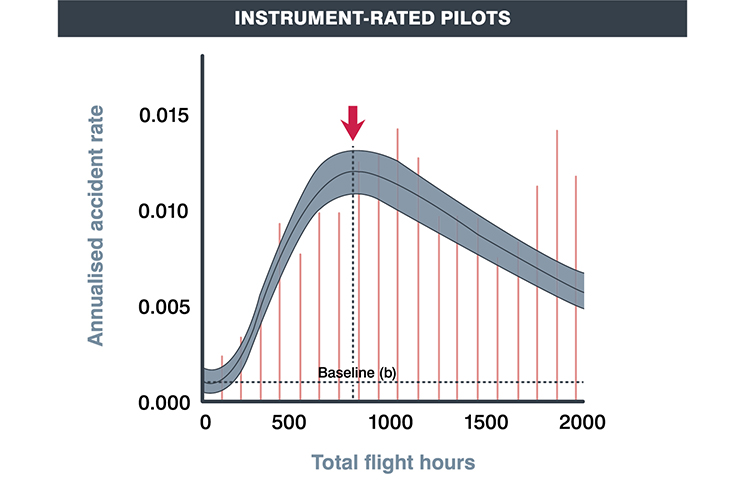
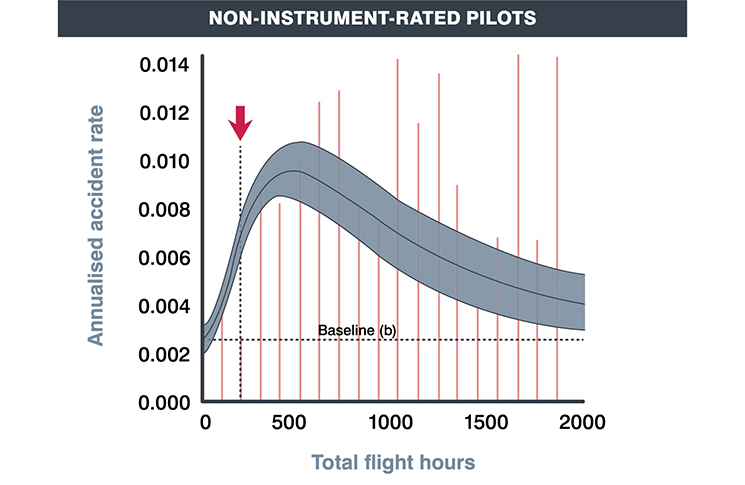
BASI makes no mention of Kennedy’s flight hours, but it is unlikely he had more than 500 hours on type, and possibly much less, in Evatt’s assessment. That puts him in an experience range known, a little sensationally, as ‘the killing zone’ by author Paul A Craig, who argued that accident risk is highest for pilots with about 250 hours total time.
In a 2023 examination of the concept, engineering psychologist William R Knecht concluded a ‘killing zone’ may indeed exist. ‘However, the killing zone may be far broader than earlier imagined,’ he said. ‘Relatively high risk for an individual pilot may extend well beyond the 2,000-hour mark before leveling off to a baseline rate.’
Evatt concurs with BASI’s finding that ‘the water surface at the time of the accident was smooth and glassy.’ He remembers small ripples which did not break the reflective surface. Such conditions are inherently hazardous for low flight and have killed pilots with much more experience than Kennedy. In March 2011 an Austrian police EC135P2+ helicopter struck Lake Achensee killing all 4 on board.
Byron was no cowboy.
After 8 years the official investigation found the pilot, who had 2,500 hours, had misjudged height over a glassy surface. No reason for low flying could be discovered.
A New Zealand CAA report into the crash of a Hughes 369D in Lake Sumner in May 2012 said:
The human visual system can also suffer from height perception illusion which occurs during flight over flat terrain where there are few visual cues. In these situations, a pilot may experience a false sense of height above the particular surface which may result in controlled flight into terrain. The New Zealand investigation found it was most likely the pilot probably had been affected by somatogravic illusion (where acceleration gives the illusion of pitch-up) and height perception illusion (where a pilot perceives they are higher than they are). ‘This resulted in him inadvertently flying the helicopter along a shallow descending flight path,’ it said.
Seaplane pilots have wary respect for glassy water. The US Federal Aviation Administration’s Seaplane, Skiplane, and Float/Ski Equipped Helicopter Operations Manual says:
‘The visual aspects of glassy water make it difficult to judge … height above the water. The lack of surface features can make accurate depth perception very difficult, even for experienced pilots. Without adequate knowledge of the … height above the surface, the pilot may … fly into the water at relatively high speed. Besides the lack of surface features, the smooth, reflecting surface can lead to confusing illusions.’
Aftermath
Seven years after the crash, Evatt began experiencing spinal spasms and pains and saw a surgeon, who, on looking at his scans, said, ‘I only see these in car accident victims or aircraft accidents and usually they’re dead. What happened to you?’ Forty-two years later his spine is ‘an ongoing challenge’ and the nightmares about being grabbed by the water and pulled under have receded. He nods with rueful approval when technologies such as flight following, emergency location transmitters and personal locator beacons are listed to him.
But nothing replaces flight planning and notification, he says. ‘I remember after the accident I’d be sitting in meetings with these grown men, pilots, talking about things, saying they didn’t want compulsory flight plans, and my question is, why wouldn’t you have a flight plan?’
Victor Evatt turned away from aviation and filmmaking and became a teacher of disabled children. His actions after the crash illustrated a survival truism: response matches the level of training. But the accident that nearly killed him broke the rules of storytelling: danger does not always make a dramatic entrance, like a mohawked barbarian on a motorbike.
Sometimes it hides, behind stillness and beauty.