
‘The guide says there is an art to flying,’ said Ford, ‘or rather a knack. The knack lies in learning how to throw yourself at the ground and miss.’
– Douglas Adams, Life, the Universe and Everything
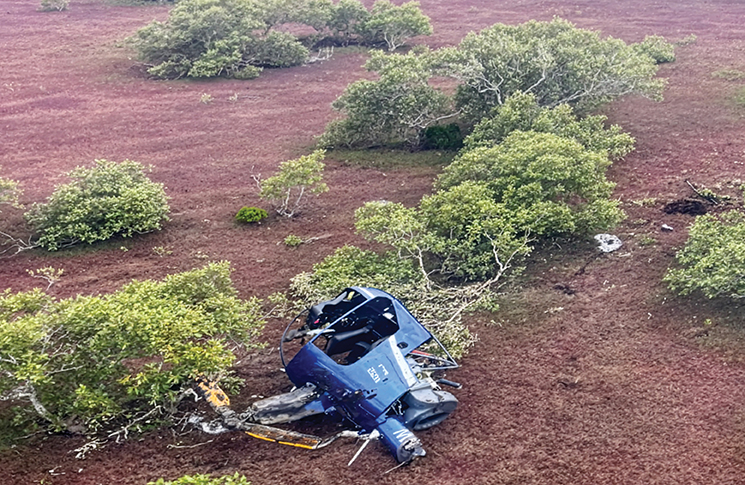
It was a routine morning with the sun just rising as an instructor and student prepared their Robinson R22. The flight was intended to consolidate advanced emergency procedures, a standard step towards a commercial helicopter licence.
It was unlikely the book, The Hitchhikers Guide to the Galaxy by Douglas Adams, was discussed in the pre‑flight brief. If it had, the prophetic line above may have prompted some more discussion.
After a series of successful emergency procedures and low flying, the instructional sortie took an unexpected turn. The student, eager to build skills for a future in agricultural flying, requested to practise torque turns (Figure 1) – a manoeuvre not on the lesson plan! For this, the pilot uses the main rotor torque effect to turn the fuselage in the opposite direction.
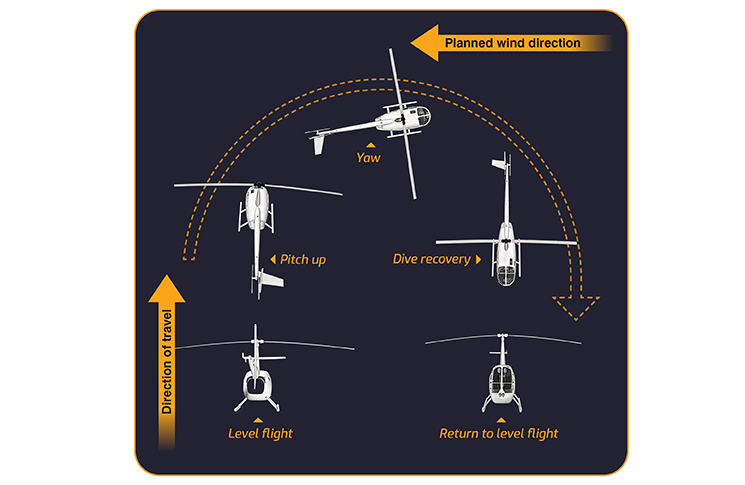
The instructor, although not having briefed it on the ground, agreed and several torque turns were completed at 50 feet above ground level. But as the final one began, the wind was picking up and starting to gust.
Exiting the last torque turn at 20 feet, the helicopter’s nose attitude was too low. The instructor, sensing danger, took control and moved the cyclic aft to arrest the descent. But in a blur of vibration and noise, the R22 struck the ground at speed, skidding through mangroves before rolling onto its side. The instructor was seriously injured; the student, with minor injuries, managed to shut down the machine and call for help.
The ATSB investigation noted several points:
- Torque turns were not a part of the commercial pilot syllabus. Further, they are not common in the agricultural domain, with the preference for procedure turns instead.
- The torque turn activity was not an element of the pre-flight brief and was only requested and discussed once airborne.
- Beginning the torque turn manoeuvres at 50 feet meant reduced margin for error; starting at a higher height and working down would have reduced operational risk.
The ATSB report covers these factors. However, this article will discuss diving recoveries in helicopters more generally.
Many fixed-wing pilots have misjudged the pullout from a dive with tragic consequences. There have been numerous airshow accidents where aerobatic pilots have misjudged the diving component of their display. Fighter jets can generate large rates of descent and even though very manoeuvrable, can enter unrecoverable dives from heights well above 10,000 feet AGL.
Over the years many organisations have developed rules of thumb to avoid diving accidents. These include the 50% rule where the dive angle should be half of your altitude above ground divided by 100.
For example, at 5,000 feet your dive angle should not be greater than 25 degrees.
Minimum safe altitudes can also be set where you are not allowed below a certain altitude while conducting a manoeuvre. Many of these rules were anecdotal and passed down through the generations without much understanding or analysis. A rule for fighter aircraft was not relevant to transport aircraft and few had even considered helicopter applications. It wasn’t until an F22 doing experimental test flying (2009) at Mach 1.6 in a vertical dive couldn’t recover, using 9G when at 13,000 feet AGL, that some real science and thought was applied to diving risk management.
Time safety margin
The concept of time safety margin (TSM) was developed. This was defined as the time the aircraft could remain on the worst-case vector, until the planned recovery would be insufficient to complete the recovery. The aircraft could be on this worst‑case vector intentionally or because of pilot mishandling.
The important point here is that if you go past this point, there is no way to safely recover the aircraft from the dive. It was initially used in flight test activities; however, it has application outside this domain. Table 1 shows some parameters for various TSM.
| Parameter | Routine | Focused | Aided | Redundantly Aided | Automated |
|---|---|---|---|---|---|
| Time (sec) | TSM > 8 | 8 > TSM > 4 | 4 > TSM > 2.5 | 2.5 > TSM > 1.5 | 1.5 > TSM |
| Planning Fidelity | Flight manual | Modelling & simulation | Modelling & simulation | Modelling & simulation | Modelling & simulation |
| Recovery Procedure | Routine | Defined & documented | Defined & documented | Defined & documented | Automated – auto GCAS |
| Minimum Training | Not required | In-flight build-up | Sim rehearsal & in-flight build-up | Sim rehearsal & in-flight build-up | Sim rehearsal & in-flight build-up |
| Recovery Initiation | Pilot | Pilot | Backup for pilot | 2 backups for pilot | Automatic |
| Risk | Low | Low | Medium | High | High |
An eight-second TSM typically involves profiles such as instrument approaches or subsonic aerobatics above 5,000 feet AGL. A TSM between 8 and 4 seconds involves weapons deliveries, flame-out landings or manoeuvres requiring additional training or qualification. A TSM between 4 and 2.5 seconds involves aggressive manoeuvring weapons profiles and require inflight build-up and a backup such as with a safety pilot. A TSM less than 2.5 seconds rarely occurs operationally but may include low-level strafing or low-level aerobatics. It requires intense training and practice, dedicated workups and a third party observer.
This is a lot of information for the average helicopter pilot to take in. Not to mention the lack of engineering planning data available to you or me. However, there are some concepts we can take out of this, including:
- There is a point somewhere in a diving manoeuvre where it is impossible to recover.
- The less time available before this point, the higher the risk.
- The less time available before this point, the more attentive you need to be and the more preparation you need to do.
If we reflect back to our accident case study, we could assume a torque turn in a teetering-head R22 may be an aggressive manoeuvre that requires additional training. This means the TSM could be somewhere around 4 seconds. This puts the risk at either the upper threshold of ‘low’ or the lower threshold of ‘medium’.
Controls that are recommended (Table 1) include defined and documented procedures, SIM rehearsal, a backup pilot and in-flight build-up. In our accident occurrence, there was no pre-flight brief so the pilot under training would not have had a good idea of the documented procedures.
The ATSB found the operator did not have a written procedure for torque turns in their exposition. A simulator was unlikely to be available; however, the instructor could have had the student chair fly the activity and call out key parameters and recovery actions to confirm learning of the ground brief. There was a backup pilot who could call if key gates during the manoeuvre were not met, to allow an early recovery. The final control of in-flight build-up was not conducted, as the activity was started at 50 feet instead of a work down from a higher altitude.
The ATSB report said the instructor ‘noticed that the nose of the helicopter was pointing slightly down toward the ground at a height of about 20 ft … they were about to correct the student when a sudden gust of wind increased the rate of descent. Aware of the ground proximity, the instructor immediately took over the controls and recalled moving the cyclic aft to arrest the rate of descent.’
It is important to note here that the instructor needed to take over the aircraft before initiating the recovery manoeuvre. The backup pilot mentioned as a control is to alert the flying pilot to a deviation from parameters, not to take over the aircraft. Taking over the aircraft will take a period of time and this time needs to be added to the TSM.
In this type of manoeuvre, the place to identify the error may be back at the apex of the torque turn. Any deviation from the manoeuvre parameters here may require an immediate takeover of control before the situation develops into an unrecoverable one. If the instructor wants the student to be able to correct these errors themselves, then extra height buffer needs to be applied increasing the TSM – a work
down in height!
Dive recovery technique
Diving flight requires changing the flight path. This is done by increasing the lift produced to pull the aircraft up. Fixed-wing aircraft increase their lift by increasing the angle of attack of the wing. The pilot pulls back on the stick to raise the nose increasing lift and ‘G’. In some cases, the pilot may have to roll wings level to maximise the vector of lift, pulling the aircraft out of the dive.
Fighter and aerobatic aircraft that can utilise large ‘G’ may briefly unload the aircraft – reduce ‘G’ – to allow the aircraft to roll quickly to wings level, avoiding rolling ‘G’ limits and taking advantage of quicker roll rates that can be generated with an unloaded wing. The pilot then quickly reapplies ‘G’ to increase the lift force pulling the aircraft out of the dive. The principle here though is to maximise the amount of lift force as quickly as possible, pulling the aircraft out of the dive.
How then do these concepts apply to helicopters? The instructor applied aft cyclic when they realised the aircraft needed to ‘pull up’. Applying aft cyclic will tilt the rotor disk aft and subsequently tilt aft the total rotor thrust (TRT) vector produced by the main rotor. The rotor disk will see a change in angle of attack which may increase the TRT magnitude slightly, resulting in some more of this vector pulling the helicopter out of the dive.
However, the first step should be maximising the magnitude of the TRT. Increasing the TRT is achieved by increasing the collective. If you need to recover immediately from a dive, then increasing the collective to the maximum flight manual limits needs to be done without delay. A wise pilot may not use full collective to enter a dive, to allow a TRT margin for a mishandled dive recovery later. If the helicopter has an angle of bank, then this needs to be levelled immediately to maximise the amount of TRT pulling you out of the dive.
This accident shows us that the time to act and recover from diving flight can be very limited. The time to initiate a recovery may be well before the helicopter is not obviously in an undesired state. When conducting a dive recovery, helicopter pilots need to prioritise the setting of the maximum collective permissible with zero angle of bank and not rely on aft cyclic only.
There shouldn’t be any knack to avoiding the ground when flying. There is actually a lot of science behind it which support some general principles we can all apply.
Safety summary
- Don’t introduce unbriefed or non syllabus manoeuvres in flight – complex or advanced tasks like torque turns require prior planning, clear
procedures and ground briefing. - Use altitude as a safety buffer – begin advanced manoeuvres at higher heights and work down gradually to maintain a safe time margin for error and recovery.
- Apply the time safety margin (TSM) concept – recognise there is a point in any dive where recovery is impossible, and lower TSM requires higher vigilance, training and controls.
- Prioritise correct dive recovery technique – in helicopters, initiate recovery by maximising collective and removing bank angle before relying on aft cyclic.
- Use structured build up and oversight – employ defined procedures, rehearsal (chair flying where sims aren’t available) and an observing pilot to monitor key parameters and trigger early intervention.