
Early on 16 June 2025, a Cessna 182T took off from a private aircraft landing area near Emerald, in inland central Queensland, with a pilot and a passenger on board. They were heading about 425 nm, or 750 km, north to Atherton, in north Queensland. The weather forecast had prompted them to fly there a day before they originally planned to.
The pilot had seen a forecast for Mareeba airport, about 22 km north of Atherton, and used that to assess conditions as suitable for a VFR flight. A flight plan was filed with NAIPS, the National Aeronautical Information Processing System.
The pilot had not seen the graphical area forecast (GAF) for the planned route. It would have shown cloud heights forecast down to 1,500 feet, with isolated fog reducing visibility to 500 m in areas along the planned track.
A pilot reading this forecast would recognise a hazard – spatial disorientation from flying into cloud, a predicament abbreviated as VFR into IMC. In the 10 years since 2015, there have been 108 VFR‑into‑IMC occurrences reported to the Australian Transport Safety Bureau (ATSB). Of these, 14 resulted in accidents, with 23 deaths.
About 95 km north of Charters Towers, the plan started breaking down. Tracking directly to Atherton was off the table because of low cloud over the terrain ahead. The destination would have to be Mareeba. The pilot diverted west to avoid the inland slopes of the Great Dividing Range and planned to fly for an approach to Mareeba from the west.
About 35 minutes after this decision, they were flying about 500 feet above ground level, following a main road. As they flew towards rising terrain, their height reduced to about 200 feet.
Roller coaster
Suddenly the windscreen went white. The pilot made a left turn and reduced power to avoid flying into the cloud. During this turn, the pilot lost visual reference with the ground. Recorded data showed the aircraft flew a 360-degree left turn with several abrupt changes in altitude.
The aircraft descended to treetop level 3 times before the pilot remembered a safety message from a CASA AvSafety seminar on VFR into IMC: to use the autopilot if caught in IMC.
Luckily, the 2005-built Cessna had an autopilot and the pilot used it to command a 180- degree turn to the left, intending to return to VMC. The aircraft was pitched up when the autopilot was selected and this made it climb during the turn. Airspeed fell and in the words of the ATSB investigation, ‘the aircraft likely stalled, leading to a rapid descent’.
The Garmin G1000 digital instrument panel turned red and sounded a terrain warning. The pilot, not succumbing to the awful confusion that overwhelms many visual pilots when they fly into IMC, immediately made the correct control inputs to ease the aircraft out of its dive.
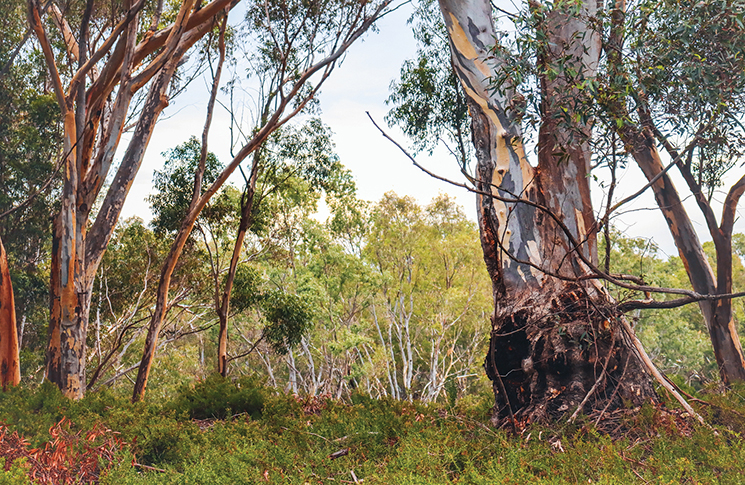
Through the windscreen, the occupants glimpsed the scrubby and seemingly eternal woodland of western Queensland – black, grey, green and blurred – in the dim light beneath the cloud base. It was the same rushing, angled image that must have been the last thing seen by countless VFR-into-IMC victims. But this pilot and passenger were extraordinarily lucky.
From the ATSB report:
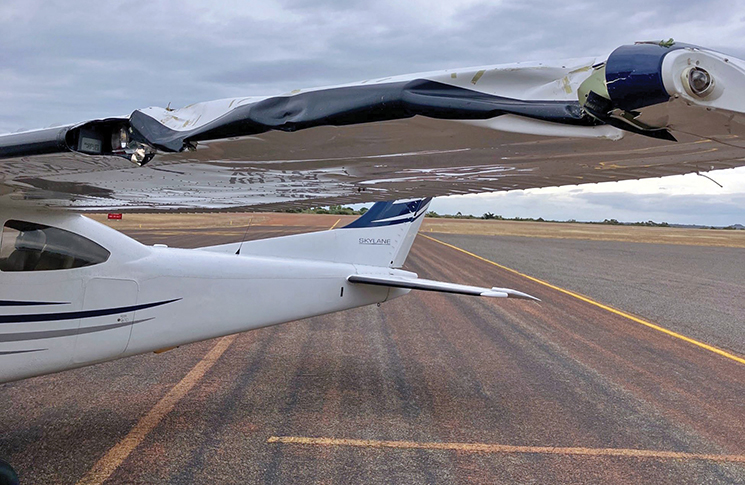
‘The pilot reported that they momentarily became visual and heard the aircraft impact trees. They pulled back on the control column and commenced a climb, entering IMC again. The pilot climbed to an altitude of about 1,000 feet AGL and was able to stabilise the aircraft and navigate out of IMC using the instruments. They became visual again once on top of the layer of cloud.’
The pilot chose to turn back to Charters Towers, 155 nm away, and in doing so flew a damaged aircraft past several viable landing places. The deformation on the left wing’s leading edge was not visible from the cockpit but the pilot noted the aircraft needed more right rudder than usual and would not accept the autopilot.
The ATSB investigation noted how this accident illustrated a characteristic of VFR-into-IMC events – the perceived pressure to continue rises as pilots get closer to their destinations.
‘It should be accepted that flying under visual flight rules will not always enable you to reach your planned destination,’ the report said. ‘Making an early decision to land or divert and to resist the urge to “press on” may prevent flight into marginal weather conditions and ultimately disaster.’
The pilot’s reactions to IMC had saved the aircraft from destruction but the same pilot’s insufficient flight planning had been a factor in the drama. It had failed to meet the standard set by astronaut Frank Borman’s adage that, ‘a superior pilot uses superior judgment to avoid situations which require the use of superior skill.’
Yet the pilot told the investigation about previously turning back many times when conditions were not suitable. This illustrated another adage: you are only as good as your most recent flight.
There is another interpretation, for those who believe in luck. This pilot should either buy a lottery ticket at once, because they lead a charmed life, or never gamble again, because they have used up a lifetime’s supply of good fortune. That said, it’s a relief to tell a cautionary story about VFR into IMC where the pilot lives to see another day.
Visit atsb.gov.au to read the full report (search for investigation number AO-2025-028).
Weather planning done right
CASR Part 91 (General Operating and Flight Rules) Manual of Standards 2020: 7.02 Forecasts for flight planning says, before commencing flight below 10,000 feet, a pilot in command must study:
- the authorised weather forecasts and authorised weather reports for the route being flown, departure aerodrome, planned destination, planned alternate aerodrome and any other reasonably available weather information that is relevant to the intended operation
- the authorised weather forecast must include a wind and temperature forecast as well as either a GAF, GAMET area forecast or a flight forecast
- should the forecasts and reports be studied more than one hour before commencing the flight, the pilot in command must obtain and review an update to that information before the flight begins.