

Name withheld by request
I’ve held a VFR private pilot’s licence since 1988 and have around 1100 hours in command. Recently, I was involved in an incident, which could’ve ended in tragedy.
School holidays had just begun, and my 12-year-old son had convinced me that I should fly him to a friend’s farm near Minimay, in far western Victoria. I checked the weather and found a suitable time to fly, as the weather was forecast to deteriorate the next day.
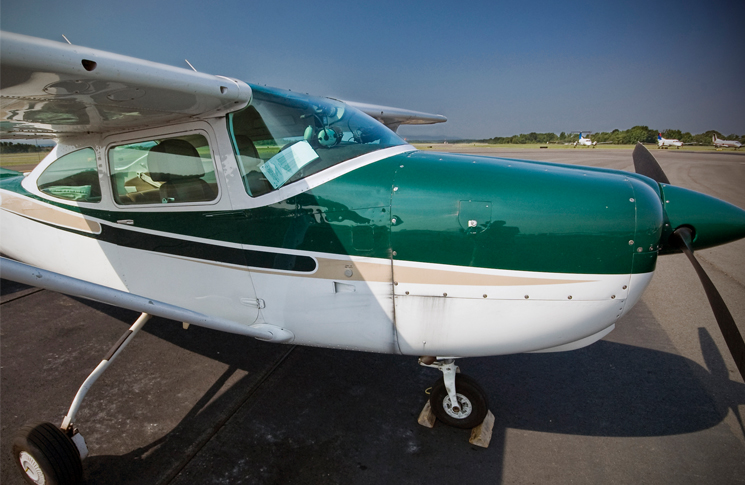
The flight from Tyabb Victoria was uneventful in clear conditions and I landed my Cessna 182 RG on the property’s dirt strip. I stayed overnight and planned to get away in the morning, as there was an anticipated change later in the day.
The weather forecast in the morning predicted a north-westerly wind of 28 knots, at my intended cruising level of 5500 feet, this’d give me a nice tailwind. And there were some isolated thunderstorms, well south of my proposed route.
With some fresh farm produce onboard and leaving my son for a stay over, I took off, heading for Tyabb, into a stiff breeze and a darkening sky to the west. I then turned onto my south-east heading and continued climbing to 5500 feet.
I was in clear smooth flying conditions, so I set the autopilot, with a 190 knot ground speed (26 knots faster than the 182RG’s cruise speed).
My ground speed indicated the wind was significantly stronger than predicted, in the vicinity of 40 knots. I was whipping along.
My first waypoint, Balmoral, came up quickly and not long after I crossed the Victoria Range—the first part of the Grampians, which was some 2500 feet below me. In no time, I was flying over Victoria valley and fast approaching the second ridge line, the Serra range, when all hell broke loose.
BANG!! Arghh!! It felt my like my head had been rammed into a brick wall, Uhh! I was dazed … My headphones were hanging around my neck, which was aching and I had a metallic taste in my mouth—
I’d bitten heavily into my tongue. After a few moments, I came to my senses.
I was sure the aircraft was seriously damaged?
And the thought crossed my mind; I might have to deal with a crash.
But unbelievably, the incident had left the wings level, with a slightly nose down attitude and I was only a couple of hundred feet below my cruise altitude. I turned the auto pilot off and scanned the rest of the aircraft, incredibly it seemed intact. I then cautiously checked the control operations, which were normal, as was the engine.
I was sad, sore and sorry, but still able to fly. I considered landing at Hamilton, but once I had confirmed the plane was operating normally, I decided to continue to my destination.
So what had happened? Initially I thought of a bird-strike, or had I hit another plane? Clearly, my head had hit the roof and this was further confirmed by my bleeding tongue. And sadly my gifts from the farm were now a complete mess, with apples strewn about the cabin and broken eggs decorating the seats.
I contemplated my situation and deducted that I had hit some sort of extreme turbulence and somehow I had lost some 150–200 feet in a split second.
I knew something of mountain waves, and as a regular flyer over the Grampians, I have
always been cautious in my approach when tracking into a wind, which is at right angles to the mountain range.
I would always fly an oblique approach to allow for an easy retreat should I detect down drafts or severe turbulence. However, as I was flying with the wind, and at 5500 feet, I was thinking I was above the danger zone for this sort of turbulence.
As the pain and blood in my mouth subsided, I came to the conclusion I must have flown through a rotor, which was the result of mountain-wave turbulence activity.
Although I had my seatbelt on, I had loosened it a little and I’m 195cm tall, meaning my head’s pretty close to the cabin roof. I could’ve been knocked out and the outcome would’ve been much worse.
Having now read more on lee wave turbulence, mountain waves and rotors, this may have been an error.
In hindsight, all the conditions were right for these to be present over the Grampians on the day of my incident—a 25 knot-plus wind at right angles to the direction of the ranges, coupled with insufficient altitude to be positively clear of turbulence.
On reflection, when I became aware of the increased wind velocity, I should’ve either climbed to 7500 feet before flying over the Grampians to allow increased clearance from any turbulence activity, or better still, planned to fly via Dunkeld thereby avoiding the range.
The other thing which is easy to do, but often overlooked: keep your seatbelt done up tightly in any conditions.
The next day I had my LAME look over my aircraft which all checked out OK.


Comments are closed.