Better off apart

0

In aviation, as in life, separation is preferable to conflict. Nowhere is this more true than in IFR operations.

Of all the components when learning to fly, the instrument rating syllabus is arguably one of the biggest challenges. Understandably, the focus of the rating is often on the more tangible parts of flying under the IFR. Flying an ILS or RNAV, managing engine failures, handling missed approaches – all are key elements of becoming a proficient instrument pilot.

One of the less considered challenges of IFR flying is managing traffic, particularly around non-controlled aerodromes. For the most part, ATC assists with en route separation and handles flow of traffic into the controlled aerodromes around our major centres. But when we descend into and depart from aerodromes in Class G airspace, the responsibility for separation is with the pilot.

Mildura, Wagga Wagga, West Wellcamp, Ballina and Proserpine are some of Australia’s busiest uncontrolled airports. Multiple simultaneous air transport arrivals, sometimes with a mix of regional turboprops and narrow-body jets, are difficult enough. But when you overlay on this the training aircraft, charter and other local operators, building the picture becomes the first big challenge.

Start by writing it down

For IFR aircraft, building the picture of the airspace around you for a departure or arrival often starts with the IFR traffic statement. This is the advice provided by ATC to an IFR aircraft prior to entering Class G airspace, of any known IFR traffic in the vicinity. It is often passed at the same time as information about any known VFR traffic, sometimes identified from ADS-B transponder returns.

The IFR traffic statement can contain a lot of information in a very short period. It’s often paired with a descent clearance, a QNH or a frequency handover. The easiest way to get on top of all of this is simple – write it down. I prefer pen and paper, going directly into a blank area on my navigation log, but other pilots I’ve flown with make the scratchpad on their EFB work well for this purpose. In either case, be ready to write. Most of the time, all you need to write is the callsign and ETA or ETD for any other aircraft.

How far apart?

A common unknown for newer IFR pilots is exactly how much separation is required in Class G airspace when you can’t visually separate.

In controlled airspace, air traffic controllers have a defined separation standard – the minimum lateral and vertical distances permitted between aircraft. Controllers have a more than 600-page manual that defines this standard – the Manual of Air Traffic Services (MATS).

In VMC in both controlled and uncontrolled airspace, visual separation between conflicting aircraft may be perfectly acceptable. Sight the other aircraft and visually separate – this is the ‘common sense’ separation we typically apply at uncontrolled aerodromes. When one or both aircraft are in IMC, things get a little cloudier.

The MATS states that aircraft in controlled airspace that are not able to see each other must have either lateral or vertical separation (or both). The manual explains at length how separation should occur in various situations; however, for en route operations in RNP2-capable GNSS-equipped aircraft (most IFR operations), acceptable separation boils down to either:

  • 1,000-feet vertical separation
  • 5-nm lateral (horizontal) separation.

But of course, the MATS exists for air traffic controllers, not pilots. The AIP and the regulations are less-prescriptive on the topic of separation in Class G, other than to say it’s probably a good idea, which leaves it up to the pilot to come up with a safe plan based on the circumstances. So why bring up the MATS at all? Well, it offers something to base our decision-making on – a basic standard which pilots can use, even at uncontrolled aerodromes.

In summary, if you can’t sight another aircraft for visual separation, aim for a minimum of 1,000-feet vertical separation and 5-nm lateral separation. Aim for a minimum of 2 minutes separation between position ETAs, such as approach waypoints.

Putting separation into practice

Like many things in flying, it’s all easy enough until you have to do it! I’ve sat next to many a pilot under supervision as they’re faced with, perhaps, their first IFR traffic separation puzzle at a busy uncontrolled airport. They receive all the information, understand what separation is required, but haven’t ever had to think about how to pull it all together.

A common unknown for newer IFR pilots is exactly how much separation is required in Class G airspace when you can’t visually separate.

I give pilots new to IFR operations 3 steps to manage this – plan, negotiate, review:

  • plan how you will separate from the other aircraft
  • negotiate that plan with the other aircraft affected
  • review the plan as it unfolds and take action if separation breaks down.

Planning separation

Planning separation is complex and every situation you come across will be different in subtle ways. Here I will focus on departure/arrival conflicts, i.e. one IFR aircraft departing into IMC, one arriving in IMC. This scenario is arguably the most common and the highest risk.

The principles apply equally when you have additional aircraft or must manage multiple conflicting arrivals or concurrent departures. The goal in your plan is to systemically protect your separation of 1,000 feet vertically or 5 nm laterally.

Here are 3 examples of how you could plan separation for an inbound and an outbound aircraft in Class G airspace.

Example 1: Differing tracks, lateral separation

You are departing on the 350 radial. You have been advised that another aircraft is inbound on the 020 radial and is due to arrive at the field 7 minutes after your departure time. Diagram 1 depicts this, overlaid with the lateral separation as you move further from the aerodrome.

Sidenote: how do you work out the distances? Contrary to popular belief, the 1-in-60 rule isn’t just for VFR pilots. With 30 degrees of radial separation, at a distance of 60 nm, the radials are 30 nm laterally separated, meaning that our 5 nm of lateral separation is achieved 10 nm from the field.
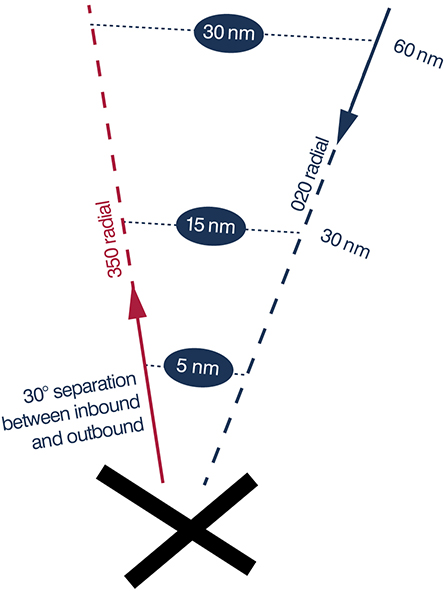
Diagram 1: Lateral separation for differing tracks

The plan that this converts to is – the outbound aircraft will plan to pass 10 nm from the field before the other aircraft gets to 10 nm. Therefore, as long as both aircraft are not concurrently within 10 nm of the field, lateral separation is ensured.

Example 2: Reciprocal tracks, lateral separation

Now consider that the inbound aircraft is on our reciprocal track. Vertical separation may not be desired, so you may plan to separate by each deviating 3 nm right of route, thereby ensuring at least 5 nm between the aircraft.
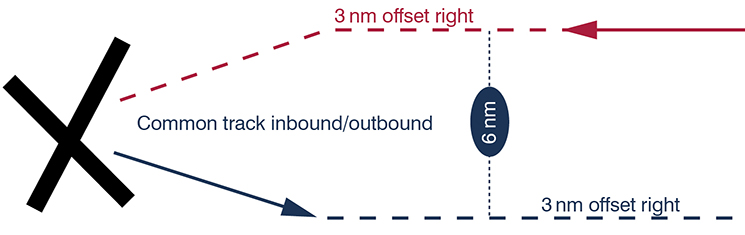
Diagram 2: Lateral separation reciprocal tracks

Example 3: Reciprocal tracks, vertical separation

As in Example 2, reciprocal tracks generate a conflict; however, this time vertical separation is planned. The departing aircraft will level off at A040 and the arriving aircraft at A050. Once it is confirmed the aircraft have passed one another (ensuring lateral separation), each may continue unrestricted climb or descent.

Negotiate your plan

The AIP goes to great pains to explain that under no circumstances should one aircraft direct another aircraft. And so, the key here is that you negotiate your plan for separation with the other aircraft.

This negotiation should normally occur on CTAF, although there may be times where the area frequency or even interpilot, 123.45 MHz, is the appropriate channels to have this conversation.

Importantly, although the area controller may pass you traffic information and may want to know you have a plan for separating, they will not tell you how to separate in Class G airspace. That’s entirely up to you and the other pilot. The area controller will likely still pay attention, so telling them you’ve got a plan for separation isn’t a terrible idea.

There is no standard phraseology for negotiating separation in Class G – plain language is the way to go. Address the other aircraft directly using their callsign (which is why it’s important to write their callsign down). Once you’ve established contact, in as simple terms as you can, explain the plan you have in your head for ensuring separation, and ask if they’d like to be a part of that plan. The other crew might have other ideas but, between the (at least) 2 of you, come up with something mutually acceptable.

The time to have this negotiation will depend on where the potential conflict is; if you’re going to pass each other 40 nm from the field, it’s likely to be something you talk about after departure. But, especially for single-pilot operators, planning separation is a hell of a lot easier on the ground – not when flying an aircraft in IMC.

Review the plan as it unfolds

Once you’ve got your plan for separation in place, negotiated and running, keep reviewing it. They say no plan survives contact with the enemy and half the time, you’ll find that your separation plan either goes out the window or becomes completely unnecessary.

Maybe the inbound aircraft breaks off from the reciprocal track to head to an initial approach fix for an instrument approach. Perhaps the outbound aircraft delays their departure by 3 minutes due to a VFR aircraft backtracking on the runway.

Importantly, if your plan isn’t working and you can’t ensure an acceptable level of separation, you have to act. Pilots shouldn’t be afraid to deviate from track or level off, to re-establish separation, especially in Class G airspace.

These situations can be incredibly dynamic. Closing speeds for reciprocal aircraft can be upwards of 400 knots – 6 or more miles a minute. If situational awareness is lost, the best thing you can offer the other aircraft is information about what you are doing – position and altitude, along with your intentions.

Fundamentally, you can never assume separation exists in uncontrolled airspace. Area controllers won’t instruct you on how to separate in Class G. It is up to IFR pilots to create and ensure separation. Plan how you will do this, negotiate it with the other airspace users around you and monitor and review separation continually, until you reach the sanctity of controlled airspace above you. 
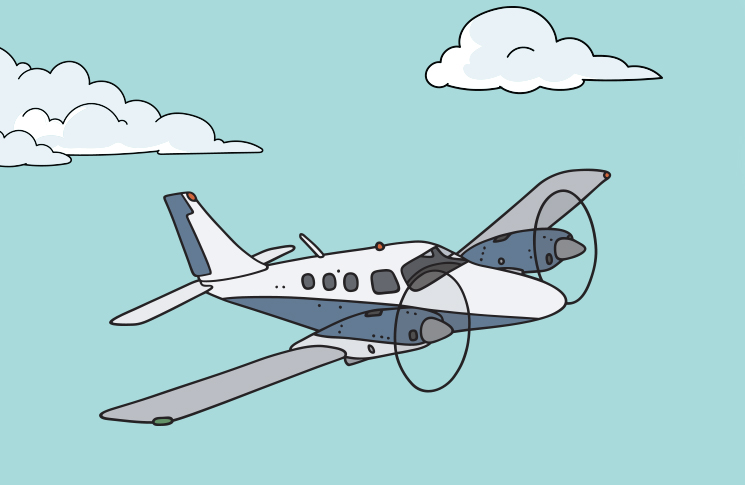
If your plan isn’t working and you can’t ensure an acceptable level of separation, you have to act.

Non-controlled operations is one of the special topics on our Pilot safety hub. Refresh your knowledge.

See and be seen with ADS-B

Automatic dependent surveillance-broadcast (ADS-B) helps improve situational awareness of pilots. It also allows air traffic control to see you and other aircraft, helping to improve safety.
Help shape the content you read on Flight Safety Australia

We want to hear from you!

Help us ensure we continue to provide engaging content by taking our quick reader survey.

Whether you are a subscriber to our print edition or read our stories online only, we want to know your thoughts on what type of content you would find valuable.

The survey will only take about 15 minutes of your time and closes on 25 July.

Take the survey at the CASA Consultation hub.

Hazards in the hangar!

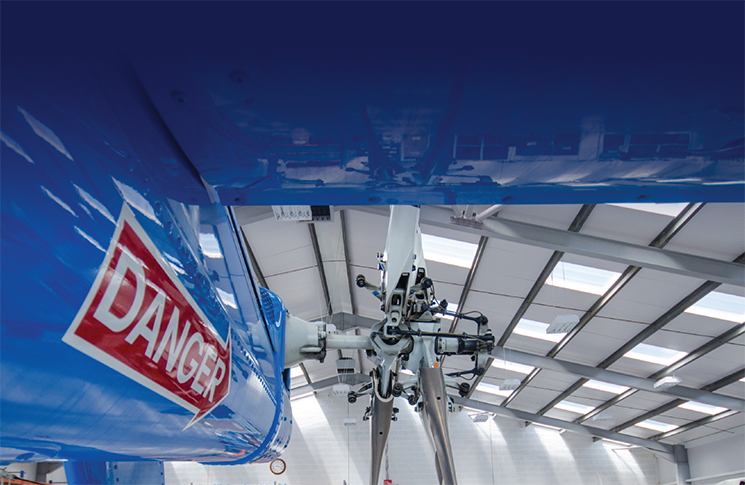
Safety in the hangar is an important aspect of aviation safety that is worth brushing up on.

‘Airplanes may kill you but they ain’t likely to hurt you,’ the accomplished but aerophobic baseball pitcher Leroy ‘Satchel’ Paige famously said. Unfortunately, this isn’t true about aircraft in the hangar. Aircraft maintenance can be a hazardous occupation in its own right, quite apart from the importance for flight safety of doing the job properly.

Aircraft maintenance is the top area for civilian worker injuries in the US Air Force, resulting in 33% of all lost workdays from 1993 to 2002.

In 2018, the US Bureau of Labor Statistics found aircraft service technicians had more than 4 times as many occupational injuries involving days away from work than pilots, co-pilots and flight engineers (186.3 vs 39.3 per 10,000 full-time workers).

American statistics also suggest that the COVID-19 pandemic had an indirect effect on maintenance worker safety from the disruption, interruption and retirement of senior personnel. The US Occupational Safety and Health Administration last year reported, ‘In 2022, there were 30 severe mechanic injuries, defined as injuries requiring amputation or in-patient hospitalisation or involving loss of an eye. This is the highest annual total since the administration began reporting these injuries in 2015. It compares with an average of 15 annual injuries during 2015–21 and the highest previous annual count of 19 in 2017.’

Safety in the hangar is covered by overlapping regulations. Generally, CASA does not oversee workplace health and safety as state governments have charge on this subject; however, some safety items required for issue of CAR 30 or CASR Part 145 authorisations would be expected to be adhered to, such as tyre inflation cages, safety harnesses and barriers. A maintenance and repair organisation would be expected to maintain and use this equipment in accordance with published instructions for continued airworthiness.

Maintenance accidents can be horrific.

  • In May 2015, an engineer at Istanbul airport was killed in a maintenance hangar when his head was caught between retracting flaps on a Boeing 777.
  • In December 2015, an engineer at Mumbai airport was ingested into a jet engine after helping the flight crew with a cross-bleed start during pushback.
  • In July 2019, a 22-year-old engineer was killed at Kolkata airport when the landing gear doors on a Bombardier Q400 closed while he was repairing the right-hand side main gear.
  • In December 2020, an engineer was crushed by a pushback tug he was servicing in a hangar at Chicago O’Hare Airport.
  • In December 2021, a 63-year-old engineer fell from an aircraft at Singapore Changi Airport and died from injuries 2 weeks later.
  • In November 2023, an Air India engineer slipped off stairs at Delhi airport while working on an aircraft radome and died from head injuries.
  • In February 2024, a China Airlines engineer was crushed to death by retracting landing gear in a maintenance centre at Taipei Taoyuan Airport.

Different types of aircraft bring their own repertoire of hazards into the hangar. Smaller general aviation types bring the dangers of magneto ignition propeller engines that must always be considered potentially live. A less fatal but distinct hazard is that of walking into the often head-high and sometimes painfully sharp edges of wings. (Any LAME who hasn’t done this is either new or a specialist in low-wing types.) Large aircraft bring the hazard of falls from height and crush injuries from hydraulic or electrical systems. All aircraft carry the risk of fire during maintenance.

Six hurtful things

Fire

Overhaul, repair and service of any powered aircraft involves a potential fire hazard because the factors that make fire so dangerous in the sky are also present on the ground – volatile fuel, high-energy electrical systems and flammable structures. Particular risks include:

  • Aircraft fuel system maintenance involving fuel storage and transfer. All operations involving gasoline and fuels with a flash point under 38 degrees C (such as aviation gasoline) must be done outside. The fuels allowed in hangars present a fire risk if located where open flame or spark-producing equipment is used.
  • Electrical equipment such as power units, aircraft electrical systems and chargers are possible ignition sources that must be kept separated from the fuel system, including aircraft fuelling points, tank vents and fuel line drains, which may be hard to see. Cordless tools using brushed electric motors are spark generators that have produced fatal accidents when used near aircraft fuel systems, even when they are empty.
  • Aircraft breathing systems, whether using bottled oxygen or chemical oxygen generators, should only be maintained and recharged outside the hangar.
  • Welding must be completely isolated from hazardous activities such as fuel transfer or painting.

“The factors that make fire so dangerous in the sky are also present on the ground.

Electric shock

With 58 km of wiring in a Boeing 737-700 aircraft, running at 115–120 volts AC or 14/28 volts DC, large aircraft electrical systems are inherently complex, and sometimes degraded by age.

The US Navy has this to say about the dangers of aircraft electric and avionics systems in maintenance. ‘Electric shock, burns and fire are potential hazards from working with electrical systems. To mitigate these risks, personnel should always follow established safety protocols and wear appropriate personal protective equipment (PPE), such as insulated gloves, safety goggles and flame-retardant clothing.’

In addition to PPE, aircraft maintainers must also use special tools and equipment designed for electrical work. For example, tools such as insulated screwdrivers and pliers help prevent electric shock and reduce the risk of short circuits. Aircraft maintainers must regularly inspect tools and equipment to ensure they are in good condition and free from defects.

Earthing electrical equipment helps prevent electric shock and reduces the risk of fires. All equipment must be properly earthed (or grounded, in American English) before work on electrical systems. Regular inspections and maintenance can help identify electrical issues before they become problems or failures. This includes checking for loose connections, worn or damaged components, split, overheated, chaffed or damaged wiring, signs of arcing and signs of corrosion.

Lockout tags notify maintainers they cannot apply electrical power to the aircraft. The tags can take the form of a sign at the entrance of the cockpit, or on the external power connection point and in the aircraft maintenance log.

Electricity is also an ignition source and particularly dangerous in the presence of fumes or combustible materials.

Chemical exposure

Working on aircraft means working near fuels, lubricants, coolants, cleaning solutions, including solvents and adhesives. All of these can be harmful if swallowed, breathed in, or absorbed through the skin. Composite materials including fibreglass and carbon fibre can cause dermatitis and a growing body of evidence is linking breathing in carbon fibre dust to mesothelioma.

PPE, including gloves, masks, respirators, cloaks, gowns and shoe covers, is the best way to counter these hazards.

Painting large aircraft is a significant challenge for hangar fire protection and not surprisingly, is usually delegated to specialists. Unlike motor vehicles or smaller aircraft whose components can be painted in booths then assembled, aircraft exterior painting involves workers using spray guns at height, with the risk of a fall added to the hazards of flammable paint plumes.

Noise

A noisy aircraft hangar is both a hazard in itself, if the continuous noise level exceeds 85 dBA and is a contributor to another insidious hazard – miscommunication.

A report published in Safety Science in September 2021 found 5 reported near misses and injuries associated with ergonomic, fall, housekeeping and communication issues; noise above 85 dBA was present during 4 of these events.

Heights

Working at heights is a high-risk activity, and a leading cause of death and serious injury in Australia. Falls are mostly a scourge of the construction industry but are also a hazard in aviation maintenance. The shape of aircraft and the need to avoid damaging aircraft surfaces add to risks in the hangar, which include falling and dropping tools.

Falls are not just a risk for engineers working on large aircraft, which can involve tasks done 20 metres above the floor. A 2008 study in the Journal of Safety Research found about one in 7 fatal falls were from 3 metres or less.

Fall protection gear, such as harnesses and lanyards, may be sometimes inconvenient but they reduce the danger of falls.

“A 2008 study in the Journal of Safety Research found about one in 7 fatal falls were from 3 metres or less.

Crush injuries

These can range from a nipped finger refitting an engine cylinder to a grotesque fatality. Serious crush injuries often involve the aircraft’s hydraulic and electrical systems.

Boeing has introduced the concept of aircraft hazardous energy whether electrical, thermal, pneumatic, hydraulic or mechanical as a maintenance hazard, and has this to say. ‘Hazardous energy controls are required when technicians could be exposed to unexpected energization, startup, or release of hazardous energy during service or maintenance activities.’

Communication failures or deviations from standard procedures are often factors in crush accidents, which of course are not unique to aviation. A safety methodology used in mining and industry is lockout, tagout, tryout (LOTO).

LOTO’s general principles are to:

  • lockout the system in question by either depowering it or blocking it, for example, with a locking pin for landing gear
  • tagout the system, placing prominent warnings on it and in workplace meetings to ensure it is not repowered until safe
  • tryout the system from a safe operator’s position to be sure it has no residual electricity (from capacitor) or no residual air, gas or hydraulic pressure.

Non-accident injuries

An insidious form of harm is the range of injuries incurred when working in the hangar. These can be thought of in 2 ways: as a non-accident injury or as an accident that happens in slow motion, over days, weeks, months or years.

A 2023 Embry-Riddle Aeronautical University study found, ‘Aviation mechanics are subjected to awkward postures like bending, twisting, heavy load carrying, etc.’ The use of a rapid entire body assessment ergonomic tool to measure these generated a score of 9, in the high-risk range.

‘However, there are other factors contributing to the existence of musculoskeletal disorders such as prolonged standing and repetitive movement,’ the authors said. ‘We recommend engineering controls such as chairs, mats and equipment-handling tools to positively impact aviation mechanics’ risk.’

Other studies have found lower back pain rates of up to 65% among surveyed aircraft maintenance technicians. These were linked to bending and working with twisted trunks, lifting of aircraft parts, high physical loads and extended overhead activity.

Studies have also suggested that the duration of employment and the engineers’ time in the office may also be predictors for work-related musculoskeletal injuries.

The SMS dividend

There are many countermeasures an individual can take to avoid the hazards of the hangar. They range from LOTO to using harness systems to guard against falls, air tools to avoid accidental ignition, insulated tools as a last-ditch against electric shock, or work platforms and other ergonomic aids as a countermeasure for chronic injury.

However, the greatest safety aid is an intangible: a safety management system (SMS) as required by Part 145-approved maintenance organisations. When properly implemented, an SMS will not only identify and mitigate maintenance related hazards to flight, but will also perform an occupational health and safety function.

SMS is based on 4 conceptual pillars:

  1. safety policy, in which senior management demonstrates its commitment to ongoing safety improvement
  2. safety risk management, which uses a formal process to assess the need for new or improved risk controls based on acceptable risk levels
  3. safety assurance, which evaluates the ongoing effectiveness of risk control strategies
  4. safety promotion, which focuses on creating a positive safety culture at all workforce levels.

“A culture that allows and rewards analysis, prudence, procedure and review is as necessary on the ground as it is in the air.

Aviation and other industries have many case studies of organisations that have reaped safety and business benefits from adopting and persisting with SMS. Individuals can and should be careful, regardless of their surrounds, but putting in place a culture that allows and rewards analysis, prudence, procedure and review is as necessary on the ground as it is in the air.

Further information

Bogged down in assumptions

A quick glance suggested everything would be okay – this was an expectations-driven illusion.

It was a beautiful winter’s day in western Queensland, warm and dry, for my trip to Bundaberg. Two hours after take-off and tracking east with a recently acquired tailwind, I ran into a long line of heavy showers, several hours and further west than forecast, but I admit I had become complacent and hadn’t studied the forecast carefully.

Emerald to the north-east was blocked. I tried the nearest cattle station strip on my EFB software. It was 15 nm south but had trees growing on it and looked a little swampy. Alpha was clear but was 60 nm back. I’d landed at a nearby cattle station 2 years previously so, with showers closing in, I headed that way.

I had enough fuel to reach Charleville, 130 nm further south and then regain track and, if I waited a couple of hours as I’d done before, the showers would pass. From the air, the familiar station strip had a new windsock and I recalled the manager telling me he was going to do the dirt strip up for the RFDS. I assumed he had because it looked like asphalt.

I joined downwind and landed but after 150 metres, the aircraft slewed sideways and stopped. That was when I realised the famous black soil plains had had some of that rain and the normally grey surface had taken on the appearance of bitumen.

There was no white cross on the strip, of course. It was uncertified and the woman who came out in the buggy told me it had rained steadily all night. They hadn’t been expecting it and she hoped I wasn’t going to land. The EFB had told me it was a ‘dry weather strip’. I’d forgotten what an all-weather strip meant since the drought began, but I hadn’t carried out a precautionary search and landing. If the wheels had dug in, there could have been a prop strike, or worse, the aircraft may have flipped.

“I had become complacent.

A couple of workers towed me back to the threshold where I spent an hour on my knees in the clinging black soil, patiently gouging most of it out of the wheel spats, noticing that the slightly inclined edge of the runway was drier than the middle. I was invited to stay in the ringer’s quarters for the night. Fortunately, I’d thrown a single doona in with my swag.

‘You’ll need it,’ the woman said.

I apologised for assuming the strip was serviceable and for the wheel ruts I’d left in the soft mud.

‘Assumption is the mother of disaster,’ she said.

Over breakfast, I discovered I was the only one who had heard the light shower in the early hours. The workers went off to their various duties, leaving me to study the online form on soft-field take-offs. Most pilots know there will be an increased take-off distance with wet grass, but clinging black soil is something else. It has been the same since the early days of flying outback.

I blew the dust off the pilot’s operating handbook (POH). By this stage, a 400 kg+ bullock had walked down the top edge where I planned to take-off and I spent another 2 hours plugging hoofmarks with clods on the 1,000-m strip, elevation 1,100 ft. At least the morning sun had dried the surface and black mud no longer clung to my shoes.

I studied speeds and distances, trying to compute the trees at the end of the strip with the surface conditions, as the wind came up and rain clouds moved in. The POH gave a second stage of flap and 55 kts as soft-field take-off minima, which was not something I practised in my 420 hours as a private pilot.

“Assumption is the mother of disaster.

The surface was doughy as we pushed the aircraft into position for the narrow, top-edge runway. I had chosen the windsock as my point of aborting the take-off. The surface was softer further down where there was a small dip and then an incline towards the trees. I elected a short-field take-off, with full power, and released the brakes.

I had one stage of flap on the floor lever so that I could engage the second without taking my eyes off the runway, but dropped all flap as the windsock came up with 45–50 knots IAS. I just wasn’t getting the speed and was running out of runway.

With the yoke back, the aircraft lifted off around 57 kts, but a wing caught the crosswind and the nose was too high. Back in ground affect, I passed 60 kts and lifted the nose, quickly reaching best angle of climb.

I didn’t see the trees, which may have been the case with a shallower
climb-out.

Lessons learnt

In hindsight, the wiser course of action would have been to complete a precautionary search and landing and then consider my options.


Have you had a close call?

8 in 10 pilots say they learn best from other pilots and your narrow escape can be a valuable lesson.

We invite you to share your experience to help us improve aviation safety, whatever your role.

Find out more and share your close call here.

Disclaimer

Close calls are contributed by readers like you. They are someone’s account of a real-life experience. We publish close calls so others can learn positive lessons from their stories, and to stimulate discussion. We do our best to verify the information but cannot guarantee it is free of mistakes or errors.

Plan for the plume

New power station near Shellharbour airport

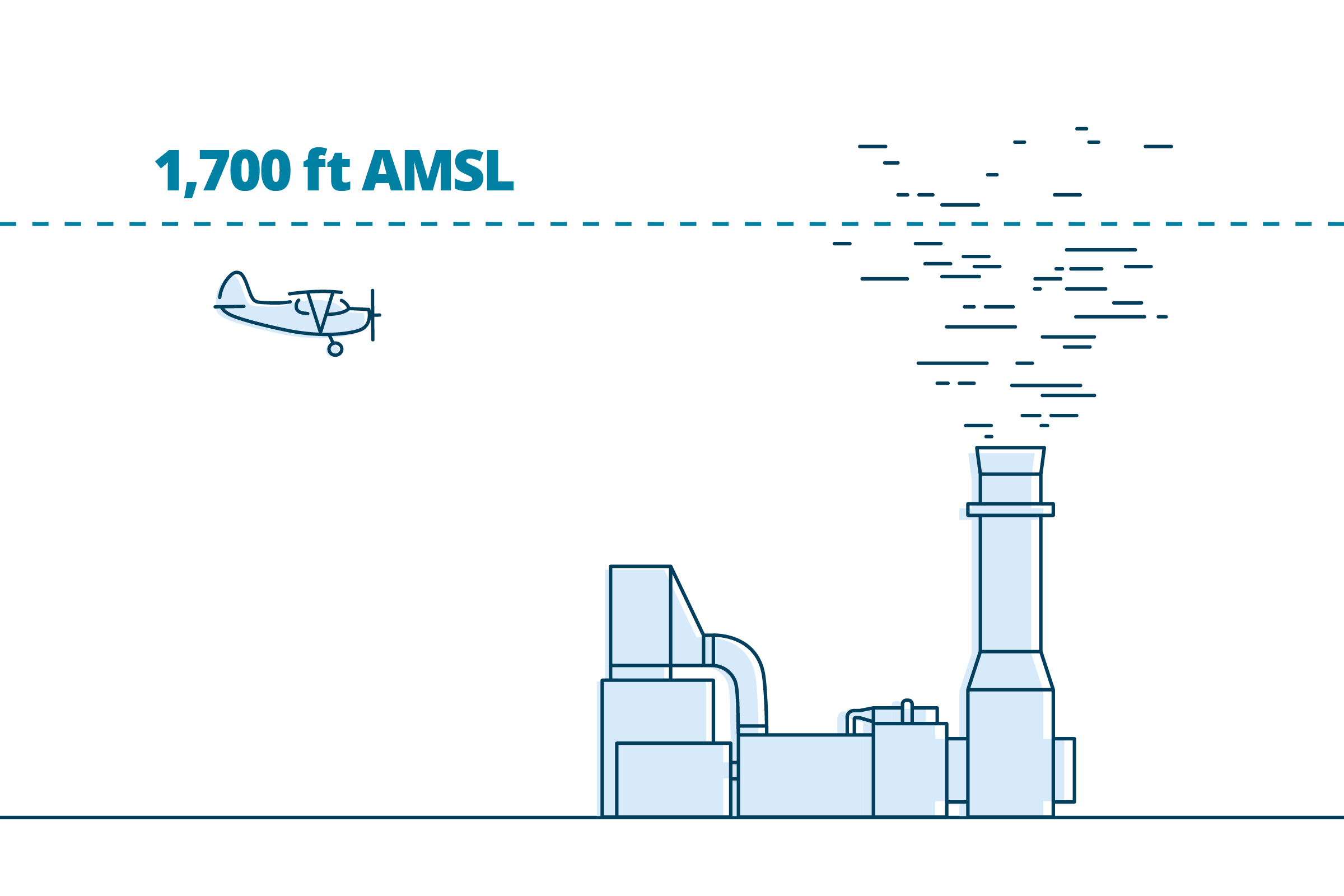
If you’re flying in the Wollongong and Shellharbour areas, be aware that the new Tallawarra B power station commenced operations in mid-June and may produce a high-velocity plume when operating.

The high-velocity plume may cause turbulence if you fly over at or below 1,700 ft AMSL. The plume will not be visible to pilots when it occurs.

To support the safety of air traffic in the area, the power station exhaust stack will have warning lights and a local aerodrome frequency response unit (AFRU) will broadcast messages when the station is operating.

Remember to plan ahead

All operators and pilots are reminded to review the Aeronautical Information Package (AIP), including the ERSA and visual terminal charts which have been updated to show the location of the plume. Where possible, plan your flight to avoid flying over the power station.

About Tallawarra B

Located in the Illawarra region in NSW, Tallawarra B is a new power station that operates intermittently when extra energy resources are required. It is located approximately 2.4 nm northeast of Shellharbour Airport.

Tallawarra B is an initiative of the NSW Government. CASA has provided technical advice on the plume. We have been working closely with local operators to raise awareness to ensure the ongoing safety for pilots in the area. We will continue to monitor and collect data about the plume. If you do experience any issues when flying near the power station, please let us know.

Drone flyer diary – Peter Jose

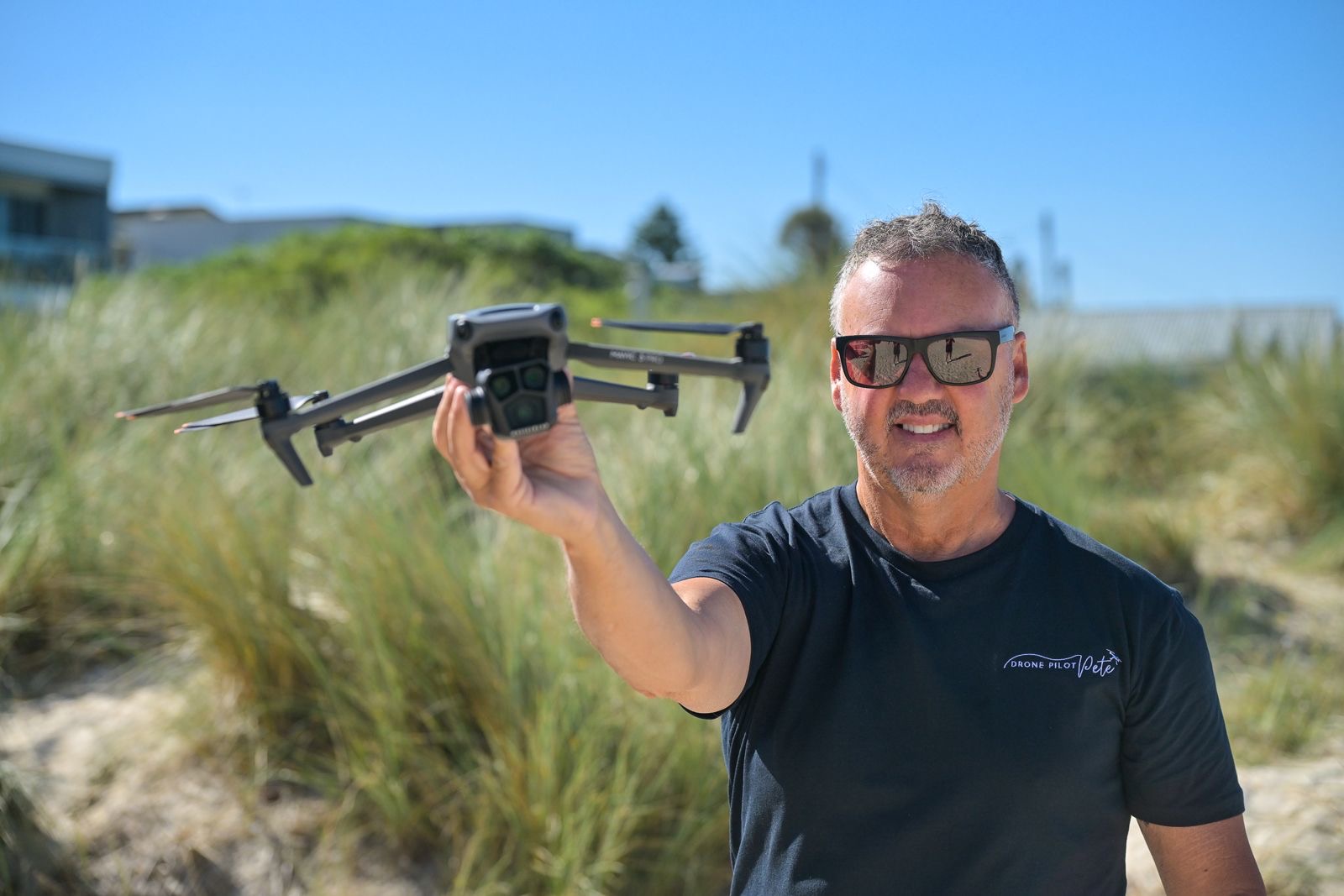
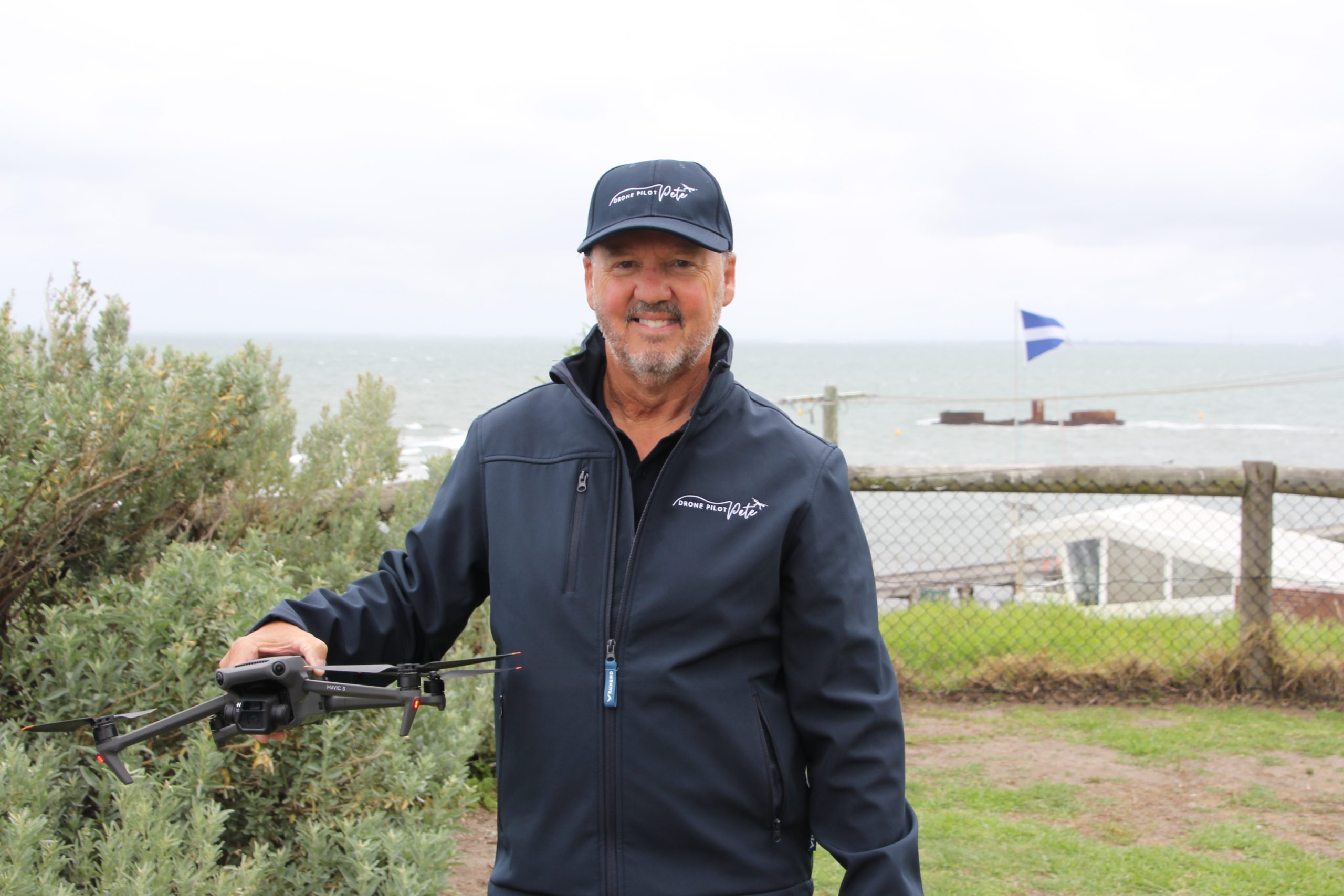
With a passion for aviation, photography and technology, Peter ‘Pete’ Jose transformed his love for the skies into a thriving aerial photography business. As the CEO and founder of DronePilotPete, he has his work cut out for him planning, filming and editing his clients’ drone flying shoots.

Pete’s aviation career began as a junior flight instructor at Moorabbin, with Schutt Flying Academy. He moved into his ‘most intense yet rewarding job’ for the Victorian Air Ambulance and then racked up 25 years working for the Qantas group, on the BAE-146 four-engine Jet and the Dash-8 Q300 as Melbourne base training captain. He finished his flying career on the Dash-8 Q400 as captain.

In 2018, Pete retrained in drone operations. He did several courses including a Certificate IV Training and Assessment at Swinburne University, teaching the next generation of pilots in aviation. Then he moved into the drone industry with remotely piloted aircraft (RPA) courses and obtained his remote pilot licence (RePL) and remotely piloted aircraft operator certificate (ReOC).

This set up the full business structure for DronePilotPete. ‘Thanks to my formal pilot licence and experience, many skills were transferrable to drone operations, which helped me pivot into aerial photography,’ Pete says.

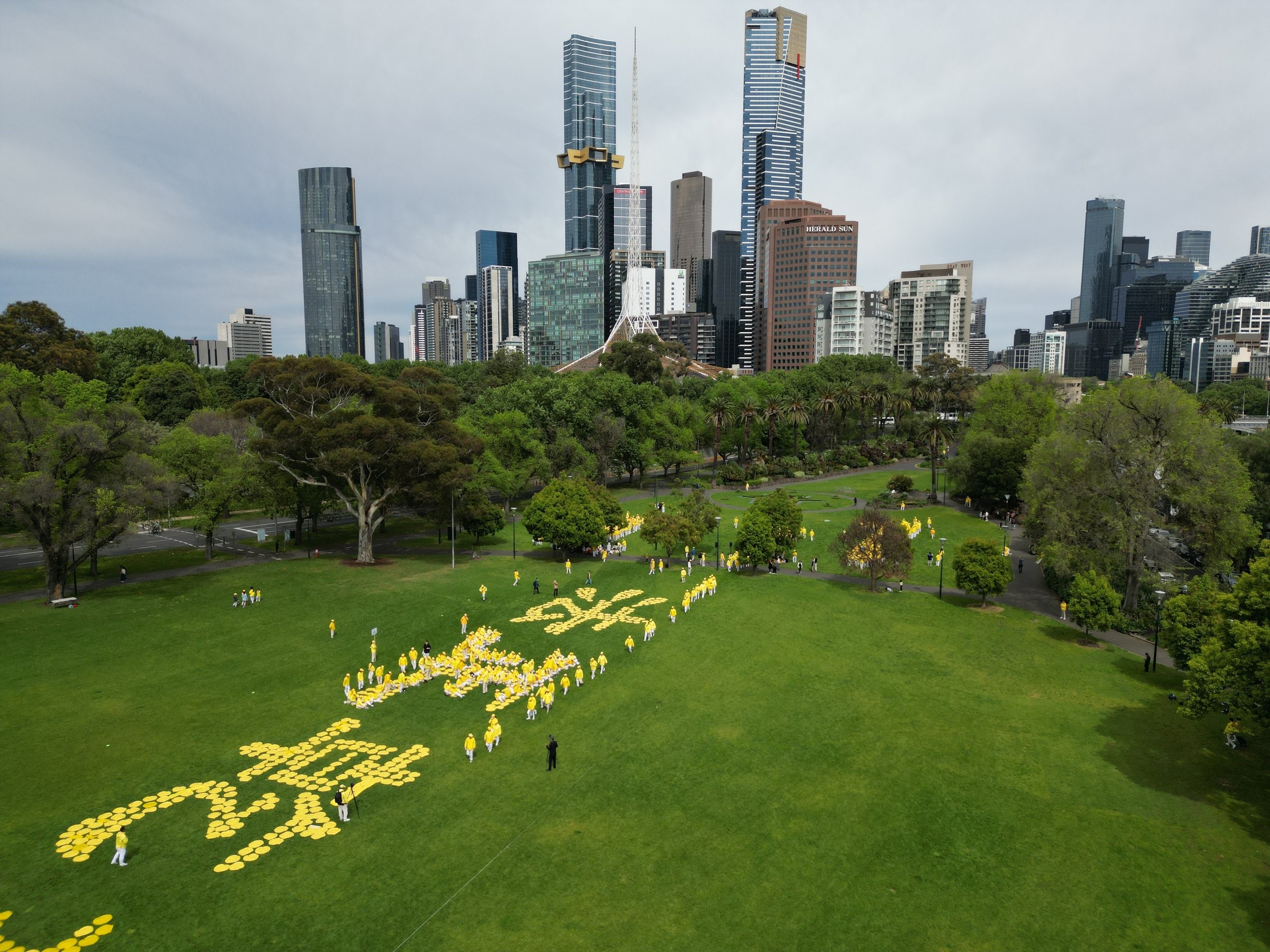
Character formation awareness with city view | DronePilotPete

These days, you can find him in the Melbourne area with a soy latte in hand prepping for his shoots with the help of a CASA-verified drone safety app.

‘The apps are easy to use and notify where I can and can’t fly,’ he says. ‘When clients ask if we can shoot in a specific area that’s within 5.5 kilometres of an airport, I can check and say “no”. For special jobs, I’ll organise permits through CASA, like for a shoot I did at Parkdale Yacht Club.’

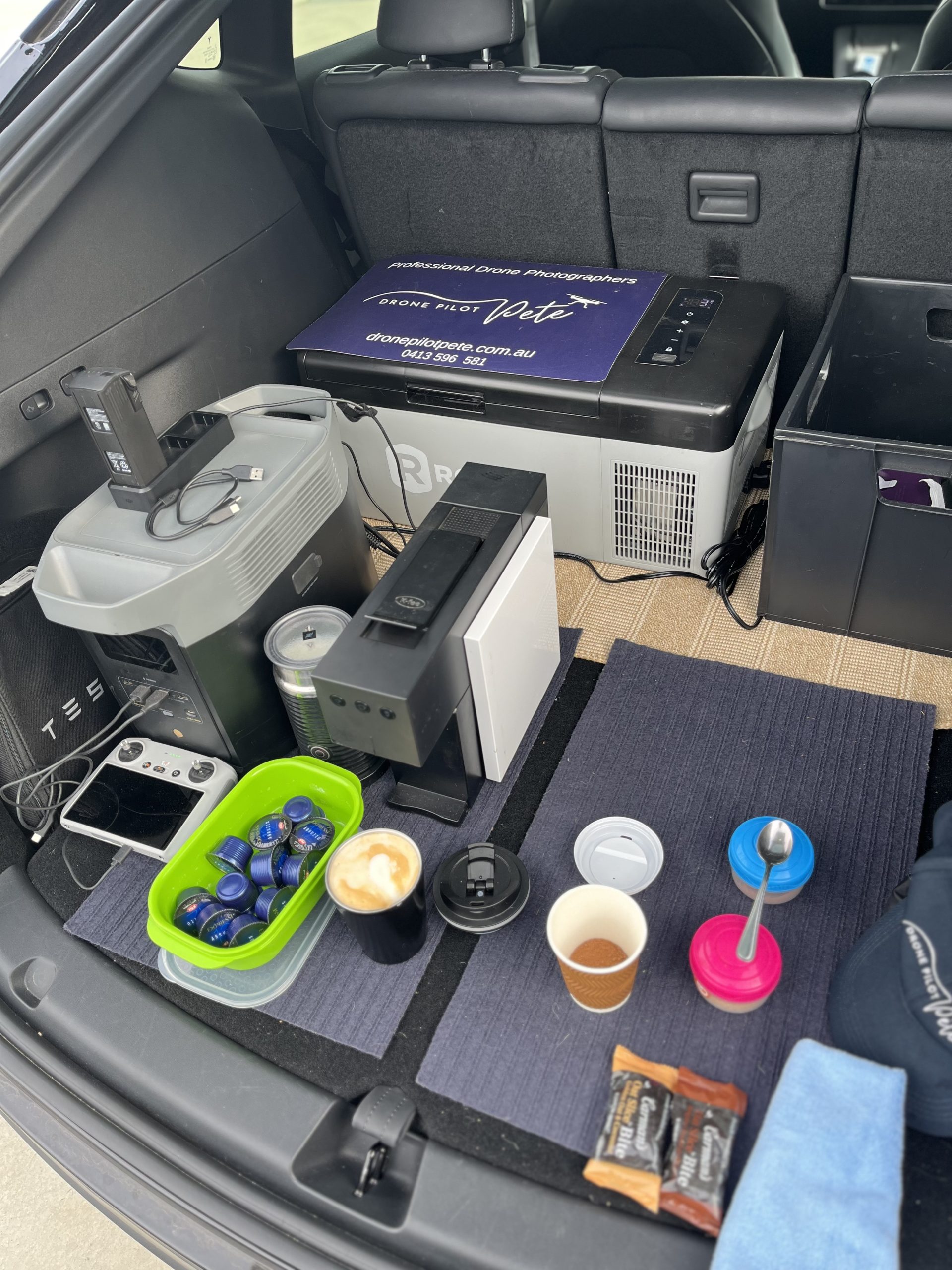
When preparing for a shoot, Pete stocks the boot of his car with cones, hi-vis vests and drones. His drone of choice is the Mavic 3 Pro for its lens zoom and video output capabilities. He also packs a coffee machine for infinite refills and a fridge filled with sandwiches.

Morning preparation set up | DronePilotPete

On top of the RePL (up to 25 kg) and ReOC, Pete also holds public liability insurance and makes sure all his operations are legal and compliant with the drone safety rules.

‘Even with the relevant qualifications, accidents can still happen,’ he says. ‘Drones can break, fail, fall and crash. Showing your clients your insurance certificate of currency gives them peace of mind that we are covered.

‘On these big days, it’s important to keep a safe 30 metres distance from other people. I do this by marking out a 30-metre circumference with cones or tape. I also complete a job safety assessment and, depending on the number of attendees, I might bring up to 3 spotters to the event.’

His eye for aesthetics gives him an edge in the industry. He happily waits hours for the right lighting or shot. ‘It’s an art form,’ Pete explains.

His advice for new aerial photographers is to do all the drone operational tasks properly. ‘Do the courses and your theory before you even touch the drone. There are too many people willing to break the law for a quick buck. That makes it harder for people like me doing the right thing to get work.’

Pete has completed a diverse range of drone flying jobs in his time, from filming Cirque du Soleil extravaganzas to capturing yachting regattas. His favourite job didn’t involve putting a drone in the air but keeping it close to the ground in a confined space.

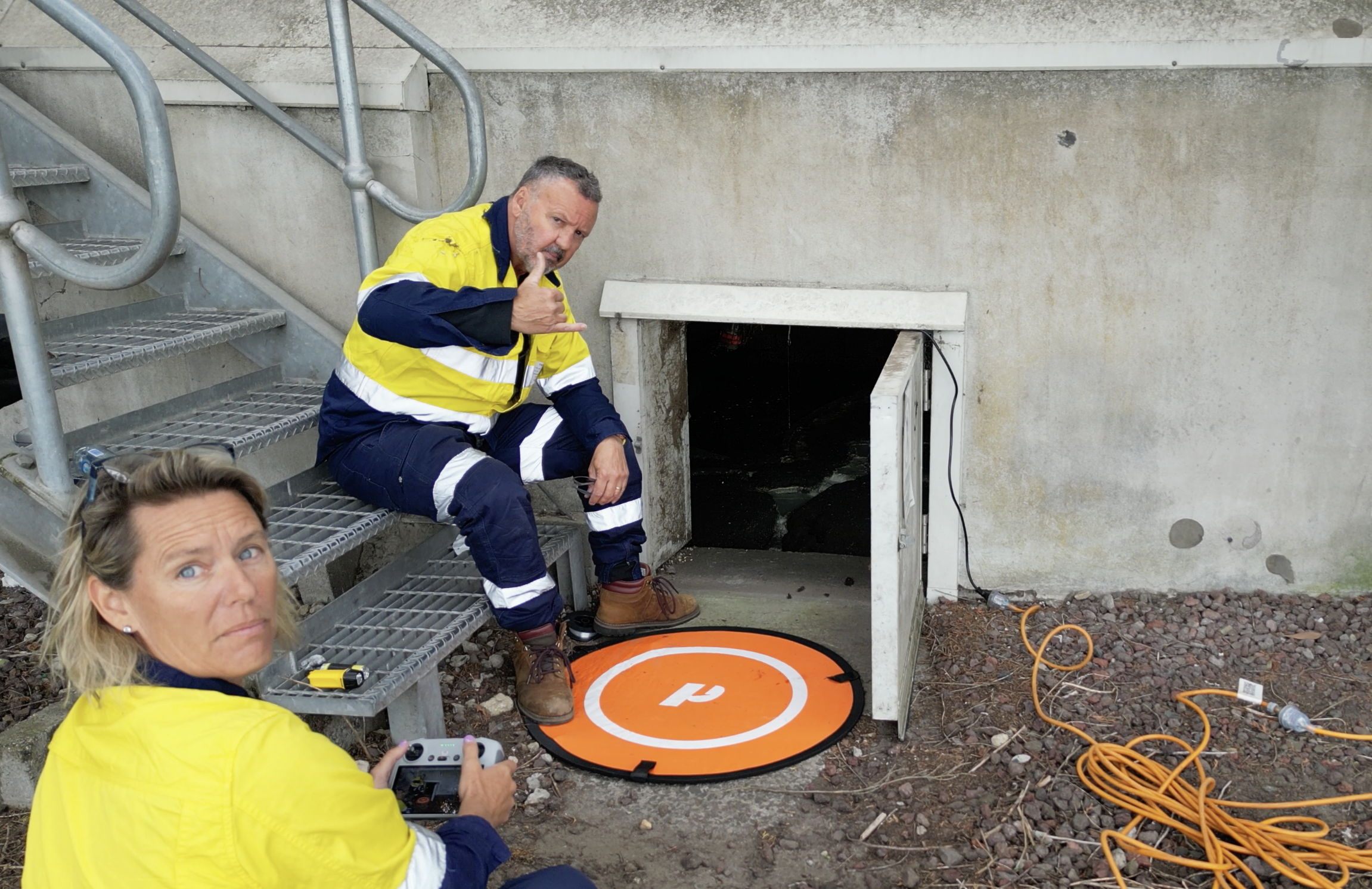
‘One of my clients had a burst pipe and they couldn’t send anybody in there due to toxicity,’ he says. ‘So, we sent a drone through a tunnel underneath the building to find out where the leakage was coming from. At the end of the day, we saved them over $100,000!’

Navigating a confined space drone flight | DronePilotPete

Take-off and landings are the trickiest periods during a shoot, so Pete takes special care to stick to the 30-metre area marked out by his cones and tape.

His top flight safety tip is to monitor fatigue to mitigate the risk of accidents. Fatigue can reduce situational awareness especially on shoots that last hours. As Pete explains, ‘You need to be well-fed, well hydrated and wide awake. Situational awareness is everything.’

Water sports, yacht regattas and events | DronePilotPete


 Don’t go cold

For pilots and aircrew there is no such thing as ‘just a cold’. A viral infection affecting breathing, concentration and energy levels is a strong reason to ground yourself. You should also know that some cold medications are an aviation hazard in themselves.

Take off with a headache, fever, chills and blocked nose or ears and they could become the least of your problems. Even a minor viral infection can lead to dulled concentration, intense pain and spatial disorientation even at lower altitudes, any one of which can cause you to crash your aircraft.

It’s also important to realise that some over-the-counter and prescription medications for colds and flu can affect your performance.

Why do colds matter?

Simple “head colds” can impair performance more than most people realise. These tiny viruses can cause severe problems in the ears and sinuses, all of which can be incapacitating if people continue to fly.

Many other viruses cause symptoms similar to those of the common cold but can become much more severe. These can extend to an ongoing cough, fever, breathlessness or pneumonia. Around 80% of bronchitis cases with fever, cough and heavy phlegm are caused by viruses. Don’t underestimate how much this “just a virus” can impact your ability to fly safely.

Medicines and incapacitation

Just because a medication is available over the counter doesn’t mean it is automatically safe in aviation.

A particular drug to be aware of is codeine. Since 2018, pain relief and cough and cold medicines containing codeine have only been available with a doctor’s prescription. This is because codeine is converted into morphine by the body and can impair performance in a safety sensitive environment.

If you’re a pilot, engineer, air traffic controller or in any other safety sensitive aviation position, you should not take products containing codeine without consulting a doctor.

Allergy to plant pollens, known as hay fever, can produce similar symptoms to a cold. The cause doesn’t matter. If your ears are blocked and you are feeling blunt, it is not a day for flying, no matter how blue the sky.

Hay fever can usually be treated with antihistamines or decongestants, but antihistamines can cause drowsiness, which is a ground for grounding in itself.

For more information check the CASA website for a list of approved, hazardous and prohibited medications.

Remember, if you’re not sure, to consult your DAME.

Retro but current

Projects swapping combustion engines for electric power seek to give long-serving aircraft types a second, green career.

Clean-sheet aircraft designs require not only huge sums of investment dollars but command time frames for development, testing and certification that can expand into decades.

Therefore, retrofitting – removing a combustion engine and installing new, clean technology propulsion systems to existing aircraft – is becoming an increasingly tempting path for some operators. It’s a process that not only holds the promise of reduced carbon emissions in a halved timeframe, but the dollars add up as well.

The company’s long-term goal? Retrofit a Saab 340 with an emissions-free propulsion system.

Electric dreams

Electrification is not widely considered a viable option for large jet aircraft, but regional airliners and commercial aircraft running short flights are a different proposition. Key to the battle of weight trade-offs and power availability are smaller airframes, short routes and fewer passengers – less weight-to-drag for the take-off and shorter distances to haul the weight. So retrofitting these smaller types of aircraft with new cleaner propulsion systems has become an ‘achievable prospect’.

Not only is the electric-retrofit concept tantalisingly close to being proven in a number of places around the world, it is also claimed to be fiscally prudent and has a few other great payoffs. With an improved bottom line and other advantages on offer, what regional airline or short-mission commercial operation wouldn’t want to consider retrofit?

Electric schemes

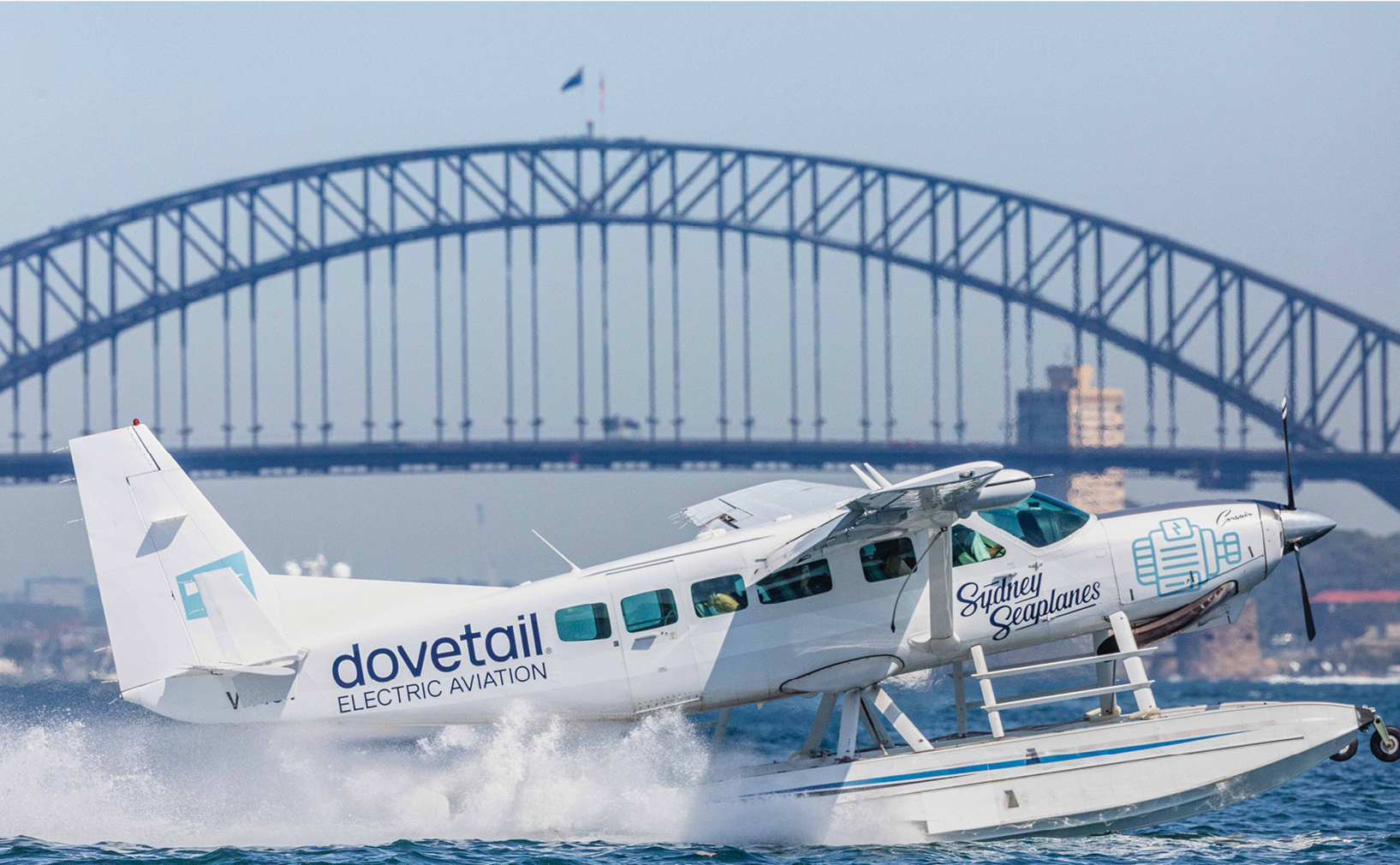
In July 2022, Rex Airlines partnered with Dovetail Electric Aviation – owned by Sydney Seaplanes and Dante Aeronautical – to ‘pioneer the conversion of turbine-powered aircraft to electric, nil-emission propulsion’ through the retrofitting of an electric propulsion system (EPS) to an existing aircraft. Rex would provide technical expertise, maintenance support and some facilities for storage. The company’s long-term goal? Retrofit a Saab 340 with an emission-free propulsion system.

The partnership was cemented in April 2023 with an ‘equity participation agreement’ and Rex appointing Ron Bartsch, one of its board members, to the Dovetail board. In June, Dovetail announced that Hyundai Motor Group’s business brand, HTWO, would supply a hydrogen fuel cell system to integrate with its EPS for powertrain trials.

Rex and Dovetail’s current plan is to work towards retrofitting a Saab 340 by first proving the concept on a Cessna 208 Caravan and a Beechcraft King Air.

David Doral, Founder of Dovetail Aviation, confirmed the retrofit of a Saab 340 at this stage is a ‘prospect’ rather than a ‘project’. ‘Preliminary sizing investigations into how that might work have been done, but the focus is the eCaravan and King Air projects, and they will create a roadmap for further developments,’ he said.

‘For both projects, the motor will be electric and then the question is where does the electricity come from? For the eCaravan, it will come from batteries; for the King Air, it will most likely come from battery and hydrogen fuel cells.’

The Saab 340 project may become a parallel project but for the moment, it’s the carrot at the end of a very long stick. Along the way, there are many, many baby steps.

The logic of retro

Retrofitting an existing aircraft means the hull of the aircraft stays almost the same. The project may create engineering challenges but also offers significant value.

As mentioned above, Dovetail is in the research and development phase of retrofitting an electric powertrain to a Cessna 208 Caravan, with flight tests planned for 2024. ‘Although retrofitting the Caravan requires structural change considerations … it’s not a new aircraft type, so it’s not a new type certificate – it requires a supplemental type certificate,’ Bartsch said. ‘This is when the manufacturer and the regulator agree to modifications to an aircraft, where it’s essentially the same aircraft.’

Aaron Shaw is the owner of Sydney Seaplanes and co-founder of Dovetail. ‘There are already major modifications to Caravans out there,’ he said. ‘Some parts of the industry have put very powerful motors in them. And for electric retrofit, it’s a very similar process. Rather than a whole new type certificate, retrofit offers a faster and cheaper way.’

Shaw described the Caravan retrofit as an ‘early adopter’ project and ‘fit for purpose’ for short scenic or commercial flights of around 20 minutes. ‘Most of Sydney Seaplane’s flights are in that ballpark, but longer flights, such as Sydney to Canberra, require additional power derived from hydrogen fuel cell technology or similar,’ he said.

Electrically propelled aircraft produce up to 65% less noise than the conventional design, a bonus for crew, passengers and communities around airfields. Less noise may even mean a reduction in curfews at some airports, which is another commercial temptation. And there are no fumes, soot or other atmospheric pollutants produced from flight.

Electrification also offers operators some dream-worthy cost-reduction percentages. Figures vary across companies and between powertrain systems, but not uncommon is the claim that operating costs would be reduced by 40% and hourly maintenance costs by up to 75%, when compared to turbines.

‘For the eCaravan, the operating costs can be down to 25% of what they would be if turbine driven,’ Bartsch said. ‘You can do the trade-off with maybe one or two fewer passengers. It’s like a Tesla car – it doesn’t need to be tuned or have the spark plugs changed or things like that. It’s just an electric motor.’

Dovetail suggests the financial investment for a pure electric retrofit of a Caravan could be amortised within 3 years.

The engineering challenge

The process of retrofitting and certification is complex and rigorous, to say the very least. Well, this is aviation!

Retrofitting begins with an exhaustive study of the target aircraft – including its performance characteristics, weight distribution, weight-and-balance calculations, airframe loadings, weight limitations, even glide ratio – to tease out all the potential modifications required to make a conversion.

Weight and space are major considerations. For example, while batteries might replace fuel tanks in the wings, the resulting higher weight might affect the wing root loading.

Australian company FlyOnE imports and distributes the Pipistrel Alpha Electro, a two-seat fully electric version of the Pipistrel Virus SW 121. After recently completing a case to convert the nine-seater Partenavia/Vulcanair P68, the company found some significant redesign considerations. ‘The P68 is low drag, but also low lift due to a substantial weight and short wings,’ FlyOnE founder and CEO Korum Ellis said. ‘For a practical conversion, we would want to modify the wings for greater span and lift characteristics to achieve an endurance of close to an hour without penalising the payload capacity by more than 10% by having to add batteries in the fuselage.’

For hydrogen power trains, the question might be: where to put the gas tanks? ‘Definitely one of the challenges to overcome is the volume of hydrogen tanks,’ Doral said. ‘This is a huge challenge for a [heavy jet] that flies thousands of kilometres. However, the typical route for Rex is hundreds of kilometres. Finding room is not as big a challenge for something like the King Air.’

This remains a complex and nuanced engineering battle between centre-of-gravity considerations and trade-offs between weight, space and power. And then a retrofit must prove its safety and the success of the modification to the certifying authority through testing.

One company that is baby-stepping towards certification of an electric-hydrogen powertrain retrofit is ZeroAvia in the UK. As part of its HyFlyer II project, it removed the left-side turbine engine on a 19-seat Dornier 228 and replaced it with a fully integrated EPS.

ZeroAvia’s retrofit and certification process has been unfolding for nearly 2 years:

  • December 2021: first spin of electric motor propeller on testbed aircraft
  • June 2022: hydrogen-electric powertrain fully installed
  • July 2022: outdoor ground testing undertaken
  • September 2022: successful taxi under medium power
  • September 2022: successful taxi under high power
  • January 2023: first flight with left-side hydrogen-electric propulsion configuration
  • April 2023: test flight using only prototype engine
  • April 2023: achieved top speed allowed under permit – 150 knots
  • April 2023: achieved a height of 3,000 feet AMSL
  • May 2023: achieved 16-minute flight with 2 climbs
  • May 2023: achieved 22-minute flight and 4,000 feet
  • July 2023: achieved 20-minute flight and 5,000 feet.

Baby steps, sure, but steps nonetheless. And the project is yet to convert both engines.

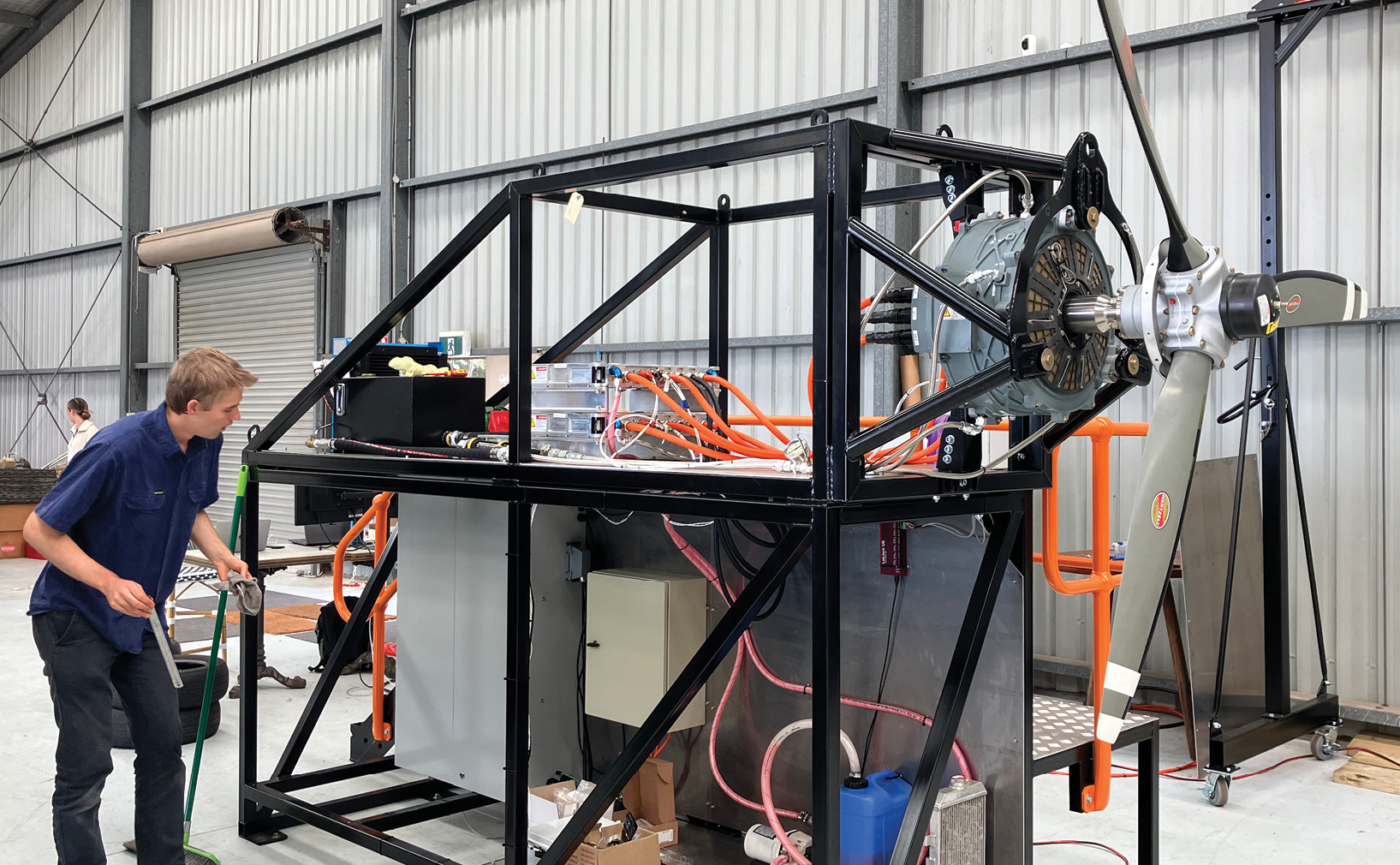
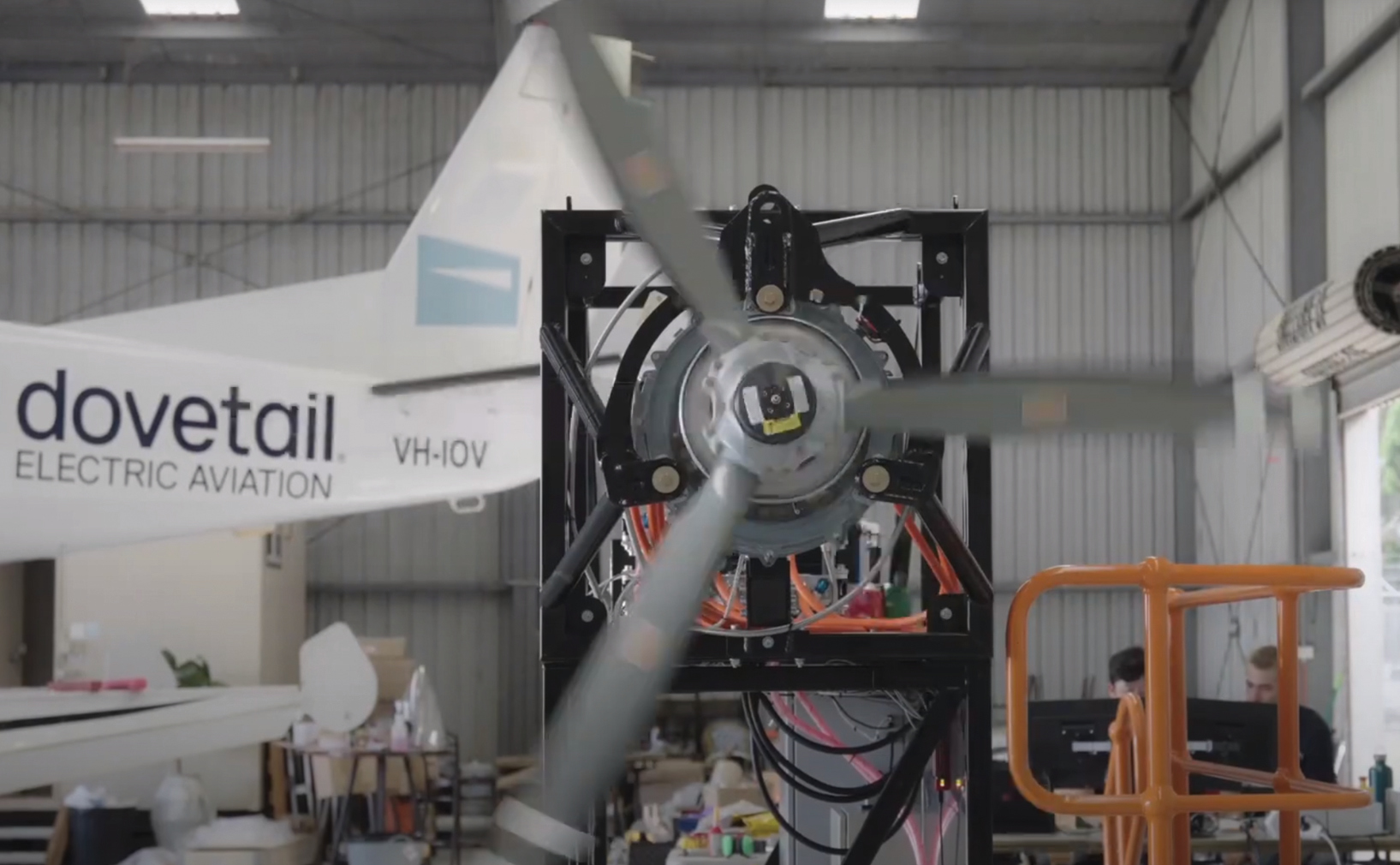
images: Testing the propulsion system | Dovetail Electric Aviation

Replace or recycle

Legacy airframes were certified for the weight capacity and endurance for which they were designed, not with retrofitting or electrification in mind, making the weight and power availability dilemma very real. Ellis said, ‘The added weight dispersion of battery energy storage across a legacy airframe in an ad hoc manner adds further cooling and cabling difficulties that, while not proving complex to address, ultimately penalise the usable range and payload of an aircraft that was designed at a time where induced drag was easily overcome by burning more fuel.’

Further, reducing the cost and production times of new airframes by using composite materials may rival the cost of maintaining an old airframe with retrofitted new technology. ‘Although I’m all about recycling, the success of some clean-sheet designs [new type certificate aircraft], such as the new Joby design and the Eviation Alice [nine-seater] aircraft, are testament to the requirement of purpose-built, vastly more efficient airframes, with integrated battery architecture that complement the weight and balance of the aircraft, rather than compromise it,’ Ellis said.

images: Testing the propulsion system | Dovetail Electric Aviation

However, with aviation profit margins historically wafer-thin, ditching airworthy King Airs to purchase new Alices might make an airline accountant’s eyes blink furiously, whereas retrofitting might only make them water a little.

Retrofitting doesn’t necessarily need to wait until the engine has run out of hours for the investment to be worthwhile. ‘It becomes viable at engine overhaul time, which for a conventional engine is every 3,600 hours,’ Dovetail founder Doral says. ‘Then, give it a second life and make it more efficient. And we think the same business model would be applicable to hydrogen-electric powertrain retrofits, but that will depend on the price of hydrogen.’

Ditching airworthy King Airs to purchase new Alices might make an airline accountant’s eyes blink furiously, whereas retrofitting might only make them water a little.

Safety elements

It is a given that a cleaner aviation industry cannot compromise aviation safety. Electrification may mean fewer moving parts and therefore a promise of less maintenance, however, batteries are still considered dangerous goods and some hybrid systems, such as those with associated gas tanks, can be complex. The truth is probably that there are reduced and increased elements of risk that are entered into the risk matrix and mitigated by design as far as is humanly possible.

Dovetail’s proposed King Air project, for example, draws power from both lithium batteries and hydrogen-assisted fuel cell technology – a safety measure in itself through redundancy. As well, using fire-resistant batteries, thermal management and battery-monitoring technology to mitigate the risk of battery failure or fire is not inherently different to similar safety measures for conventional combustion engines.

It is a given that a cleaner aviation industry cannot compromise aviation safety.

Certainly, the authorities wouldn’t have it any other way – the public can rest assured that retrofitted aircraft, having undergone the additional, rigorous scrutiny required of a major modification, will be at least as safe as conventionally powered aircraft.

Navigating the airport: Understanding movement area guidance signs

To make things easier and safer for aircraft ground movements, visual aids called movement area guidance signs (MAGS) are installed at controlled (and even some non-controlled) airports. It pays to know your MAGS before flying into, or out of, a busier airport than perhaps you are used to!

The signs can be especially helpful for pilots who have limited experience of controlled aerodromes: Class C, or metro and regional Class D airports.

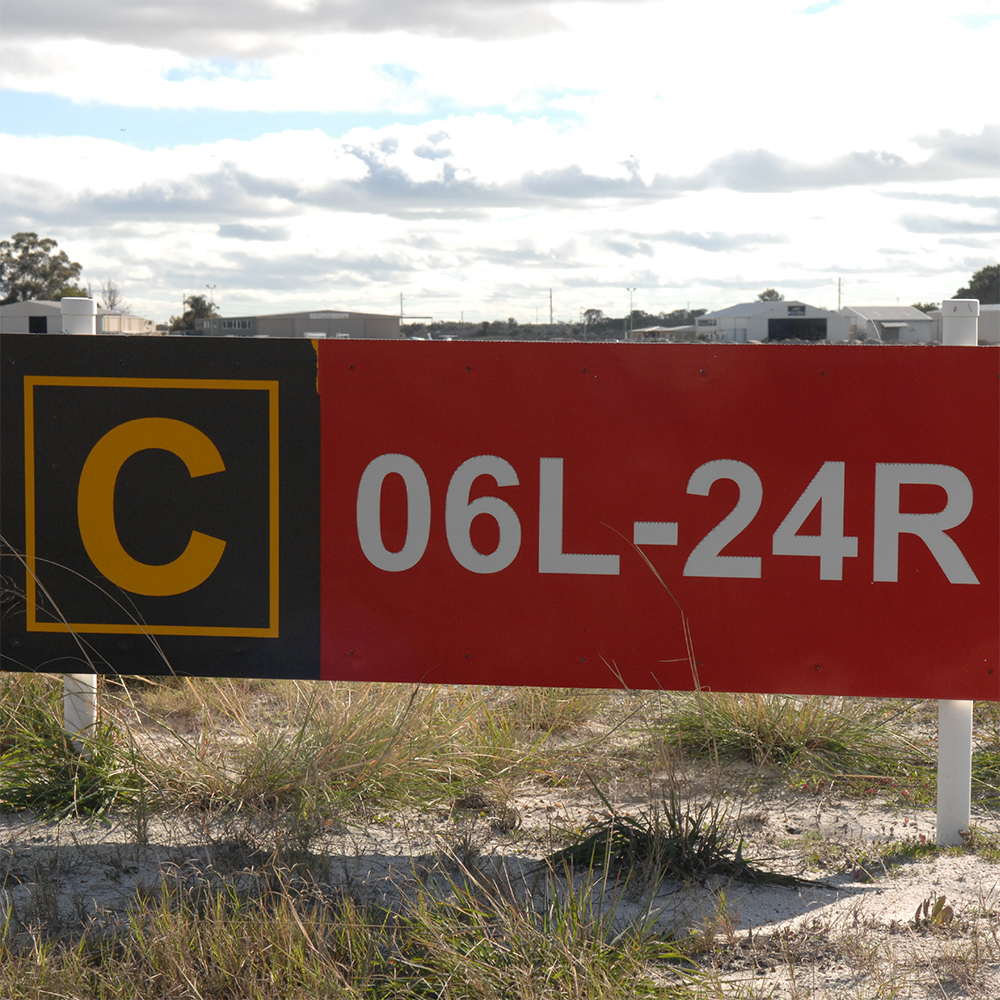
There are 2 types of MAGS: information only and mandatory instruction. Information only signs are yellow and black while mandatory instruction signs are red and white.

Whether you’re on a taxiway or runway, you’ll find most of the signs positioned to your left from the cockpit.

Yellow and black signs

Information only signs indicate where you are or direct you to your desired destination.

Location signs

Memory aid: Black and square – you are there!

Taxiway location

Taxiway location signs are square with a black background and a yellow letter and identify the taxiway that an aircraft is on.

Runway location

Runway location signs are also square with a black background but have yellow numbers indicating the runway the aircraft is on.

Direction signs

Memory aid: Yellow array – points the way!

Taxiway direction

Taxiway direction signs are the inverse; yellow background with black inscriptions and include an arrow that indicates the direction that you need to take to get to the taxiway indicated by the letter. 

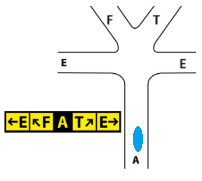
Here’s an example that combines both a location sign and some direction signs.

The square black sign with the yellow A in the middle indicates you (the blue mark) are on taxiway Alpha. Black and square – you are there!

Taxiway Echo intersects taxiway Alpha at right angles so it’s indicated by the E with the arrow pointing directly left, and the E with an arrow pointing directly right. Yellow array – points the way!

Taxiway Foxtrot veers off at 45 degrees to your left and taxiway Tango veers off 45 degrees to your right.

Destination guidance

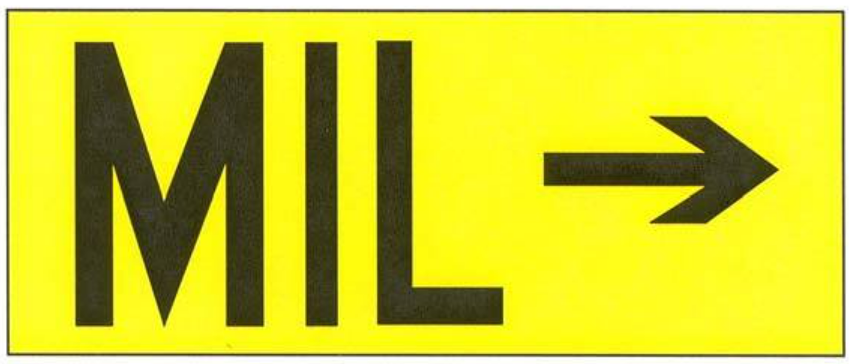
Destination guidance signs are rectangular with a yellow background and black lettering and an arrow pointing to a destination. Some examples include APRON, FUEL, CIVIL, or CARGO, and they can be abbreviated. For example, TERM for terminal, INTL for international areas, HGR for hangar, or MIL for military.

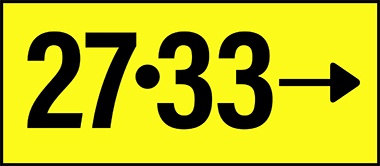
Destination guidance signs can also guide you along taxiways to other runways. For example, turning right here at this sign will take you in the direction of runway 27 and runway 33. Think of the dot as an ‘and’.

Red and white signs

Mandatory instruction signs have a red background with white letters, numbers or symbols, and identify a critical area. For example, an entrance to a runway, a holding point, or a prohibited area.

At a controlled aerodrome you must stop and obtain clearance to proceed past the point of a mandatory instruction sign. Memory aid: Red and white – runway in sight!

Outside tower hours (and at uncontrolled aerodromes), you must not pass a red and white sign until you are certain that you are allowed to, and it is safe to do so.

Holding position signs mean just that: HOLD here.

Holding position

Holding position signs located beside yellow taxi-holding point markings signify the entrance to a runway. In this example, you are on taxiway Tango, the threshold of runway 18 is to your left and the threshold of runway 36 is to your right.

Holding position signs also indicate the entrance of another runway. Again, the numbers will correspond left and right to the upcoming runway’s threshold positions.

Runway approach area holding position

Runway approach area holding position signs are found near the threshold of a runway and its approach path.

ILS critical area holding position signs

ILS critical area holding position signs are located at a holding point designed to protect the instrument landing system (ILS) signal from interference.

No entry signs

No entry signs are self-explanatory, signifying a prohibited area or that a taxiway is one way. In any case, you won’t get clearance to pass this point and, in an uncontrolled environment, well you simply wouldn’t, right?

These are just some of the basic MAGS you might find at an airport. Others include runway distance remaining signs (black and white), runway boundary signs, taxiway ending signs and intersection take-off signs. The busier the airport, the more signs  you will find and the more complex they will be.

You can find more comprehensive information about MAGS in:

Keep your nose clean

0

Propeller strike is expensive, embarrassing, but not inevitable.

The phrase ‘prop strike’ will make any aviator’s gut wrench – from the sound, shock of impact or repair costs. There’s no silver lining to a propeller incident.

It is essential for every pilot to understand what constitutes a prop strike, the potential consequences and the steps to take after the incident.

How to respond to a prop strike

Todd Pennifold, general manager at Southern Propeller Services, says: ‘A foreign object strike to your propeller can include a broad spectrum of damage, from a minor stone nick to severe damage.’

He says the strike may cause blades to become loose in the hub, damage pitch change mechanisms, bend blades and damage and crack propeller hub assemblies; not to mention that load transfer from the blades during a strike is transferred towards the hub assembly.

No part of this is a good situation. Anytime you’re unsure about what has happened, but you suspect a blade strike, shut down and inspect the blades. Avoid taxiing the aircraft. Do a preliminary inspection for signs of strike or damage, write up the suspected strike and have engineering take care of the assessment, repair and return to service.

‘A conservative approach in evaluating the damage is required because there may be hidden damage that’s not readily apparent during a visual inspection,’ Pennifold says.

You must document the incident and report it to the relevant authorities, such as an entry on the maintenance release and a report to the aircraft operator. Engineers will need to evaluate the aircraft’s condition and do any repairs needed, before it flies again.

Meanwhile, Grade 1 instructor Enzo Lacono at the Aerobatic School, offers this advice to pilots. ‘If you strike on the ground, do not take-off – simply shut down the engine as soon as possible.’

He recommends a three-point take-off for tailwheel aeroplanes with large blades, instead of raising the tailwheel before rotating. He says a three-point attitude will also be required on landing to avoid a prop strike.

‘If you make impact [by the prop] with the ground on landing, do not take off again, as you may give yourself an engine failure due to high vibrations from imbalanced prop blades,’ he says. ‘Instead, land safely and stop engine rotation immediately to avoid further damage to engine components.’

What constitutes a prop strike?

Propeller companies have 3 categories for a foreign object making contact with a propeller. McCauley’s Service Bulletin 176E outlines them as:

Object strike: defined as the impact of a non-rotating propeller by a moving object, such as a ground power unit. Procedures for an object strike include inspecting for damage such as scrapes, gouges, etc., caused by the impact. Any damage beyond normal field repair limits (defined in other McCauley service information) is cause for propeller removal and repair.

Blade strike of rotating propeller: Blade strike, sometimes referred to as ground strike, is defined as any impact or suspected impact of the rotating propeller on such items as, but not limited to, the ground, tow bars, landing lights, carts, snowbanks, hedges, etc. Any blade bent beyond repair limits must be scrapped.

Bird strike: involves any bird collision with the rotating propeller. Post-strike, a McCauley propeller requires inspection based on specified criteria for airworthiness.

Hartzell Propeller Inc Service Bulletin 61Y states, ‘Propellers exposed to impact damage, lightning strikes or overspeed must be inspected in accordance with the Special Inspections chapter of Hartzell Standard Practices Manual 202A (61-01-02) before return to service.’ In other words, if something goes wrong with the prop – or even if you suspect it – don’t fly.

Considering the propeller is one aspect, but what about the engine? Before the mid-1960s, following a blade strike, the crankcase wasn’t opened and inspected. Instead, a dial-indicator test was conducted on the crankshaft end to determine if it was bent. However, this approach is now considered insufficient and requires a bulk strip.

What’s a bulk strip? CASA defines it as ‘the partial disassembly of the engine for the purpose of inspection or repair; the extent of which requires the separation of the crankcase parting flange or removal of the crankshaft’. And yes, it is costly. But you may want to consider the alternative – a catastrophic prop failure in flight or during take-off when the engine operates at maximum power.

For this very reason, engine manufacturers unanimously advocate for a comprehensive approach: any damage requiring propeller repair necessitates pulling the engine for a thorough inspection.

As per Lycoming’s Mandatory Service Bulletin 533A, ‘A propeller strike can occur at taxi speeds and during touch-and-go operations with propeller tip ground contact. In addition, propeller strikes also include situations where an aircraft is stationary and a landing gear collapses, causing one or more blades to be bent, or where a hangar door (or other object) hits the propeller blade. These instances are cases of sudden engine stoppage because of potentially severe side loading on the crankshaft propeller flange, front bearing, and seal.’

The bulletin further explains that in any of these cases, ‘The safest procedure is to remove and disassemble the engine and completely inspect the reciprocating and rotating parts, including crankshaft gear and dowel parts. Any decision to operate an engine involved in a [prop strike] without such inspection must be the responsibility of the agency returning the aircraft to service.’

Similarly, Teledyne Continental Engines’ (TCE) Service Bulletin SB96-11 says, ‘Following any propeller strike, complete disassembly and inspection of all rotating engine components is mandatory and must be accomplished before further flight. Inspect all engine-driven accessories in accordance with the manufacturer’s maintenance instructions.’

That said, the one minor out for aircraft operators that TCE asserts is, ‘For instances where the propeller is damaged by a small foreign object during operation, such as a small stone, inspection and repair must be accomplished in accordance with the propeller manufacturer’s published instructions. Any time foreign object damage requires propeller removal for repairs other than minor dressing of the blades, the incident is considered a propeller strike and must be inspected.’

Why don’t you skip the prop overhaul?

Whether you’ve had a prop strike or not, the care and maintenance of your propeller are essential for aviation safety, compliance, and optimal performance. Regular maintenance addresses wear, detects hidden issues, and ensures structural integrity.

Overhauls contribute to aircraft longevity, meeting insurance requirements and a safer and more efficient flying experience.

Pennifold says, ‘A propeller overhaul matters because it is one of the most highly stressed components on an aircraft. The centrifugal force on a blade is over 18 tonnes and, together with thrust bending, flexing, and aerodynamic twisting loads, the scheduled propeller inspection is crucial.’

In addition to such pressures, you have the effects of exposure to the environment over a period, which creates a need for propeller overhaul regardless of flight time. Corrosion can create hidden defects in critical blade retention components, as Hartzell’s Service Letter 61Y stipulates.

Sensenich Propellers considered poor maintenance and damage to include ‘leading edge nicks and cuts, face nicks and cuts or corrosion that are left unrepaired and or painted over without proper removal and re-application of a corrosion coating.’

Following any propeller strike, complete disassembly and inspection of all rotating engine components is mandatory.

What to expect from a propeller overhaul

The overhaul process is complex and is usually around 4–6 weeks, depending on the pre-existing condition of your prop – and that can feel like an awfully long time for a pilot to be grounded.

However, once you understand the meticulous (and interesting) overhaul process – you’ll appreciate the TLC that the prop maintenance crew awards your propeller. After all, it’s the crux of what gives man wings.

A prop overhaul can be broken into these main phases: disassembly, cleaning, inspection, repair and reassembly.

Once the shop receives your propeller, it undergoes disassembly, with each component documented, stripped and subjected to appropriate cleaning procedures.

The dimensions of propeller parts are measured against specified tolerances, and a thorough inspection is conducted using dye penetrant and other techniques that identify potential cracks or damage.

A test is carried out for a propeller with composite blades to determine any de-lamination in the composite material and leading edges. The propeller is stripped and cleaned.

Composite propeller blades are known for being lightweight and contribute to improved fuel efficiency and overall aircraft performance. Additionally, composite materials provide excellent resistance to corrosion and fatigue, enhancing the durability and lifespan of the blades. They often exhibit superior aerodynamic efficiency, leading to reduced noise levels and vibrations during flight.

Pennifold says, ‘In the case of a propeller with aluminium blades, the blades’ dimensions are measured to determine serviceability.’

‘All propeller parts are visually inspected, and non-destructive testing is carried out on specific parts, including the hub and blades.’

Blade profiling is undertaken to eliminate surface impairments and restore the correct shape and aerofoil while additional components are substituted or mended as required.

‘Aluminium blades and hub are coated with corrosion protection and then repainted,’ he says. ‘Composite blades are sanded and inspected. If required, leading edges are replaced. The propeller is then re-assembled, functionally tested and statically balanced.’

The static balance prevents any imbalance in blade weights. Additionally, dynamic balancing is recommended after the propeller is mounted and reinstalled on the aircraft. Dynamic balancing entails assessing the vibrations of the entire propeller and engine assembly during operation. Opting for dynamic balancing assists in minimising cabin vibration and in-flight noise, and therefore, reduction in fatigue or damage to systems or structures through reduced vibration. It’s important to note that not all propeller service providers offer dynamic balancing due to the specialised equipment, tools, and training required.

After that’s complete, your LAME will hand over a logbook entry and a time since overhaul (TSO) of zero. Not to mention a shiny new prop.

Conclusion

From a pilot’s point of view, the issue is not only a ground strike, but damage – or suspected damage – from rocks, birds or other objects. If this occurs, an entry is made on the maintenance release – the aircraft cannot be flown until this defect is cleared by a LAME. Pilots should not take matters into their own hands and use a metal file to remove nicks or chips – this should be done by a LAME.

Propeller care

Eight best practice tips:

  1. Avoid manoeuvring the aircraft by the propeller blades, use the tow bar – always treat the prop as ‘live’.
  2. Don’t skip your prop during pre-flight inspections.
  3. Do not touch propeller blades without checking the magnetos are off!
  4. Monitor leading edges. Ensure they’re in good condition with proper paint coverage and no stone nicks.
  5. Monitor for unusual prop vibrations during run-ups and in-flight.
  6. Ensure there are no loose blades in the hub.
  7. There should be no grease or oil leaking from the propeller.
  8. A qualified engineer should file any blade damage.

Five prop ground rules

Moving an aircraft by pulling or pushing the blades is generally not recommended, for several reasons:

1. Safety concerns

‘Propellers are designed to generate thrust and lift, not to push or pull the entire weight of an aircraft on the ground,’ Lacono says. Attempting to move an aeroplane by pushing on the blades can pose serious safety risks, including the risk of injury to people nearby.

2. Structural integrity

Aeroplanes are designed to withstand aerodynamic forces generated during flight, not the mechanical stresses associated with ground movement. ‘Neither the engine nor the prop benefit from the loads imposed by horsing the whole airplane around,’ Lacono says. Attempting to move an aircraft by hand may subject the landing gear and other structural components to forces they were not designed to handle, potentially leading to damage.

3. Precision control

Aircraft movement on the ground requires precise control, typically achieved by using ground handling equipment (e.g. tow bars, tugs or tractors). Attempting to move an aircraft by turning the propeller lacks the precision to navigate around obstacles or park safely.

4. Risk of unintended engine start

Manually turning the prop may lead to the rotation of the engine’s crankshaft which, under certain conditions, could result in an unintended engine start. This would pose a serious safety hazard to anyone close by.

5. Manufacturer recommendations

Aircraft manufacturers provide specific guidelines for ground handling and movement to ensure the safety and integrity of the aircraft. Deviating from these recommendations may void warranties or compromise safety.