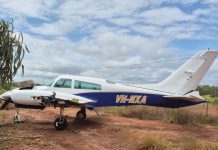


A few years ago, I was visiting friends at Calvin Grove airstrip about 25 kilometres north of Adelaide. It has a short, single unsealed runway, primarily used by crop spraying fixed‑wing aeroplanes and helicopters. It is located in the market gardening area around the township of Virginia, also known as Adelaide’s ‘salad bowl’.
The airfield is also within RAAF Edinburgh’s controlled airspace. Other pilots at the airfield that day told me the tower at Edinburgh closes at 5 pm on weekdays and after that, no airways clearance was required.
Armed with this knowledge (which I soon discovered was erroneous), I postponed my planned 4 pm departure until after 5:30 pm, to avoid complications obtaining an airways clearance. After all, I had only about 40 nautical miles to fly to my home field and daylight was not critical as it was mid-summer. Soon after 5:30 pm, I started my Cessna, intending to backtrack on runway 20 and take off to the south.
Before backtracking, I transmitted my intentions and heard a reply containing the words ‘Edinburgh tower’. I assumed this was the automated response, denoting the tower was closed. This reassured me the tower was indeed closed so I taxied to the northern end of the runway, gave a rolling call, nominating an upwind departure to take me away from Edinburgh and began my take-off roll.
A few seconds after take-off, at about 200 feet, I received an urgent and direct message from the tower. ‘[My callsign], you are in a military control zone and do not have an airways clearance!’
You are in a military control zone and do not have an airways clearance!
I immediately felt sick to the core, and embarrassed. I didn’t know what to do so I asked for instructions. The controller gave me airways clearance for my departure, to track direct to my home field.
Needless to say, I had a very worried and uncomfortable flight home. After arriving, I immediately called the Edinburgh tower and was relieved to have the controller who had spoken to me 20 minutes earlier, answer the phone. I assured him that I would phone the tower prior to future Calvin Grove departures.
He said if I phoned the tower immediately before take‑off, hopefully they could give me a 10‑minute airways clearance window for departure, and then issue any further instructions after I get airborne.
In hindsight no physical harm was done but I have thought about this incident many times since and wondered how I would have reacted if I had encountered a military heavy lifter or fighter jet during my incursion take-off. I had flown into Calvin Grove on many occasions and have seen fast fighters and heavy lifters doing circuit training at altitudes of only a few hundred feet, directly overhead, and I thank my lucky stars that I didn’t come across one on that afternoon.
Lessons learnt
- check controlled airspace hours with official sources
- do not rely on second-handadvice about airspace status
- repeat a radio call from another position or phone the tower if unsure
- get an airways clearance before taxiing for departure in controlled airspace.
Related content
Don’t forget to check out the audio close calls and hear the stories come to life.
Controlled aerodromes and operations- is one of the special topics on our Pilot safety hub. Refresh your knowledge.
Have you had a close call?
8 in 10 pilots say they learn best from other pilots and your narrow escape can be a valuable lesson. We invite you to share your experience to help us improve aviation safety, whatever your role.
Find out more and share your close call.
Disclaimer
Close calls are contributed by readers like you. They are personal accounts of individual experiences and are not corroborated by CASA. We publish close calls so others can learn from their stories and spark discussions about safety. These stories should not be used to identify individuals or operators.