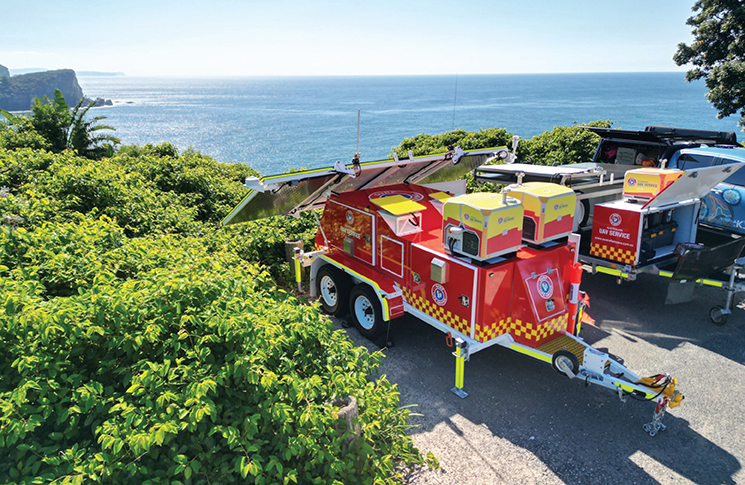
On a small beach on the NSW coast sits a yellow trailer. It may seem a bit out of place but every so often it comes to life with one mission – keeping the community safe.
The trailer swings open to release a drone that lifts off and sweeps across the waves, searching for sharks below. When the job is finished, it flies back to its trailer until it’s needed again. There is no human pilot around – instead it’s operated by a pilot in a different location. This is what’s known as a ‘drone in a box’ and is being used by businesses and emergency services across Australia.
But when a pilot isn’t onsite to see the drone, it raises some questions. How do you know how fast it’s going, how high it’s reaching and which direction it’s heading? How do you ensure it won’t conflict with other aircraft in the airspace or hit a person on the ground?
Answering these questions and regulating these risks is where CASA comes in. When a company needs to fly what’s known as a beyond visual line of sight (BVLOS) mission – where the pilot cannot see the drone – they are required to apply for CASA approval for each area they need to fly within. This occurs no matter how large or small the area is and each approval can take months to be assessed.
But last year CASA recognised the impact the approval process was having on operators and opened a broad-area BVLOS trial. The 12-month trial authorises operators to assess their own environments using a standardised risk-assessment process and offering operators greater flexibility.
The trial includes 4 pathways determined by the drone’s size, maximum speed and the population density it will fly over. It means operators can now fly across large areas of Australia, often where the environment doesn’t change much, with less approval wait time. It also puts more responsibility back in the hands of operators to ensure the safety of their missions.
‘We were getting a push from operators to be able to do the risk assessment themselves,’ Heath Macdonald, CASA principal RPAS operational standards officer says. ‘They wanted more flexibility in approvals and applications for BVLOS and it really aligned to the application queue which was a six-month turnaround time for one application. So the trial has turned what was previously 6 months into potentially a day turnaround for operators.’
Surf Life Saving NSW is a relatively new entrant into the broad-area BVLOS trial but have been using drones in their operations for years. They are the primary contractor for providing shark surveillance along the NSW coast.
Chief remote pilot Oliver Heys says the trial will allow them to more easily deploy drones in a box to support their shark surveillance, in areas with no volunteers available. Then shark sightings are sent back to the operation centre in Sydney. The broad area BVLOS has given us the ability to get drone capability in areas where there’s low levels of community and where we struggle to get volunteer patrol members or staff there.’
Sphere operates remote drone-in-a‑box solutions with their Hub X and Hub T products. They were among the first to see the potential, putting their hand up for the trial early. Elliot Cummins, chief remote pilot at Sphere, said the reduced lead time in applications has helped them to better meet the changing needs of clients. They can validate the air risk, ground risk, engage with nearby stakeholders and choose to deploy on their own timelines as long as it is safe to do so.
‘It allows us to streamline things in line with our existing processes and procedures and be a bit more responsive while having a slightly lower burden on individual personnel,’ he says.
It also gives them the ability to work on time-sensitive shorter missions, something that they normally couldn’t consider due to the length of approvals. ‘Previously doing BVLOS for a two-week trial or month-long trial might not be achievable, but now we have more certainty and can be more responsive to our clients.’
There are also work health and safety benefits for their remote pilots.
‘If you have a trailer that’s deployed for an extended period in a remote location, you don’t want to necessarily have to send a person out there to stand around and support the trailer for the entire time,’ Cummins says. ‘Part of the point [of drone in a box] is that you’re removing a person from a hazardous environment. If we’re able to avoid the need to have a person standing there around the snakes and the sun and the wind, then that’s preferable.’
Heys says the trial has opened the possibilities of new missions for Surf Life Saving NSW.
‘By implementing drones in a box, we’re now actually starting to look at how we can have a reactive capability,’ he says. ‘If a search and rescue is occurring, we can potentially get that drone flying a lot quicker than having someone drive for an hour and then start flying. We’re currently looking at concepts of mobile remote operation centres and the ability, if a search is happening at a beach at 2 in the morning, to quickly get that drone up.’
Since the trial commenced in October 2025, there have been 15 operators approved with 1,012 missions conducted over half a million hectares of approved BVLOS areas in Australia (at 7 April 2026). CASA is working on a post‑implementation review and aims to have another version of the trial available by October 2026.
Visit casa.gov.au to learn more about the drone rules.