Two aircraft taking off from intersecting runways at the same time from Mildura Airport in Victoria almost collided, an ATSB report says.
During the 6 June 2023 incident, a Piper PA-28 Cherokee was conducting a solo private flight to Broken Hill, while a QantasLink Dash 8 with 3 crew and 33 passengers was departing on a scheduled service to Sydney.
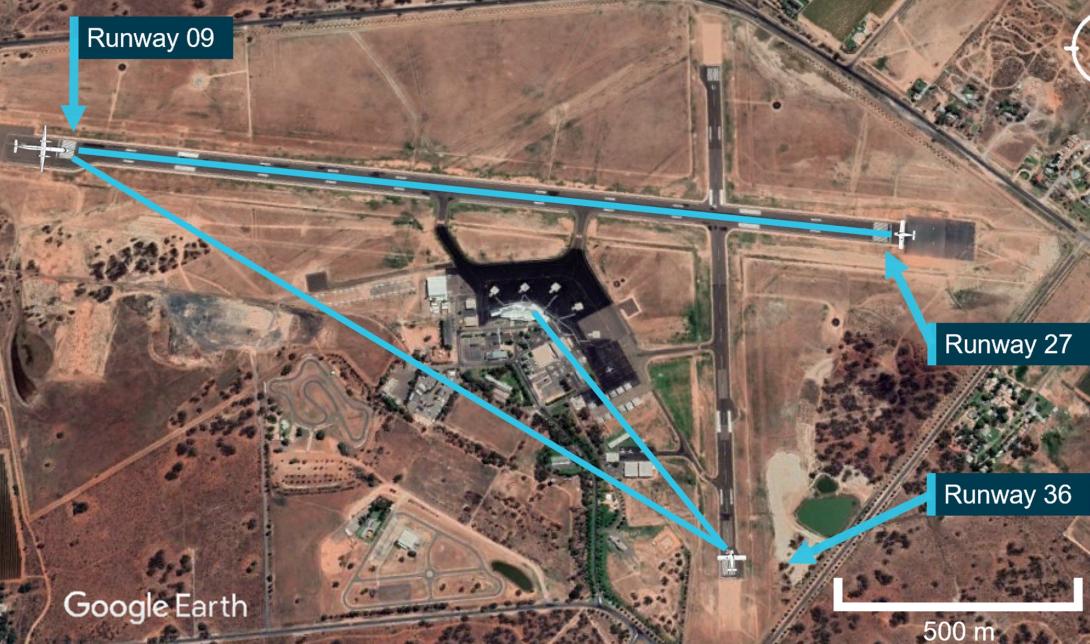
The Cherokee had taxied to the threshold of runway 36, while the Dash 8 had taxied to the threshold of runway 09.
Both aircraft had made the required mandatory calls on the CTAF. However, the pilot of the Cherokee had incorrectly identified Mildura’s runway 36 as ‘runway 35’.
This occurred while the Dash 8’s pilots were obtaining their pre-departure information from air traffic control and had the volume turned down on the CTAF radio.
Incorrect runway identification
In addition, the Dash 8 crew only received certain elements of the Cherokee’s calls due to an over transmission from air traffic control.
The incorrect runway identification compounded with these factors to create an incomplete comprehension of local traffic in the Dash 8 crew’s mental models – specifically, both Dash 8 pilots did not believe that the Cherokee was at Mildura, given the nearby Wentworth Airport also uses the same CTAF.
Additionally, when the Cherokee was ready for its take-off roll on runway 36, its pilot believed the Dash 8 would still be backtracking on runway 09 – but the Dash 8 was in fact also about to begin its take-off roll.
Subsequently, both aircraft began take-off rolls towards the intersection of their respective runways, and the Dash 8 passed about 600 metres in front of the Cherokee.
Rolling calls now mandatory at Mildura
The report says the pilot of the Cherokee gave a rolling call on the CTAF at the start of their roll, while the Dash 8 crew did not – but that rolling calls are not mandatory.
However, due to terrain and buildings at Mildura Airport, aircraft are not directly visible to each other on the thresholds of runways 09, 27 and 36.
‘With the inability to see another aircraft when each aircraft is at the threshold at Mildura Airport, the lack of a requirement for mandatory rolling calls increased the risk of aircraft not being aware of each other immediately prior to take-off,’ ATSB Director Transport Safety Dr Stuart Godley said.
Since the incident, Mildura Airport established a permanent requirement as of 4 April 2024 for mandatory rolling calls from all aircraft immediately prior to take-off due to the increased risk of aircraft not being aware of each other.
In addition, QantasLink has made rolling calls part of the minimum requirements for operations at CTAF aerodromes.
Pilots can guard against occurrences like this one by making the recommended broadcasts when in the vicinity of a non-controlled aerodrome, actively monitoring the CTAF while maintaining a visual lookout for other aircraft and constructively organising separation through direct contact with other aircraft, and ensuring transponders, where fitted, are selected to transmit altitude information, Dr Godley said.
While the ATSB did not identify radio interference or shielding as contributing to this occurrence, another ongoing investigation into a similar event that occurred at Mildura later in 2023 is considering these factors.
Flight Safety Australia has published several stories on radio calls which would be worth rereading in conjunction with this report.
It seemed like a good idea at the time, and it saved 200 labour hours, but it turned out to be a human factors and safety culture debacle that led to the deaths of 273 people.
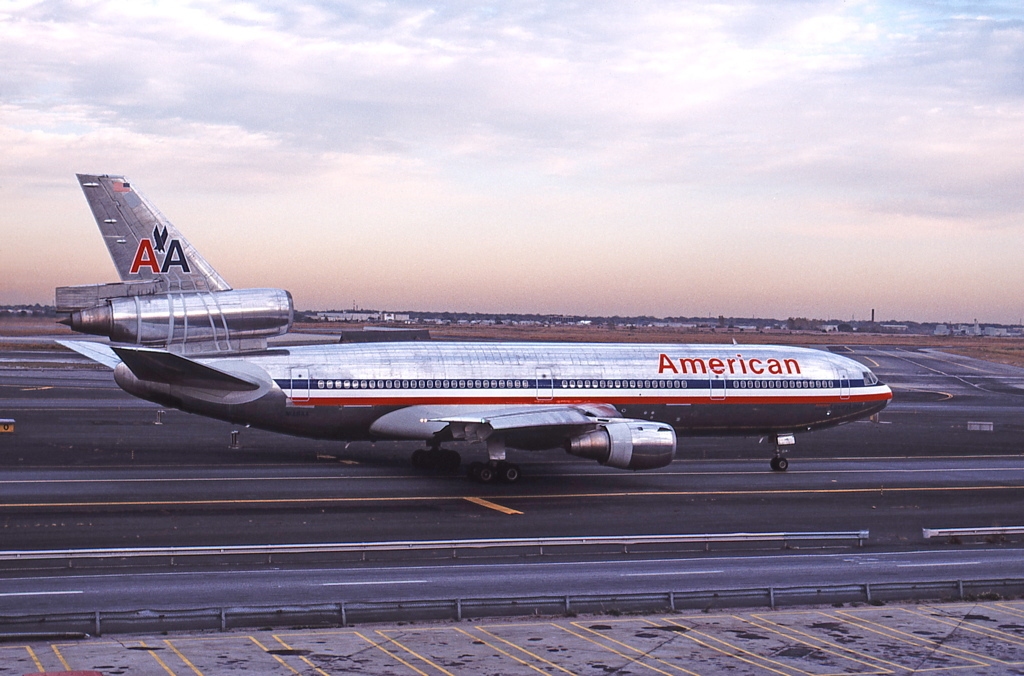
On Friday 25 May 1979, Captain Walter Lux and First Officer James Dillard lined up a McDonnell Douglas DC-10 on runway 32R at Chicago O’Hare Airport for a trip to Los Angeles. Take-off was unremarkable until rotation, when Dillard said ‘Damn!’ just before the cockpit voice recorder cut out.
The reason for his mild outburst was obvious to the tower and, in all likelihood, to some of the passengers on the left side of the aircraft. The No 1 engine and pylon had detached from the wing and fallen backwards over it. As the accident was after V1, the take-off decision speed, the crew had no choice except to continue the take-off.
A maintenance supervisor had been waiting to cross the runway in a vehicle and had a close view of the event. He told investigators of seeing the No 1 engine ‘bouncing up and down quite a bit’ and detaching, climbing and flipping back over the wing
The supervisor saw the aircraft make a ‘fairly normal climb’ and presumed it would return to the airport.
But after the DC-10 had reached about 300 feet, it began a left roll and bank that the flight data recorder later disclosed reached 112 degrees, combined with a 21-degree nose-down pitch. It crashed into a field 1,400 metres north-west of the airport, killing all 271 on board and 2 people on the ground, in a fireball fuelled by the 79 tonnes of jet fuel onboard.
Suspicion
The loss of an engine should not have caused the crash: the DC-10 was certified to be able to take off at maximum gross weight on 2 engines. The first clue to what had gone wrong came from the engine that fell on the runway.
Investigators found a thrust link bolt, which was initially suspected of contributing to the crash through fatigue failure. But it was exonerated when its failure was found to have been through overload, not fatigue. A breakthrough came when a dent in the rear pylon bulkhead was found to match the shape of the wing fitting to which it was normally bolted. This suggested maintenance-induced damage.
Improvisation
National Transportation Safety Board (NTSB) inspectors went to the American Airlines maintenance facility in Tulsa, Oklahoma, and were taken aback to see how engineers changed DC-10 engines. The airline had written an engineering change order (ECO) that saved about 200 labour hours per engine and had a potential safety benefit in reducing the number of systems that had to be disconnected and reconnected from 79 to 27.
McDonnell Douglas had recommended the engine be removed separately to the pylon holding it, but the ECO involved removing the entire engine/pylon combination, using a forklift with an engine shipping stand on its tines to support their combined weight. Other airlines had been using a similar procedure, and the investigation found 88 of the 175 recorded engine and pylon removals by US DC-10 operators had used this method or variations, such as using a crane.
A McDonnell Douglas field inspector knew of this process and had recommended against it, saying, ‘Douglas would not encourage this procedure due to the element of risk’, but the company had no legal power to prohibit it. No McDonnell Douglas employee ever saw the removal and replacement processes being performed.
It’s important to say clearly that the maintenance crews were not gleefully doing the wrong thing so they could save time – they thought they were doing the right thing. The combined centre of gravity for the engine and pylon combination had been calculated for the procedure and the forklift placed under this point as precisely as possible. The procedure had been analysed, but some of its associated risks had escaped consideration. The result was that scheduled passenger flights became test flights for the new procedure.
Later investigation found a skilled operator could move the forklift with a finesse of 4–5 mm, but that the forklift used on the doomed aircraft had a faulty hydraulic valve that meant it dropped by 25 mm in 30 minutes while switched off, as had happened during the shift change on the job. The sagging forklift had stressed the rear pylon bulkhead.
Airworthiness directive inspections found 8 aircraft had overload cracks in the same area of the pylon that was damaged on the accident aircraft. One DC-10 had an engine that engineers could rock back and forth by hand.
The investigation also uncovered widespread shortcomings in engineering safety culture, incident analysis and reporting. Continental Airlines had cracked the rear pylon bulkhead on 2 of its DC-10s during maintenance in late 1978 and early 1979, with one of these incidents having been described as sounding like a pistol shot. Continental had also worked out that a faulty forklift was implicated in the two incidents and repaired it. But the first the Federal Aviation Administration heard about these close calls was after the Chicago disaster.
Consequences
The question of why the DC-10 had crashed despite having sufficient power to fly was explained by the collateral damage that came when the engine fell off. As it departed, it ripped out lines from the No.1 hydraulic system that controlled the leading-edge slats on the left wing and locked them in place, causing the left outboard slats to retract under air pressure – the right-side slats stayed deployed. Slat retraction raised the stall speed of the left wing to about 159 knots, 6 knots higher than the take-off minimum airspeed (V2) of 153 knots, and put the aircraft into a state of asymmetric lift
The engine also ripped out the No 1 electrical bus and several systems and instruments immediately lost power. Among these were the captain’s flight instruments, the left-wing stall warning, the stick shaker and the slat disagree warning light system. The flight crew were therefore unaware of the lift asymmetry between the wings and had no stall alarm or stick shaker to warn them.
Conclusions
By a tragic irony, the pilot flying had throttled back to V2, which brought about the stall that sent the aircraft into the ground. The pilot had followed procedures to the letter and was probably not aware that the engine was no longer attached to the wing. Multiple factors doomed all the people on the aircraft: drift from established procedures, lack of communication and maker’s advice ignored. It’s a horror story that all aircraft maintainers should know and seek never to repeat.
The names of everyone on board are part of the flight 191 Memorial, Lake Park, Des Plaines, Illinois. Image: Steve Cochran
Aircraft washers were mainly identified as AN960-XX. The numbering system has been superseded to NAS1149-XX. If you are looking for an AN960-416L, what would be the equivalent in the NAS1149 range?
NAS1149F0463P
NAS1149F0463N
NAS1149F0432P
NAS1149G0432P
Describe the following washer part number: NAS1149F0332P
an aluminium washer, .032′ thick and silver-plated
a carbon steel washer, .032′ thick and cadmium-plated
carbon steel washer, .032′ thick and silver-plated
an aluminium washer, .032′ thick and cadmium-plated
What does the letter ‘C’ designate about a washer, in part number AN960C416?
manufactured from corrosion-resistant steel
is carbon steel and cadmium-plated
is thinner than a standard washer (light)
is manufactured from carbon steel
An AN970 washer:
has a larger diameter than the AN960 equivalent, with a hole in the centre that fits the corresponding AN bolt
has a smaller diameter than the AN960 equivalent, with a hole in the centre that fits a standard bolt diameter
has a larger diameter than the AN960 equivalent and is twice the thickness for added strength
has a smaller diameter than the AN960 equivalent, and is ideal for distributing the pressure of the bolt or screw
A NAS1169 washer is:
100 degrees dimpled, is not structural and can be manufactured in carbon steel, corrosion-resistant steel or aluminium
100 degrees dimpled, is structural and can be manufactured in brass, corrosion-resistant steel or aluminium
100 degrees dimpled, is not structural and can be manufactured in brass, corrosion-resistant steel or aluminium
100 degrees dimpled, is structural and can be manufactured in carbon steel, corrosion-resistant steel or aluminium
What do the initialisms MS, NAS and AN stand for when referring to aircraft hardware?
military standard, national aircraft standard, American national
military spec, national aerospace standard, Army-Navy
military standard, national aerospace standard, Army-Navy
military spec, national American standard, Army-Navy
AN310 and AN320 are plain castellated nuts that:
require to be loosely tightened until the split pin hole lines up
are designed to be tightened to the correct torque and, if doesn’t line up with the split pin hole, to be tightened further to line up the holes
are designed to be tightened to the correct torque then retained by a split pin (cotter pin)
are designed for high torque application
Slotted nuts and split pins are:
usually used in tension applications
always silver-plated
always manufactured from stainless steel
usually used in shear applications
Tinnerman sheet metal nuts are commonly used on Cessna single-engine aircraft. They:
can be used on structural and non-structural components
may only be used in accordance with the approved data and typically are limited to non-structural applications
are ideal for use on structural components
always have a dark green finish
Nyloc nuts such as MS21044N can be substituted for other types of locknuts:
in engine bays
in accordance with approved data
on landing gear components
where they are subject to high vibrations
Does CASA’s ‘modular licensing’ option allow you to get a B1 subcategory ‘airframes’ modular licence without necessarily studying ‘engines and propellers’?
Yes
No
LAME licences are issued under:
Part 61 of CASR
Part 42 of CAR
Part 66 of CASR
Part 30 of CAR
You may need to level a light aircraft during maintenance in order to weigh the aircraft or adjust avionics. Where would you find the levelling point on the aircraft?
the levelling point on single-engine aircraft is the upper door frame of the pilot’s door
the levelling point on helicopters is the transmission deck 2 degrees nose down
the levelling point varies for different types of aircraft and sometimes for different models of aircraft type and, thus, should be checked in the maintenance manual, flight manual or type certificate data sheet of the aircraft
the levelling point on twin-engine aircraft is found by placing a spirit level across 2 specified screws on the side of the fuselage
To view the answers, go to the next page using the page navigation buttons below.
For private pilots, flying in controlled airspace requires 3 things: preparation, concentration and communication, as the editor of Flight Safety Australia discovered for himself.
To fly into a particular controlled aerodrome – Alice Springs – I had to negotiate the airspace around Pine Gap.
That is not a minor detail when you’re referring to this sensitive site. Dozens of brilliant white radomes mark the site where hundreds of Americans and Australians work. The thought of being responsible for an airspace, and possibly diplomatic, blunder concentrates the mind, unpleasantly.
Obviously, the first step is to consult the Alice Springs VTC. There you see, big and bold, R215, surrounding the base and restricting aircraft from flying within 2.5 nm of the base, in a column of airspace from surface to FL180 (18,000 feet AMSL).
You also see the customary spiderweb of VFR lanes through Class D airspace, leading to and from the aerodrome.
To set the scene, the reason I needed to review my knowledge of procedures for controlled aerodromes and airspace was because I was flying with 5 other aircraft on a nine-day air safari to the Outback organised by Bathurst-based WardAir. Along with some amazing scenes – such as the cruise around Uluru-Kata Tjuta, crossing the Simpson Desert and Kati Thanda (Lake Eyre) and soaring over the MacDonnell and Flinders Ranges – we had unique experiences such as seeing the Maree Man and landing on strips at isolated stations, roadhouses and the Dig Tree.
Along with at least one Class D aerodrome – Alice Springs – we knew we may encounter Class E airspace. I was also taking the opportunity to fly some of the enroute legs and RNP approaches under the hood – with a current, instrument-rated pilot in the right-hand seat – since my PFIR renewal was scheduled for one week after returning home.
Controlled aerodromes
Approaching Alice Springs, I was keen to practise an ILS which operates to runway 12. To align with that runway, we planned well to the north of Pine Gap, instead of passing close by the installation.
Therefore, to set up for the 12 ILS when approaching from the west, I needed to fly via Jay Creek along VFR route 9, running to the northeast. This leads to Simpsons Gap for a right turn to begin the straight-in approach to the south-east.
Alice Tower wants early notice of arrivals and all traffic into the Class D airspace requires ATC clearance. As most pilots know, the distance from the aerodrome when you must ask for clearance varies with your altitude.
At Alice Springs, the stacking of airspace boundaries follows the usual ‘cake tin’ arrangement, with each volume of airspace topped with an even larger one, whose boundaries extend out further than the one below.
Alice Springs tower provides combined tower and approach control services within Class C and D airspace, up to 6,500 feet.
The requirement to call in at 50 nm means GA pilots are pushing the mike switch a long way from the airspace boundaries – exactly as intended.
We also needed to check the ATIS before asking for clearance; however, by the time we were close enough to hear the transmission, we discovered 30 was the active runway. So, no ILS today. But we continued on our flight plan to Simpsons Gap for the turn. We know controllers want as few surprises as possible, such as pilots deviating from their flight plan without notice.
On first contact with Alice Tower, I said ‘unfamiliar’ and, after reading back the clearance to track direct, concentrated on identifying the new (to me) VFR reporting points.
And as Shelley Ross says in ‘The comfort of control’ feature, ‘Don’t try to stumble through a direction from ATC that you don’t understand. Say, ‘I don’t understand’.’
We called in again at around 10 nm and were given, ‘Right downwind, runway three zero.’
Then I discovered I hadn’t read the ERSA thoroughly – runway 30 is 45-feet wide so your depth perception for the flare is altered. So yes, the landing was harder than I wished.
This underlines what instructors say is the key to safe flying in controlled airspace – preparation. Study VTCs and the ERSA and, if necessary, write out the radio calls and practise them aloud in the cockpit. People who fly with me know I do.
Once on the ground at Alice, we gawked at the flock of wide-bodied airliners parked in the ‘boneyard’ on the other side of the runway to the GA apron, still awaiting recall to service after the pandemic.
Controlled airspace
On the last leg of this bucket list trip, from Cobar to Bathurst, we encountered severe turbulence. Flying IFR, we went from 7,000 to non-standard 8,000, with no relief from the rock ‘n roll, so we asked for 9,000. Abeam Parkes, we could see on the ERC LO we would soon be entering Class E (lower level 8,500). I was getting ready to call Melbourne Centre to ask for clearance, but the controller beat me to it, clearing us to Bathurst at 9,000. That’s the joy of flying IFR – the hand-offs are smooth and mostly automatic.
We would enter Class E airspace just before the quaint village of Molong and I wanted to begin descent and turn right to do the RNP approach to Bathurst’s runway 35. But this was controlled airspace and, on this occasion, my request was declined.
A QantasLink Dash 8 from Sydney was on descent into Orange and would cross in front and under us, so we were kept high. Since an approach to 35 was now not feasible, we changed to the RNP for runway 17 as, according to the AWIS, the wind was 10 knots directly across the strip, so not favouring either direction.
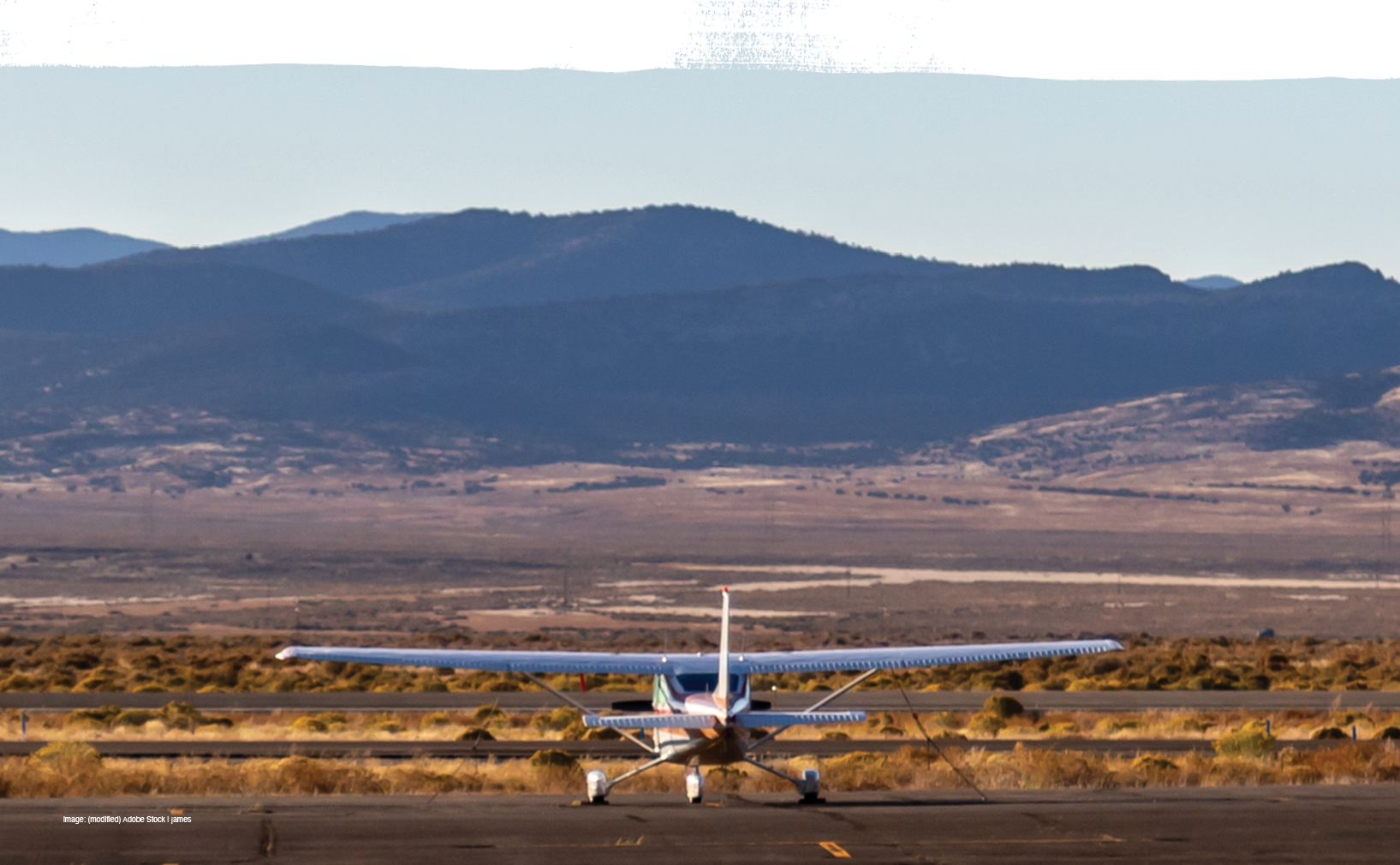
image: (modified) Adobe Stock | James
Do your homework
WardAir Head of Operations Catherine Fitzsimons says many pilots either completely avoid controlled airspace (CTA) or control zones (CTR) where there is a tower or fly long legs to avoid ones with which they are not familiar.
‘There are no secrets to CTAs and CTRs,’ she says. ‘It is not true that you should only go there if you have been accompanied at least once by an instructor or someone with experience.
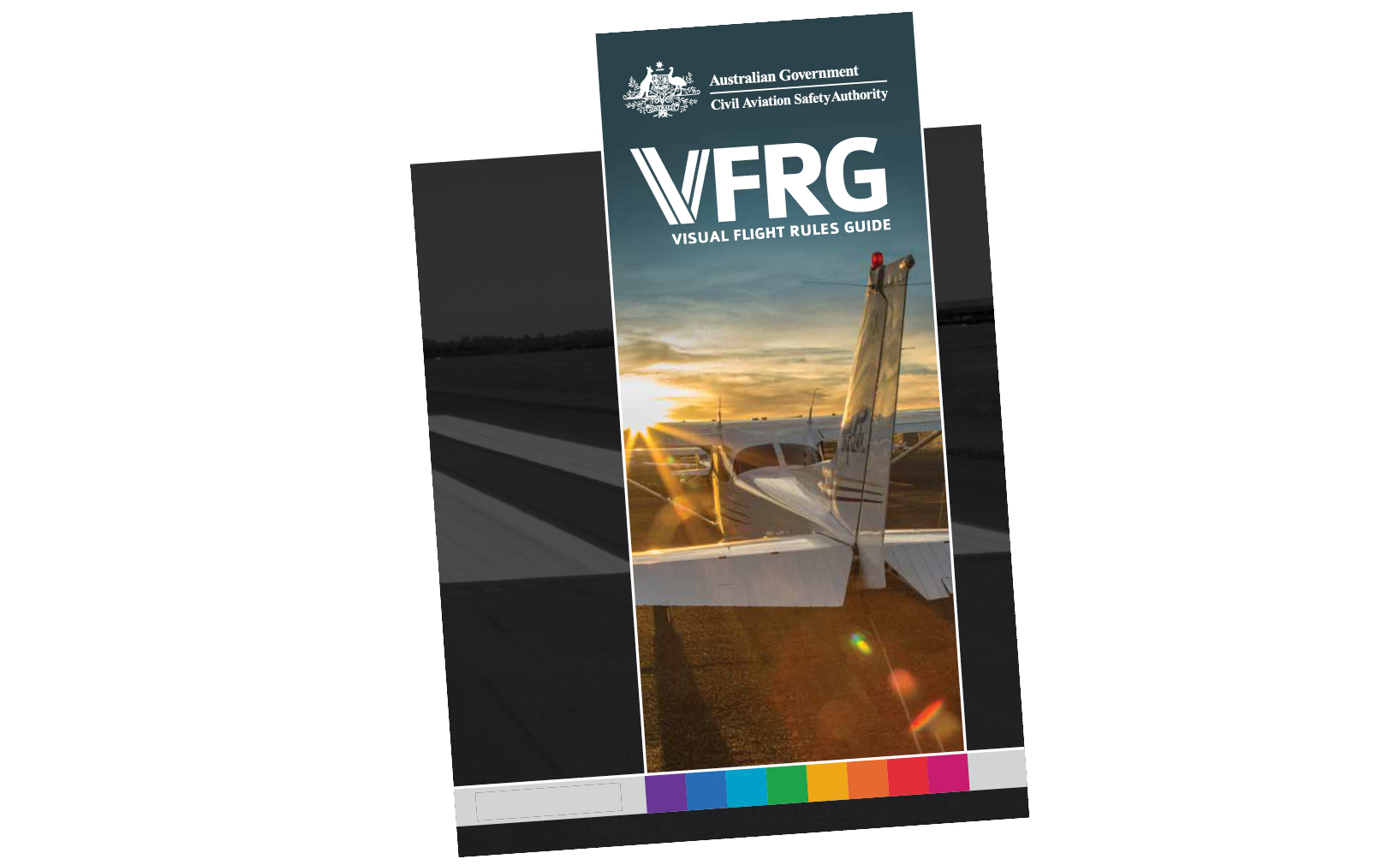
‘Everything you need to know is contained in the ERSA entry for that aerodrome, on the VTCs and in the AIP. VFR pilots can elect to use the excellent online Visual Flight Rules Guide (VFRG) instead of the AIP.
‘The VFRG is a plain English, illustrated synthesis of many of the important rules and regulations from the AIP. Pilots can use it to refresh their knowledge of rules and procedures relating to operations in different classes of airspace. It is not something to leave behind once you’ve passed your CASA theory exams. It should be with you – in hard or electronic format – throughout your flying days as a handbook and ready reference.
‘Armed with the information contained in the ERSA, a current VTC and a VFRG, a qualified pilot should have no trouble negotiating controlled airspace. Make sure you know the class of airspace in which you are operating and refresh your knowledge with a good read of the VFRG or AIP beforehand.
‘There are some differences between Class C and D which are well explained in the VFRG. Most of these account for what pilots often incorrectly believe to be something special or ‘local knowledge’ of a particular aerodrome when, in fact, there is a perfectly logical explanation in the regulations; for example, the different radio calls required when leaving a Class D aerodrome depending on whether you are departing into adjacent Class C or Class G.
‘Preparation is the greatest guarantor of a successful and smooth CTA or CTR encounter. Invest some time on the ground reading maps, ERSA and regulations, rehearsing your radio calls and even calling the tower in advance for some advice. Don’t do this if you haven’t already done your homework as it won’t be appreciated!
‘Make a point of going into controlled airspace whenever you can, particularly airspace with which you are not familiar. Practice is the best way to keep your skills current.’
Getting instrumental
I’m sure other GA pilots who have a private instrument rating will agree that a key benefit of flying under the IFR is having Airservices Australia watch out for you. Yes, the hemispherical rule means you should have 500 feet clearance with VFR aircraft above or below you, but we all know that’s not always the case.
For example, I was flying from Canberra to Cowra to practise enroute tolerances and the RNP approach to 35, to calm my nerves before my first decent solo trip to Charleville, which I wrote about in Getting real: an editor’s dilemma.
I knew from the AWIS the wind in Cowra was favouring the reciprocal runaway 17 and was planning to discontinue my approach at circling height, and either join downwind for 17 or go to the dead side to work out where the traffic was.
Then Centre alerted me to a VFR aircraft climbing towards me, apparently departing upwind and not turning left at 500 feet AGL for circuits. This allowed plenty of time for me to alter course.
Ask the question
As Mark Twain once said, ‘I’ve had a lot of worries in my life but most of them never happened.’
In aviation, as in life, mild concern before the fact beats heartbreak and rebuke afterwards. But, next time, there’s one less worry: ATC isn’t out to get me, or you and, as far as they’re concerned, the only dumb question is the one you were too shy to ask.
As Maintenance Month unfolds, we revisit this 2023 article spotlighting the aviation industry’s agility in adjusting to the new challenges and opportunities of virtual and augmented reality technology in maintenance repair and overhaul.
Simulation has been part of aviation since at least 1929 when Edwin Link built the first of the thousands of trainers to bear his name using parts from the floor of his father’s musical instrument factory. But until relatively recently, aviation simulation meant flight simulation. That is starting to change, and the dividend is likely to be faster, more thorough training for engineers, greater safety in the hangar or on the apron and less opportunity for maintenance error.
Simulation in maintenance can potentially play a greater role than in operations, where its main use is for training and validation. The same technologies of computer modelling, high-definition 3D imaging and interactivity have the potential to change not just how the tasks of maintenance are trained but how they are done.
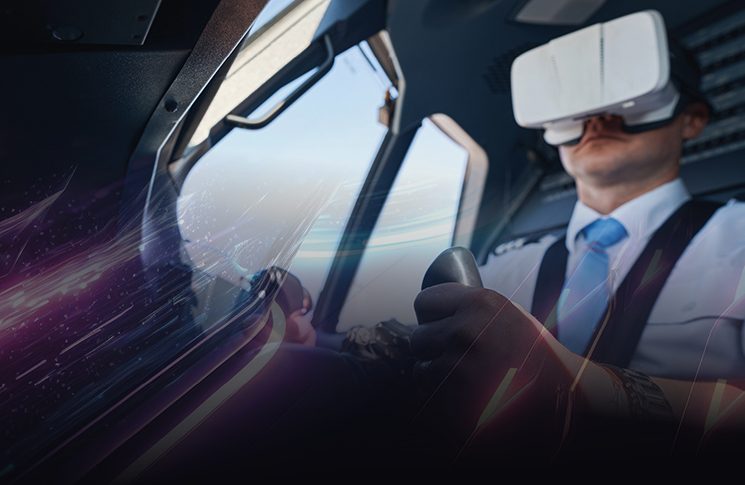
Engineers can now train for complex procedures in the same way surgeons do – computer systems can guide them through the job and experts can watch their progress, not just over their shoulders, but literally through their eyes.
Levels of reality: AR, VR and MR
Edwin Link’s ‘blue box’ Link Trainer created a form of virtual reality with its piano and pipe-organ technology that reproduced instrument flight for more than 500,000 pilot trainees during World War II.
Modern information technology has allowed a much more immersive form of virtual reality, defined by NASA as the use of computer technology to create the effect of an interactive three-dimensional world in which the objects have a sense of spatial presence.
Virtual reality (VR) can be created in a full-flight level D simulator, or with head position-sensing goggles, headphones and haptic gloves. It has 2 virtual cousins:
Augmented reality (AR) – simultaneous experience of the physical world with an overlay of digital elements. (Smartphone programs that display information about an exhibit in a museum or on a walking tour are an example.)
Mixed reality (MR) – simultaneous experience of the physical world with an overlay of digital elements, where physical and digital elements can interact. These interactions can be visual, audible or tactile.
Tool or toy? The evidence
Academic consensus is that virtual reality can be an effective teaching tool. A systematic literature review published in the Journal of Computers in Education in 2021 concluded, ‘[Virtual reality] conferred a learning benefit in around half of cognitive studies, especially where highly complex or conceptual problems required spatial understanding and visualisation.
‘Encouragingly, most procedural tasks did show a benefit to utilising [mixed reality] and, furthermore, there was evidence that virtual skill acquisition could be transferred successfully to real world problems and scenarios.’
The review found 3 of the 4 studies that attempted to utilise VR as a means of teaching procedural skills, showed a distinct advantage over less immersive methods. ‘One study on emergency fire response found that 70% of those who utilised virtual reality training were able to perform the correct procedure in the correct order,’ it said. ‘This was 50% higher than the control group who were exposed to a presentation and reading material only.
Academic consensus is that virtual reality can be an effective teaching tool.
‘The ability to repeatedly practise a procedure in a safe environment whilst expending little resources could be one of the most advantageous and intrinsic benefits of [mixed reality] technology.’
Another academic study found VR/AR training translates well into acquiring real-world skills.
‘Skills acquired by simulation-based training adequately transfer to operative settings with firm scientific evidence of transfer from training in a virtual environment to real-world tasks,’ Bettina Mrusek and Stephanie Douglas of Embry-Riddle Aeronautical University wrote in a 2020 journal article, citing several earlier studies.
Maintenance training
Aircraft maintenance is at least as much learned by doing as by reading or lecturing. The traditional way of teaching involved air force or airline schools maintaining non-flying obsolete aircraft which were dismantled, examined and reassembled innumerable times by generations of students. Composite maintenance training devices, which were full-scale mock-ups of real aircraft, were sometimes used.
Examinations took the form of students performing repairs and maintenance under the eye of an experienced instructor. This system was effective, but costly, and not without danger in the case of hydraulic or electrical systems.
The first digital/simulation training used desktop computer systems and was useful for learning procedures, rather than techniques. Virtual and augmented realities make it possible to simulate and reproduce situations that would be costly, complex, dangerous, or difficult to replicate in the physical world. De-icing (an operational procedure) and undercarriage testing are 2 examples.
Virtual reality creates a safe and inexpensive environment for skills to be honed while allowing visible consequences for mistakes and allows repeated practice until the process is familiar.
Academic consensus is that virtual reality can be an effective teaching tool.
Maintenance training devices offer many advantages including:
aircraft exploration through virtual aircraft
component removal
troubleshooting exercises
lesson plan (reload any saved situation instantly)
animated schematics
simulation of built-in test equipment.
A hierarchy of devices has emerged: simulators and virtual trainers bridge the gap between the classroom and the aircraft, and augmented/mixed reality systems enhance training, ensure consistency and allow real-time support.
Canadian simulation specialist CAE offers Simfinity, a virtual maintenance trainer that creates a ‘virtual aircraft’ where systems familiarisation, maintenance procedural training and troubleshooting can be taught. The trainer offers the ability to display cockpit panels and instruments and save and recall layouts. It also includes a library of malfunctions and active schematics interacting in real-time in a high-fidelity simulated environment. Australian Defence Force engineers maintain the Sikorsky UH-60 Blackhawk and SH-60 Seahawk using the Simfinity system as part of the ADF’s next-generation simulated aircraft maintenance trainer. This system trains maintenance technicians to diagnose and troubleshoot aircraft systems, avionics and flight control systems in real-time.
Viral and virtual
The viral circumstances of the 2020s have stimulated virtual reality training. When the grim reality of the COVID-19 pandemic prevented Boeing technicians travelling to Australia to service the Royal Australian Air Force’s (RAAF) C-17A Globemaster III aircraft, mixed-reality devices replaced them.
In July 2020 the RAAF began a trial at Amberley involving mixed reality and a high-definition secure video connection, allowing the American engineers to observe as if they were not merely looking over the shoulder, but through the eyes of their Australian counterparts. Iris tracking in Microsoft HoloLens goggles enabled technicians in the US to see exactly what the RAAF engineers were seeing inside the aircraft.
Boeing C-17A field services manager Glen Schneider said the system would allow technicians to connect with the Boeing field engineering team while they are away on a domestic or international mission.
The first project was to replace the C-17’s floatation equipment deployment systems panels, which consist of explosive components that deploy life rafts in an emergency.
Real benefits
Airbus says mixed-reality solutions have cut manufacturing time by a third for some components and systems while improving quality. Digital information, such as instructions or diagrams, can be overlaid on a real piece of machinery to aid in complex or hard-to-reach tasks.
Airbus designers now test their designs virtually to see if they are ready for manufacture. The group says mixed reality cuts the time taken for this step by 80%.
In late 2019 Qantas began a trial of engine ground run training for engineers.
Since 2020, Rolls-Royce has offered its engine familiarisation course for the AE2100 turboprop (as used on the Lockheed C-130 Hercules and Alenia C-27J Spartan) as a virtual reality course. Students can log in from anywhere in the world to the training centre in Indianapolis, US, for a comprehensive overview of the construction, design and operation of the engine and engine systems using virtual reality. Rolls-Royce says, ‘This creates an environment for students to ‘learn by doing’, increasing their recall by completing multiple repetitions.’
The company also has developed a VR training course for the BR725 engine, as used in the Boeing 717 and, potentially, the upgraded B-52.
In late 2019, Qantas began a trial of engine ground run training for engineers. The project used HoloLens2 goggles and a virtual aircraft model instead of an actual aircraft. Using the goggles, Qantas engineers were able to train and practice this essential but potentially dangerous operation without the need to use a simulator or aircraft.
The safety case
For Lithuanian maintenance repair and overhaul organisation FL Technics, a major advantage of virtual reality training is safety.
‘The first thing that comes to mind is how to show students what can happen in a real environment in risky places,’ Ramunas Paškevičius, FL Technics’ Head of IT and Innovations says. ‘For instance, working on the emergency doors or something like that, there is a risk that if things are done in the wrong sequence, an explosion of the escape slide can be triggered within the hangar.
Virtual reality creates a safe and inexpensive environment for skills to be honed.
‘At best, that will be a financial loss; at worst, it will injure the mechanic and other mechanics. We did not have such cases in our hangars so, while all of our staff know theoretically that there is a risk, they have not seen how that explosion and deployment of the escape slide would look if it happened in the real world. Virtual reality is able to show mechanics that event and for them even to feel it.’
Further information
Hamilton, D., McKechnie, J., Edgerton, E. et al. Immersive virtual reality as a pedagogical tool in education: a systematic literature review of quantitative learning outcomes and experimental design. J. Comput. Educ. 8, 1–32 (2021)
Mrusek, B., & Douglas, S. (2020). From Classroom to Industry: Human Factors in Aviation Maintenance Decision-Making. Collegiate Aviation Review International, 38(2), 2021
As we emphasise Maintenance Month, we revisit this insightful 2019 article, shedding light on the crucial yet often overlooked aspect of aviation safety: maintenance practices. Delving into the intricacies of maintenance procedures, it serves as a timely reminder of the vital role maintenance plays in ensuring the safety and reliability of aircraft operations.
‘Never, in the history of aviation maintenance, have so many been distracted by so little.’
With apologies to Sir Winston Churchill, who was paying respect to WWII Battle of Britain air aces. The ‘so little’ I refer to in this article is that thin, slick smart phone in your pocket.
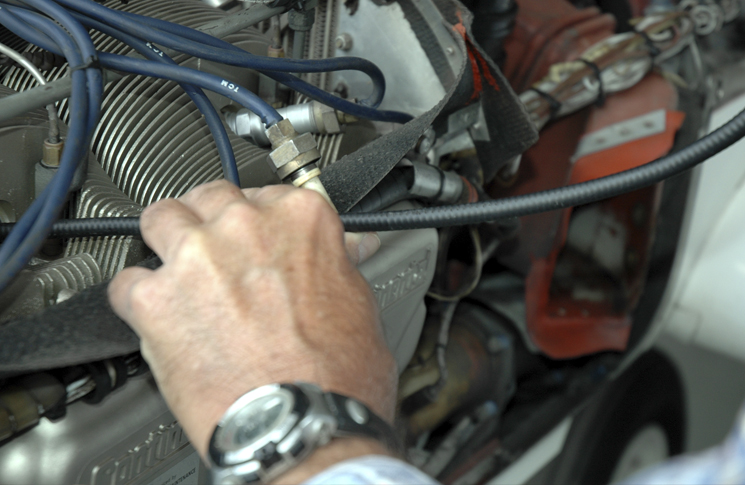
Recently I stepped through the small side door of a maintenance hangar at a regional airport and froze on the spot. Half a wingspan away was an aircraft technician leaning on the aeroplane in animated conversation, with a smart phone in his left hand, gazing into space while ratcheting out a lower rear spark plug from the engine with his right hand.
At that moment, to his complete surprise, the spark plug came out of the cylinder. His conversation suddenly became disjointed as he tried holding up his end of the conversation while doing a juggling act with the phone, socket, ratchet and spark plug.
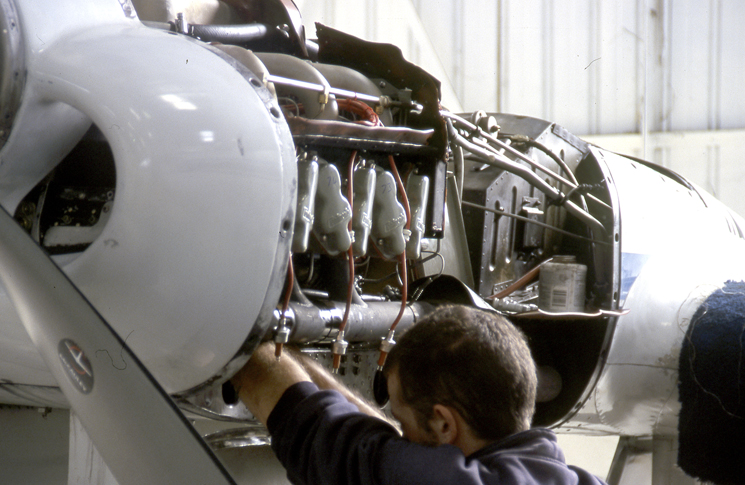
image: engineer checking spark plugs | CASA
Despite his desperate efforts, the hardware and spark plug dropped inside the cowl, rattling and rolling as they fell out on the hangar floor. The phone had won. I just turned and left, closing the door behind me.
If you are reading this on your device while actually working on an aircraft, then please take safety action immediately and step away from the aircraft—but keep reading, because you have in your hand the most disruptive device on the planet; a direct threat to your safety and to aviation safety due to the distraction it brings, and it needs to be tamed.
Very few people may remember when phones first became mobile in cars. They needed to be in a car because they were bulky and something the size of a car battery was needed for power, and a car was needed to mount the antenna
image: Civil Aviation Safety Authority
Then, one day, everything changed. A mobile phone salesman appeared at the hangar door where I was working with a group of ‘subbies’ (subcontract LAME’s) doing maintenance on a Fokker F27. The jaw-dropping thing was that he was actually carrying a mobile phone in one hand.
As memory serves, these technological marvels were equipped with an extendable antenna you could go fishing with, a full-size hand piece joined by coiled wire to a transceiver with a battery the size of a house brick and as heavy and capable of jump-starting your car. Despite the hefty price tag, he sold about five, and drove off. The dust had hardly settled when it started.
As ‘subbies’, we were always looking for the next job to try and ensure a steady income. Here was a real game changer, a phone in the hand being worth much more than two in the … (well, one at home and one in the car if you could afford it), but how could anyone call you about a job if they didn’t know your brand-new mobile phone number? It was only minutes before I heard weird one-way conversations coming from odd corners of the hanger and in the aircraft, as the excited new mobile phone owners called friends and employers to give out their new contact number.
These phones had a short battery life, had no ‘apps’, did not take pictures, could not navigate, play movies or do text messaging, and yet they were so disruptive to the work flow that the supervisor banned them from the work area within the hour.
Things sort of returned to normal, but the world was never quite the same again, because folks were now distracted, listening out for their phone to ring—which is the distraction you have while not actually having a phone distracting you (more on that later). Oh, and the phones all had exactly the same ringtone!
I didn’t realise it at the time, but I had just witnessed a once-in-a-lifetime ripple in the time-space continuum which has become a global pandemic with no signs of abating. It would be fashionable to call it a tsunami, but a tsunami recedes. Because this gateway to the universe is now in our pocket, its distractive capability looks set to continue to expand exponentially.
Distraction is a deadly enemy. While reinstalling the main fuel filter on the starboard engine of a piston twin during a 100-hourly inspection, the LAME was interrupted by another maintainer who asked for help in synchronising the magnetos on that engine. Magneto timing completed, everyone went for morning tea.
A few flight-hours later, the starboard engine caught fire in mid-air, the wing spar failed, and the fuel tank exploded. The aircraft rolled over and fell to earth as a ball of fire. I shall never forget the picture of six caskets, lids held down with the funeral parlour’s version of a brass wing nut. The LAME had been distracted. The fuel filter connection was never properly tightened, allowing highly volatile Avgas fuel to spray onto the engine as it came loose.
Today and into the future, the opportunity for distraction is much worse. We have this problem of addictive and fatal distraction from mobile phones, which is so bad that the cities of Melbourne and Sydney have embedded traffic lights in the footpath of key pedestrian crossings to try and stop downwards looking ‘phone-zombies’ from walking out into fast-moving traffic and killing themselves. What is going on?
Clinical Psychologist Dr Danielle Einstein makes three good points in her response to the question about banning smart phones in school. I only have room for two:
‘Smartphone apps and the anticipation of messages prompt dopamine release, creating addiction.’
Addiction? Correct. Addiction has many indicators such as loss of control over the amount and frequency of use, a craving and compulsive using and continued use in the face of adverse consequences. Social media engineers openly admit that their apps are deliberately designed not only to be attractive, but addictive, because the body releases dopamine with every reaction with social media, games, etc., and so you ‘need’ to be constantly connected to others via calls, texting and responding to alerts.
‘The mere presence of one’s phone consumes attention even when it’s not being checked. It’s been shown we have reduced working memory capacity and fluid intelligence when our phone is upside down, silent on our desk compared to when it is in another room,’ Einstein states.
By now you might be getting just a little defensive and think while this is true of others it’s not true of you. Perhaps you would like to argue that the phone is your source of approved data for doing the job. This may be true, but does anyone think they can use their phone undetected? Every call and internet access logs an exact time date and data provider. An accident investigation could easily discover when a mobile phone was used and for what, and a case for neglect of duty of care due to phone distraction could be proven to have existed.
Trying to tame smartphone addiction can be quite difficult and there are some complex and comprehensive phone usage policies around, but I think the simplest is the best. Treat the hangar as a sterile environment. If working solo (the very time you think you will need it the most) either put the phone in a separate location from where you are working or turn it off, so that you are not tempted to pick up whenever it rings, or to fill in those boring moments when doing something that you have done many times before.
Are you suffering the beginnings of phone separation anxiety as you read that? Sorry but it seems you may well be addicted.
Again, an aircraft owner-operator might want to visit and observe a prospective maintenance organisation’s mobile phone policy. They probably don’t want to be paying for things like, well, lost time due to social media usage and dropped spark plugs.
Oh yes, and before I go, just the one question: Hands up all those who want to fly in an aircraft subjected to phoney maintenance?
I see no hands. (With apologies to Lord Nelson and his blind eye)
Final reserve and contingency fuel requirements for a Part 91 IFR flight (piston <5,700kg MTOW) are?
30 minutes final reserve fuel only
45 minutes final reserve fuel only
30 minutes final reserve fuel and 5% of trip fuel for contingency
45 minutes final reserve fuel and 5% of trip fuel for contingency
Final reserve and contingency fuel requirements for a Part 91 IFR flight (piston >5,700kg MTOW) are?
30 minutes final reserve fuel only
45 minutes final reserve fuel only
30 minutes final reserve fuel and 5% of trip fuel for contingency
45 minutes final reserve fuel and 5% of trip fuel for contingency
Civil IFR flights entering Class E airspace, unless otherwise advised by ATC must squawk which code?
1200
2000
3000
4000
A communications failure while on an assigned heading in controlled airspace, requires which of the following actions in IMC?
squawk 7600
maintain last assigned vector for 2 minutes
listen out on ATIS and/or voice modolated NAVAIDS
all of the above
An IFR flight departs an aerodrome that is CAVOK, and is in VMC when a radio failure occurs. The forecast is for IMC conditions further enroute. The most suitable course of action is:
proceed as per the flight plan to the destination, and comply with the radio failure procedures
if the flight is planned to remain outside controlled airspace, proceed to the destination
if the flight is in controlled airspace, fly to an aerodrome with maintenance facilities
if the aircraft is certain to maintain VMC, remain in VMC and land at the most suitable aerodrome
On a radar heading, IMC in Class A airspace, ATC have cleared you to descend to an altitude below the LSALT. If a radio failure occurs, you must:
maintain the assigned heading for 3 minutes and not change level
descend to the assigned altitude and maintain it for 3 minutes
not descend below the LSALT and maintain that altitude for 3 minutes
climb until you are in VMC
Can an aircraft be operated under the IFR without an approved GNSS?
yes
no
You are IFR in Class E airspace and your GNSS fails navigating between 2 VOR aids. Your flight notification has indicated the aircraft is capable of RNP2. Does ATC require notification?
yes
no
The VOR for the aerodrome you are approaching is reported (by NOTAM) as being out of service for the time of your arrival. Your aircraft is approved for RNP2 operations. Can GNSS information be used as an alternative to the ground-based navigation aid (VOR) in conducting an approach?
yes
no
For the enroute phase of flight, GNSS information may be used as an alternative to a ground-based navigation aid under what conditions?
no restrictions apply if above LSALT
the aircraft is approved for RNP 5 operations
the aircraft is approved for RNP 2 operations
the aircraft is approved for RNP 1 operations
1Your aircraft has an unserviceable pitot heat to the single airspeed indication system, with no other means of preventing malfunction due to condensation or icing. Can it be operated IFR?
yes
no
For a single-pilot IFR flight with an inoperative loudspeaker, what communication requirements apply?
two headsets and microphones that are not of a hand-held type must be carried
only a single headset is required
a single headset is required if the aircraft has HF and VHF radios fitted
only a single headset is required if a backup communication device or mobile phone is carried
You are preparing to depart IFR from a CLASS D aerodrome, into CLASS C airspace. You have requested an airways clearance. Due to IMC conditions and heavy traffic in the overlying CLASS C airspace, ATC advises a significant delay before being able to depart. You request a Special VFR clearance to circumvent the delay. ATC issues the clearance and you prepare to depart. What conditions must you adhere to when operating under a Special VFR clearance?
remain clear of cloud and in-flight visibility not less than 2,000 m
maintain 200-feet clearance from cloud and in-flight visibility of not less than 1,500 m
remain clear of cloud and in-flight visibility of not less than 1,600 m
remain clear of cloud and in-flight visibility of not less than the circling visibility minima
During a departure from a CLASS D aerodrome and operating under a Special VFR clearance, ATC will provide clearance from what flights?
IFR flights
IFR and VFR flights
Special VFR flights
Special VFR flights when the visibility is less than VMC
Can ATC vector Special VFR flights under normal conditions?
yes
no
You have planned a flight to a destination aerodrome that has a predicted loss of GNSS integrity for 10 minutes, which starts at your planned arrival time. Your aircraft is equipped with an approved GNSS receiver that can achieve a LNAV accuracy of less than 0.3 nm using requisite satellites. Are you required to provide for an alternate or delay your departure time?
yes
no
To view the answers, go to the next page using the page navigation buttons below.
When faced with ambiguous information, this pilot swallowed pride and made the safe decision.
How much fuel do we have? I always like to know the answer to this question at any time during a flight and, with all the latest avionics onboard, I thought I was on top of it.
However, this story is about a recent flight where I almost found myself in a situation that could have become an incredibly embarrassing news story.
One of the most important tasks in aviation flight planning is ensuring you have enough fuel on board to complete the flight. Fuel exhaustion is a regular cause of aviation incidents and accidents around the world. The calculation to ascertain how much fuel is remaining in the tank is: the amount of fuel at engine start, minus how much fuel has been used up to this point.
I am a great fan of modern digital technology in aircraft, however, there are traps to be mindful of, especially when you ignore traditional safeguards that were developed to deal with unreliable technology. With experience, you come to rely on numbers rather than needles.
The redeeming feature of the original float-type fuel quantity gauges is that they don’t even pretend to be accurate. Therefore, a wise pilot will fill their tanks to the top, or to a calibrated level, then monitor fuel use according to power settings and time. Since the 1970s, many aircraft have been fitted with analogue fuel-flow gauges, which are based on fuel pressure or actual flow. More recently, digital fuel-flow meters have become common and automatically calculate ‘fuel burnt’, ‘fuel remaining’ and ‘potential endurance’.
But of course, there’s a catch. As with any kind of computer, rubbish in leads to rubbish out.
Here is a common scenario. Once a tank is filled, the fuel computer is set to ‘full fuel’. At the end of the first flight, the computer dutifully indicates how much fuel is remaining in the tanks. For the next flight, if full fuel is not required, additional fuel is added regardless to top up the tank, and this quantity is mentally added to the amount of fuel remaining in the tank. The amount is then manually entered into the fuel computer, and this process is repeated for subsequent flights. As you can imagine, the risk of miscalculation or finger errors when entering in the data increases.
A recent experience brought this fallacy to my attention. Accidents require a sequence of events to line up just at the right time, and on this occasion I was able to watch them unfold first-hand.
The first ‘event’ occurred when I was refuelling at Bankstown. I asked for full fuel but, despite usually supervising the upload process, in this instance I was preoccupied. My Mooney M20K has an anti-syphon flap on the inboard tanks and fuelling requires some expertise in relation to the speed of filling and the level at which the tank needs to be filled. The fuel slowly flows out to the long-range tanks and, thus, the inboard tanks only appear ‘full’ for a short amount of time.
When dipping the tanks before departure, I remember thinking they were not quite up to the level I was expecting, but some time had elapsed between filling and checking, so I proceeded regardless. I set the fuel computer to the full 286 litres and departed back to Canberra, arriving home with an indicated 238 litres remaining.
A week later we arrived at the airfield for a trip up to Archerfield aerodrome in Brisbane; a flight time of 3.2 hours. I calculated the required amount of fuel and was happy with the existing margin of 50 litres on top of reserves. I dipped the tanks and noticed the fuel level was a bit lower than I expected. The fuel computer still read 238 litres, so with good weather forecast, we departed north.
With a heightened level of vigilance, I was checking the fuel flow and other legacy gauges the entire way. Abeam Coffs Harbour, I realised the gauges were lower than they should be, but of course, you can’t trust them. When the new avionics were installed, I remembered being told that I should only consider the old gauges accurate when fuel was low. Well, it was low now!
Between Grafton and Brisbane lie the McPherson Ranges and Lamington National Park. The lowest safe altitude on our track was 6,500 feet. I’ve bushwalked in this area several times. Recalling hiking through the dense rainforest, I found myself thinking about techniques for tree-top landings, how isolated it was up there, how it would be wet and cold at night and, perhaps most importantly, how I would ever explain my stupidity to my friends and family – if I survived.
The co-pilot quickly informed me that such an adventure was not on her bucket list. So, with the digital gauge still reading 170 litres, I decided to ignore the modern technology and rely on the legacy gauges which, when added together, totalled 80 litres of fuel remaining. Time for a command decision. If we had fewer than 70 litres when abeam Grafton, we would need to divert to Lismore to refuel.
We had exactly 70 litres of fuel remaining at this point. It was just enough to get us to Archerfield in a ‘minimum fuel’ situation, so we decided to alter heading for Lismore. As we commenced our descent, the right-hand low-fuel light made its presence known. Lismore had been my home base for some years, so I felt very comfortable landing there. After landing, I did a tank dip: right-hand tank 10 litres, left-hand 50. We had 90 litres less than the digital gauges were reading. This is the difference between full and FULL tanks.
After a short break, we headed off and while crossing the ranges once again, we were able to enjoy the spectacular view of the rainforest below – appreciating it from up in the air – as planned!
Lessons learnt
Always supervise when your fuel tanks are being filled, or better yet, do it yourself!
Confirm the correct type of fuel is being loaded.
A pre-flight fuel dip is always worthwhile (if practicable).
Double check the total fuel on board reading on the fuel display. Can you rely on it?
Crosscheck all fuel information as the flight progresses. If things don’t correlate, take the conservative option and divert.
Flight planning is one of the special topics on our Pilot safety hub.
Have you had a close call?
8 in 10 pilots say they learn best from other pilots and your narrow escape can be a valuable lesson.
We invite you to share your experience to help us improve aviation safety, whatever your role.
Close calls are contributed by readers like you. They are someone’s account of a real-life experience. We publish close calls so others can learn positive lessons from their stories, and to stimulate discussion. We do our best to verify the information but cannot guarantee it is free of mistakes or errors.
Boeing 747-312 VH-INH Sydney (Kingsford-Smith) Airport, 12:22 pm, 19 October 1994
Every accident, no matter how minor, is a failure of the organisation.
– Jerome F Lederer 1902–2004
Nobody was hurt but this crash exposed fundamental organisational flaws and skated close to the cliff edge between black comedy and tragedy.
When the Boeing 747 reached 31,000 feet, Kate McAuley thought the worst was over. A late connection meant she had nearly missed the flight that was now taking her to a new life in a new city, where a new husband was waiting for her. As Ansett flight 881 passed the approximate latitude of Coolangatta, 3 decades ago, heading north, she turned her thoughts to the future. Then came an interruption.
‘We were near Brisbane, when the pilot said in English that oil was leaking from an engine and we had to turn around – we couldn’t land in Brisbane because the plane was too heavy,’ McAuley says now, from the US.
‘I was angry because I wanted to start my new adventure. I was, ‘Like, whatever!’ I was only a teenager.’
For the next hour she was alone in her irritation. ‘I was surrounded by Japanese honeymooners – everyone happily taking videos and photographs.’ McAuley also watched the ‘beautiful, surreal horizontal waterfall’ of fuel being dumped from the Boeing 747’s wings.
‘About 15 minutes before we came into land, they translated the pilot’s announcement into Japanese and the cabin crew were rushing through the cabin making sure everyone had their seat belts on.’
Flight 881 returned to Sydney on a grey wet spring day on 3 engines and began a standard instrument approach from the West Pymble locator. The windscreen wipers were dancing as they emerged from cloud at 500 feet with Sydney’s then-single runway 16 ahead of them.
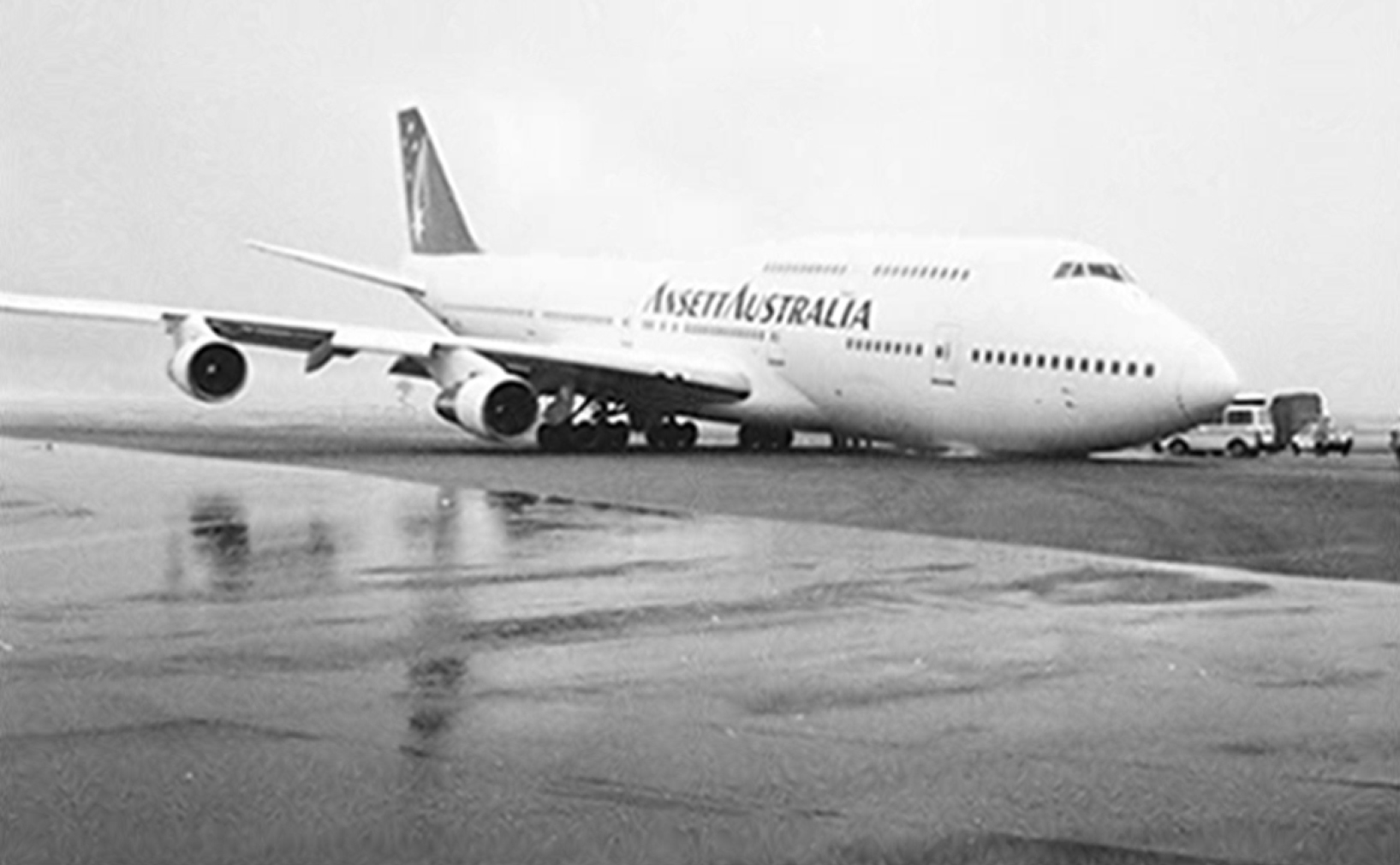
‘After we touched down, it felt like we were nose-high,’ McAuley remembers. ‘Then … the reports said the pilot gently laid the nose on the tarmac. That didn’t happen – it was very loud, a lot of careening and very bumpy, grinding noises and sliding left to right. It was not a pleasant experience.’
image: BASI
What happened
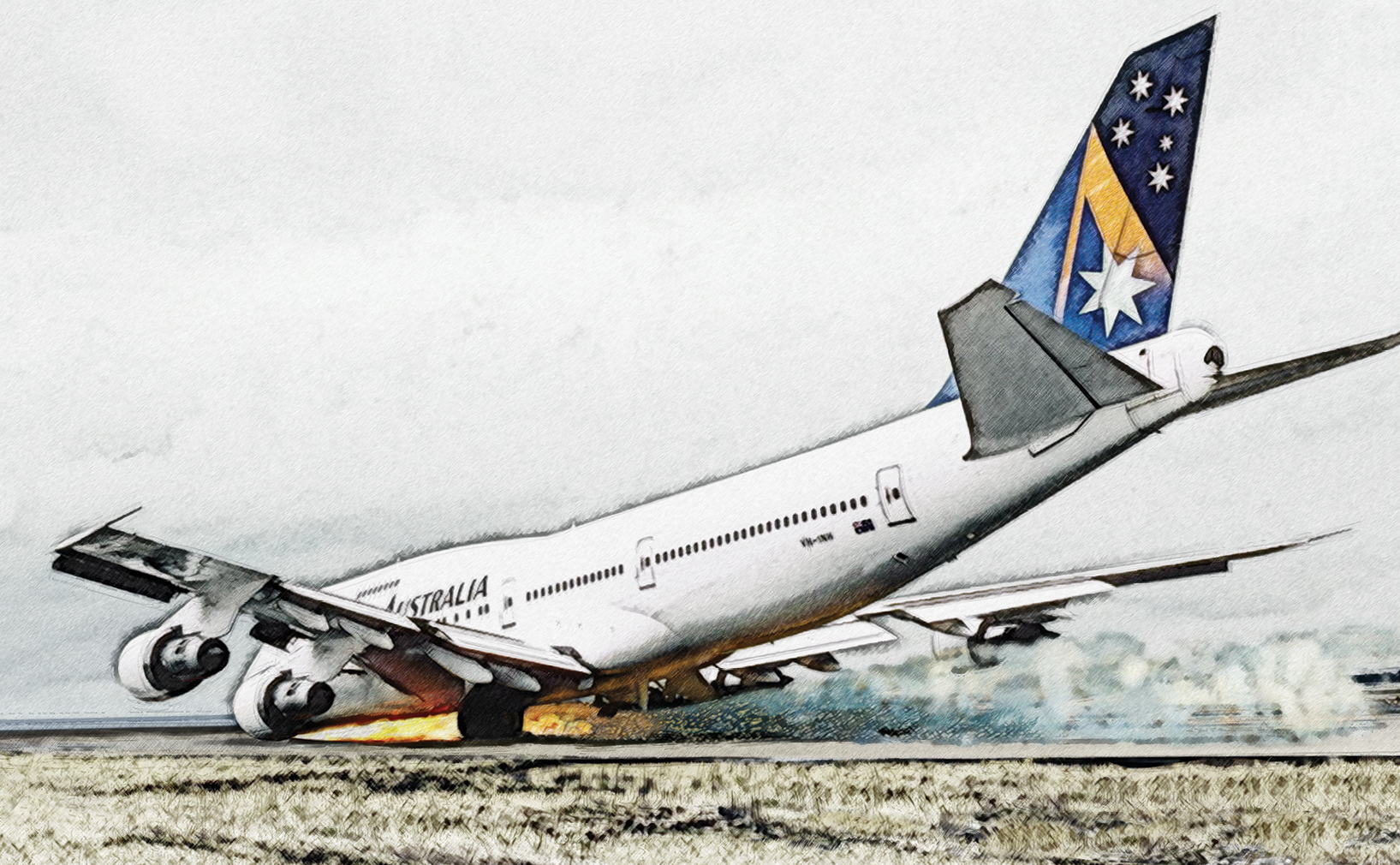
The aircraft had landed with its nose gear retracted. It was the first, and so far, the only time, a Boeing 747 has done this. Other 747 nose gear collapses have involved human error in maintenance, the wheels hitting approach lights or objects near the runway after a runway excursion.
On the way back to Sydney, the crew had briefed for the landing, including the possibility that gear extension would be slower. The captain was pilot monitoring, the first officer was pilot flying, and the flight engineer was intermittently busy replying to airline management by radio to arrange accommodation and onward flights for the passengers.
The gear had been lowered at 2,000 feet. The first sign of trouble was 50 seconds later when the flap lever was moved from 20 degrees to 25. The landing gear warning horn sounded which the captain rationalised as the gear being in transit. He moved the lever back to 20 degrees, thinking this would direct more hydraulic pressure to the gear. He asked the engineer to check the gear panel, to which the engineer replied, ‘Four greens.’ The captain later said he may have heard this as, ‘All greens.’ The crew were not using headsets.
At 500 feet, the captain asked the flight engineer if all green lights were on for both primary and secondary indicating systems. The flight engineer responded that they were. The captain said he was perplexed by the still-illuminated red gear warning light on the centre instrument panel. Seven seconds later, the flight engineer said the flaps were still running. The captain indicated he was still concerned about the landing gear warning horn, which indeed sounded until touchdown.
As the Boeing crossed the Alexandra Canal on the last stages of its descent, it was flying at 186 knots, a considerable 26 knots faster than the calculated reference speed for final approach (Vref). Observers saw ribbons of condensation trailing from its wings. As the crew were about to lower the nose, they heard from the tower that the nose gear had not deployed. There was a momentary consideration of a three-engine go-around, but this was quickly rejected and the crew let the nose settle to the runway.
As the crew were about to lower the nose, they heard from the tower that the nose gear had not deployed.
From the report
An unexplained reduction in air-driven hydraulic pump output caused slower than expected operation of the number one hydraulic system. The system may still have been capable of extending all the landing gear, given adequate time. However, the aircraft landed before the system could complete the landing gear extension. The flight crew had the opportunity to recognise and correct the landing gear problem prior to landing. The pilot in command attempted to determine the actual landing gear situation from the flight engineer. Although the flight engineer’s panel indicated the nose gear was not down and locked, the flight engineer did not recognise this and subsequent communication and coordination between the flight crew failed to detect this error.
Although the flight engineer’s panel indicated the nose gear was not down and locked, the flight engineer did not recognise this.
Why it happened: the technical picture
The Bureau of Air Safety Investigation (BASI), precursor of today’s Australian Transport Safety Bureau, investigated the crash. The bureau found that the oil loss was caused by the failure of a threaded insert used to retain the engine angle gearbox housing cover. A service bulletin for this precise issue, SB JT9D-7R4-72-410, had existed since 1990 but was not mandatory and neither Ansett nor the aircraft’s previous operator, Singapore Airlines, had actioned it.
The landing gear was normally driven by the hydraulic pump powered by the No 1 engine, as the flight crew knew. But, as one of the 747’s many design redundancies, a second identical pump was driven by a common manifold that took bleed air from all 4 engines. In the auto setting selected as part of the flight engineer’s checklist, this pump acted to maintain hydraulic pressure at or near 3,000 psi.
There had been 3 maintenance log entries in 4 weeks reporting problems with this number one air-driven hydraulic pump system, the most recent being 9 days before the crash. However, engineers were unable to replicate the fault. When the aircraft was test flown after the crash, the pump worked perfectly.
What allowed it to happen? The big picture
One false move and we could have a farce on our hands. – Tom Stoppard
The crash occurred at the perfect time in production schedules for newspapers and TV that dominated media in those days and Ansett suddenly had abundant if unwanted publicity for its new international route. The airline had begun international flights to Bali in 1993 and on 30 March 1994, its directors decided to expand operations to the new Kansai airport in Osaka, Japan. The first service was to be on the airport’s opening day, 4 September 1994. A project team took on the task’s many elements, but its manager left in July 1994.
Flight crew training quickly emerged as a problem area. An initial arrangement for Qantas to conduct line (operational flight) training was scuppered by industrial action. Two ex-Singapore Airlines’ Boeing 747s arrived in May, only for Qantas to withdraw from ground and simulator training, which it had expected would be linked to a lease of its Boeing 747s. The date for crew training commencement was pushed back by a month.
Contract crews were hired for a four-month term from September 1994 to January 1995. On 9 June after high-level discussions between Qantas and Ansett, simulator and ground training at Qantas were restored. At once there was a divergence of philosophies. Qantas recommended its training course, but Ansett preferred the Singapore Airlines version of the Boeing operations manual, amended to reflect Ansett practices. One such divergence was the role of the flight engineer. It was regarded as a technical specialist by Ansett but as an integral member of the crew by Qantas, whose flight engineers had specific duties of checking and monitoring, and a general role as a flight deck resource.
Training was intense and conducted at unusual hours when the simulators were available. The courses were confused and disorganised, with attendees reporting, ‘Unsigned, unattributed sheets of paper containing amendments to operational procedures were distributed to trainees during the night.’ One pilot reported knowing 3 different checklists, based on Qantas, Boeing/Singapore Airlines and Ansett procedures. Three pilots on the first course did not complete the program and overall final check failures were high: 6 of the 13 pilots and 2 of the 6 engineers failed their first simulator final check. The Qantas simulator had Rolls-Royce engines while the Ansett aircraft had Pratt & Whitney engines, requiring supplementary training, and unlearning of some simulator drills.
On 19 October, this roulette wheel of shortcomings and shortcuts by operator, regulator and crew came up short.
Nonetheless, Ansett’s inaugural Boeing 747 ‘spaceship’ flight to Kansai took off on 4 September and landed without incident.
The experience of the crew on the day of the incident was unevenly distributed and they had no common set of standard operating procedures between them.
The contracted captain was highly experienced, with 21,500 hours, including 7,500 on type, recently retired from Cathay Pacific Airways.
The first officer had 7,100 hours including 80 on type, all of it training. However, an illness meant the first officer had not undergone a line check before the flight.
The flight engineer, one of 2 who had failed their final simulator check, was on their first revenue flight on type.
BASI listed other significant local factors which influenced the performance of the flight crew:
cockpit noise levels – high
subtle pressures – management suggested the crew ‘turn around’ to fly the replacement flight in another aircraft.
flight engineer’s lack of preparedness for the task
flight engineer’s panel skills
task overload
layout of the flight engineer’s panel – there was no grouping of the 5 gear lights
crew resource management – was not required by the regulator at the time
stabilised approach procedures – were not followed.
Oversight by the then regulator, the Civil Aviation Authority, had been flawed. Line training oversight was managed from the Sydney office while Boeing 747 introduction was managed from Melbourne. And the authority ignored concerns raised by its own specialist 747 pilot.
On 19 October, this roulette wheel of shortcomings and shortcuts by operator, regulator and crew came up short. Another way to think of it would be as the holes inevitably lining up in a series of notably porous Swiss cheese slices.
Postscript: the next day
After the longest 15 minutes of her life, McAuley was evacuated, anticlimactically, via stairs and bus. She was given a cup of tea as disaster victim support and called her mother on a huge, heavy device known as a mobile phone.
She naively thought she might have to pay for the minibar in the hotel Ansett booked for her. The next day, when asked if she wanted to fly again, she surprised the staff by saying ‘Sure!’ – and was allocated the same seat on another 747.
The seat came with a free and unsettling serve of déjà vu. ‘Once we got past Brisbane, I thought ‘OK, it’s really happening – I’m on my way’.’
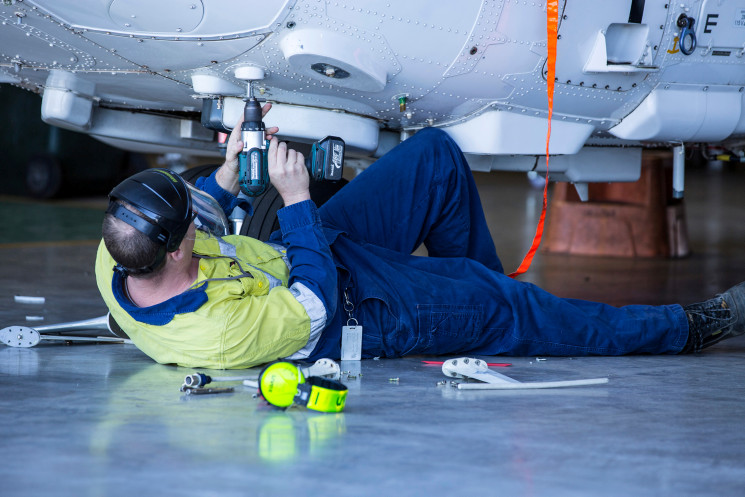
Aircraft maintenance engineers play a vital role in ensuring safety across the aviation industry. Millions of passengers rely on aircraft to take them on their next adventure – aircraft that have been assessed by licensed engineers to ensure they are safe and airworthy to fly.
That’s why we’re highlighting their important contribution to aviation through Maintenance Month. Throughout the month of May we’ll be raising awareness of the different career paths that aircraft maintenance engineers take on while also encouraging individuals to consider careers as an engineer.
What to expect in Maintenance Month
Hear from our own engineer experts and aviation safety advisors at a series of webinars (topics will be announced on 2 May)
See what some of our previous AME scholarship winners have been up to
Read a variety of maintenance articles pulled from the archives of Flight Safety Australia
Enter a competition to win one of 3 gift cards to Snap On Tools (conditions apply)
The month will highlight the dedication and expertise of engineers to keep Australian skies safe while also acknowledging their commitment to aviation safety.
Follow CASA on social media – Facebook, LinkedIn, or Instagram – to ensure you don’t miss out on celebrating with us. You can also subscribe to our maintenance newsletters to receive maintenance updates throughout the year.