

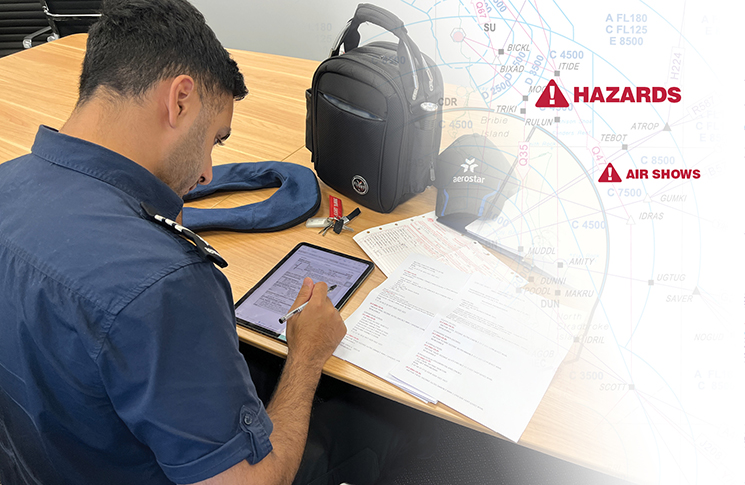
On a clear morning at Gunnedah, a pilot taxied out for departure on a runway that was, on paper at least, closed. The closure had been published in a NOTAM. It was not hidden in jargon or buried down a briefing – it was simply never read.
According to the Australian Transport Safety Bureau (ATSB), the pilot had not checked any NOTAMs during pre-flight planning and only discovered the error when they came face to face with works in progress on the runway itself. The aircraft hit a runway excavation hole and the left main landing gear collapsed.
A year later at Temora, a different kind of NOTAM oversight created a similar hazard. This time, the pilot had reviewed the NOTAMs and was aware runway 18 was closed for works. But during cruise, they changed their arrival plan and decided runway 18 would be more convenient. The NOTAM was consciously set aside – the pilot landed on a runway that was officially closed, with workers and equipment nearby.
Two events but 2 very different mindsets: one failed to look at the NOTAMs at all; the other consciously discounted the information. Both ended up in situations the ATSB classifies as serious safety risks. This reinforces a simple truth about NOTAMs in Australia – they are only effective when pilots not only receive them but genuinely absorb and act on them.
These occurrences sit against a backdrop of increasing workload, dense NOTAM formatting and the many ways pilots now access airfield information. The risks created at Gunnedah and Temora show that NOTAMs can slip through the cracks for many reasons, from complacency and overload to time pressure and familiarity with a home aerodrome.
Understanding how we read and interpret NOTAMs, and how we set up our systems to keep them in view, may be central to avoiding the next near miss.
Why NOTAMs get missed
Modern NOTAMs have a reputation among pilots for being dense, cluttered or overwhelming. Abbreviations, shorthand phrases and plain text lists remain the default, even though technology has moved on.
Jordan Argument, a Grade 2 flight instructor with Merit Aviation, sees the effects of this daily in the training environment.
‘Many pilots skip NOTAMs due to cognitive overload,’ he says. ‘Modern NOTAMs are riddled with abbreviations and are often buried in low-level or administrative notices. It becomes very easy for pilots to fall into the trap of thinking nothing relevant for me is in there.’
Argument notes a second trap that instructors see repeatedly. ‘There is also a threat of complacency when it comes to NOTAMs. Pilots get into the mindset that the NOTAMs for today will just be the same as yesterday, especially if it is a long list.’
The pilot landed on a runway that was officially closed, with workers and equipment nearby.
When a briefing is pages long and peppered with administrative items, hazards can hide in plain sight. A change to lighting or a taxiway closure can sit sandwiched between 2 irrelevant notices. As a result, many pilots scan with low engagement, more focused on getting airborne than decoding a long text list.
Argument says the antidote is structure. He teaches students to break NOTAMs into 3 categories so they stop feeling like background noise. The categories are:
- operationally critical
- performance or planning related
- administrative or low impact.
‘Once we filter NOTAMs systematically, they stop feeling like noise,’ he says.
This structured approach forces a pilot to slow down and actively classify information. It also reinforces a key human factors insight – when we know what we are looking for, we are more likely to notice it.
Decoding NOTAMs without getting lost
Part of the challenge of reading the NOTAM lies in the format. A NOTAM has a predictable structure, but to the untrained eye it looks like a block of coded text. Many pilots understand the individual words yet miss the operational significance.
Argument encourages students to follow a consistent pattern when interpreting them. ‘What location, what has changed, when does it apply and are there any conditions? Once this format is understood, even complicated NOTAMs become easy to interpret.’
He also pushes students to translate abbreviations into plain English. This simple act forces comprehension. ‘We then take time to talk about the operational consequences of a NOTAM. Will this affect our route? Does this affect a navaid we need to use? Does this change the runway length or availability? Does this introduce an airspace hazard?’
Decoding is not the end point – the final step is understanding the meaning of the change. A runway closed for works is not simply a change in status. It has consequences for performance, decision-making, alternates, arrival planning and workload.
‘Misinterpretation occurs because pilots understand the words but have not taken into account the operational significance. This last step closes the loop,’ Argument says.
Once we filter NOTAMs systematically, they stop feeling like noise.
How pilots now receive NOTAMs
Australian pilots have more ways than ever to access NOTAMs. Each method has strengths and limitations. Some emphasise visualisation. Some, like NAIPS, present raw official text. Others combine graphical layers with alerts. The spread of electronic flight bags (EFBs) – such as tablets with flight planning software – has changed the way many pilots engage with their briefing information, both pre-flight and in the cockpit.
Argument encourages students to source information from more than one channel.
‘During pre-flight, I encourage students to get their briefing information from multiple sources,’ he says. ‘This will typically include NAIPS and an EFB running a program such as OzRunways or AvPlan. EFBs are fantastic tools for filtering and visualising NOTAMs, but I always stress the importance of crosschecking the information presented to students.’
Before engine start, a final check is strongly recommended. ‘And finally, simply having the most current NOTAM before engine start. What we have checked during our pre-flight planning may have changed dramatically,’ he says.
In flight, EFBs take the lead by highlighting new or changed NOTAMs for the route, destination and alternates. Favouriting destination aerodromes allows quick access with minimal workload. For many pilots this blend of text and visual cues is easier to process than raw NOTAM text.
How apps deliver NOTAMs in real time
The major Australian EFB software providers have invested heavily in real-time NOTAM delivery. Their systems ingest, filter and display changes significantly faster than the older refresh cycles pilots may remember.
Australian pilots have more ways than ever to access NOTAMs.
AvPlan
Bevan Anderson, CEO of AvPlan, explains how the system keeps pilots informed.
‘AvPlan EFB constantly monitors for new NOTAMs,’ he says. ‘They are updated every 5 minutes and sent directly to customers’ EFBs. If a NOTAM appears which impacts the current flight plan, a directed notification is also sent to warn the pilot of an important change.’
AvPlan depicts NOTAM areas visually, helping pilots understand the geographical impact. Time relevance is also highlighted. The aim is to reduce the cognitive load that causes many pilots to skim NOTAMs rather than absorb them.
Anderson acknowledges the growing interest in AI translation for NOTAMs but stresses caution. ‘While the use of AI to translate NOTAMs shows some promise, we must ensure this is completed in a very managed way to ensure the intent of the NOTAM is not impacted,’ he says.
OzRunways
OzRunways takes a similar approach with its own flavour. Product manager Alex Hart says the system refreshes in near real time. ‘Our system processes new NOTAMs every 2 minutes,’ he says. ‘The EFB app then requests them every 10 minutes, on startup or when manually requested by the user. All NOTAM data comes directly from official sources rather than third party aggregators, ensuring authenticity and reliability.’
OzRunways has invested heavily in visual NOTAM interpretation through its SmartBrief system. ‘We developed SmartBrief visual NOTAMs to address this challenge directly. The system parses Airservices NOTAMs into something OzRunways can use, with a human-backed editor to make any required changes. AI translation is available on all NOTAMs within SmartBrief, which is particularly valuable for trainee pilots or seasoned pilots who have forgotten what a specific abbreviation means.’
The app also includes a time-enabled slider that shows which NOTAMs apply at various points during a flight, allowing a pilot to scroll through the route and identify hazards by time of activation.
‘A flight plan button within SmartBrief provides a comprehensive visual list of what is active within the flight plan,’ Hart says. ‘OzRunways supports TRA [temporary restricted area], day, night and public holiday PRD [prohibited, restricted, danger] activations and deactivations.
In addition, OzRunways has a star priority system to help pilots focus on the most important NOTAMs.’
Pilots can tailor their NOTAM experience through category filtering. Options include bird hazards, obstacles, drone activity, IFR items and PRDs. OzRunways also stores future activations offline, which is useful in low-coverage areas.
‘The live updating map provides real‑time updates when PRDs become active or deactivate. SmartBrief will show updated visual NOTAMs as they become available,’ Hart says.
Human factors and NOTAM engagement
Despite all the technology, the key factor is always human. Overload, distractions and assumptions may influence how pilots process information. Even the best system cannot compensate for a pilot deciding a NOTAM does not apply to them, or their home aerodrome will be the same today as yesterday.
The 2 ATSB examples discussed earlier show opposite ends of the spectrum. At Gunnedah, the pilot failed to engage with the NOTAMs at all. At Temora, the pilot dismissed the NOTAM as irrelevant. Both outcomes resulted from human choices rather than technical failures.
Structured habits, category filtering, visualisation tools and pre-flight refresh checks all help. Yet the deeper challenge remains cultural. NOTAMs are not an administrative hurdle – they are operational intelligence. Treating them with the same seriousness as weather, fuel or performance is the mindset shift the ATSB has been urging for years.
The ATSB reports that in January 2026, a Mooney landed on a closed runway at Cloncurry.
After a series of incidents that occurred nationwide, the National Runway Safety Group is considering NOTAM content on restrictions at aerodromes, such as temporary reduced length runway operations. The detail was complex to read, interpret and remember.
New templates for the publication of NOTAM information on temporary reduced length runway operations will focus on flight critical information, which will be easy to identify, read and understand.
Tips for understanding NOTAMs:
- Decode the structure
Ask 4 questions every time: What location? What has changed? When does it apply? Are there any conditions? - Translate into plain English
Rewrite abbreviations in simple language. This forces comprehension and reduces misinterpretation. - Visualise when possible
Use EFB visual NOTAM tools to see spatial boundaries, timing and activation periods. Graphical cues reduce cognitive load. - Refresh before engine start
Review the most recent NOTAMs immediately before departure. Conditions on the ground may have changed since the planning stage.
Flight planning is one of the special topics on our Pilot safety hub. Refresh your knowledge at casa.gov.au/pilots
For more information about NOTAMs, go to airservicesaustralia.com