Plan to survive

4

The contributing factors involved in general aviation accidents are no mystery, but avoiding them requires effort and discipline.

I’ve been an active flight instructor for 36 years and, for most of that time, have been creating lessons based on accident data. In that time, I’ve learnt a few things about flying’s risks and its rewards.

The key lesson on risks is:

The causes of almost all accidents are very predictable. We’re doing the same things again and again. The good news is this means most accidents are preventable, but only if we heed the lessons learnt from the unfortunate experiences of others.

This knowledge leads to some suggestions on how to avoid a majority of aircraft accidents: by planning to evade the common causes. Some of my suggestions may sound overly conservative. But I bet the pilots who crashed thought they could get away with it too.

First, some general tenets

Know what the aeroplane is – and isn’t

The one you’re flying may have extraordinary avionics and equipment, but it is not an airliner. It is a recreational vehicle, personal transportation or perhaps a business tool. It has not been designed, tested, certificated or maintained to the same level as an air transport aircraft. It doesn’t have the performance, redundancy or support of an airliner. It is very safe and very capable – if flown within its limitations.

Know what you are – and aren’t

You are probably not a military, corporate jet or air transport pilot. Even if you are, or have been at one time, that experience does not fully prepare you for the workload of single-pilot operations. Fly to your experience in type, not to what you’ve done in a different aircraft, in a completely different environment.

Evaluate and monitor the weather

By far the most common reason for airline delays is adverse weather. Your aeroplane is less capable to handle adverse weather than an air transport aircraft. Consequently, you will need to delay, divert or cancel flights even more frequently than the airlines. The more you fly, the more you’ll delay, reroute or cancel because of the weather.

If you do not set the schedule for events that create the need for your trip, or if there are repercussions or lost revenue if for delays or cancellations, then plan to depart in time to delay, divert or cancel and still make it to your commitment by other means if necessary. This is especially true for the trip back home, when you often have personal pressure to arrive on schedule. This sometimes means traveling a day earlier, or cutting your trip short if forecasts show the weather may close in.

Two hundred hours of flying from point A to point B alone probably won’t protect you if a fuel pump dies close to the ground.

You are pilot-in-command, the captain of your aircraft

You are also dispatcher and director of maintenance. You are responsible for self-certification of your fitness to fly, before and during flight. You are the chief pilot, questioning and evaluating your own performance. Plan each flight consciously thinking about the responsibility of all these roles. In general aviation, ‘If it’s to do, it’s up to you.’

Based on actual events

Create and follow a personal training plan

A brief flight review for aircraft and operational ratings every 2 years is probably sufficient for most pilots of simple, VFR-only aeroplanes. But it’s not nearly enough for everything the cross-country pilot, the instrument pilot or the pilot of a complex or high-performance aircraft must be prepared for. Teaching multi-engine aircraft pilots at a simulator training facility convinced me biennial training alone is insufficient – it often took all our time simply to get back to meeting minimum standards. Pilots who trained twice a year tended to meet the minimum standards and went on to improve over time.

Flying time does not by itself replace the need to train

It doesn’t for professional pilots, so why should it for you? Two hundred hours of flying from point A to point B alone probably won’t protect you if a fuel pump dies close to the ground, or if you encounter unforecast low-level wind shear. Two hours of solid practice or challenging instruction 2 or 3 times a year is probably the better measure of a prepared pilot.

Plan to fly slowly more often

Loss of control inflight (LOC-I) is the cause of more than 40% of fatal general aviation accidents in the approach and landing phase of flight. In most cases LOC-I is a euphemism for stall. Many pilots are not comfortable flying at the slow end of the aircraft’s flight envelope, where you are on take-off and go around, and where you need to be during landing. Discomfort is a symptom of undeveloped or atrophied skill.

Regularly hand fly the aircraft

Fatal crashes often result from a pilot’s inability to manually fly the aircraft in the event of an autopilot disconnect or failure. Often pilots lose control almost immediately upon a trim runaway or autopilot disconnect – the moment when they must instantly transition from automated flight to hand flying, with an aircraft that is radically out of trim as a result of the failure mode. Practise hand flying, to be as capable at that as you are using an autopilot.

Maintain mode awareness

The corollary to hand flying is to be adept at the operation of your avionics and autopilot, so there’s never any doubt about the mode in which it’s operating or what the equipment is going to do next.

Plan for instrument failure

Half an hour of partial panel flying every 6 months may be worth more than a panel full of backup instruments. The hard part is identification of a partial panel situation in the first place. Besides actual failure, the only way to experience this realistically is in a flight training device or simulator. Seek out today’s accessible simulation to plan for the worst.

Half an hour of partial panel flying every 6 months may be worth more than a panel full of backup instruments.

Maintain situational awareness

The record suggests a decline in controlled flight into terrain (CFIT) events that coincides with the widespread availability of cockpit moving map displays. That said, CFIT continues to be a problem. Whether VFR or IFR, always know the lowest safe altitude for your current and next segment of flight.

Know your EPs – emergency procedures

Why are air transport operations so safe? In a large part, it’s because the crews are required to perform normal and EPs in simulated scenarios every 6 months. When an actual abnormality or emergency arises (almost never ‘textbook’ as presented in the simulator), pilots have a wealth of experience to analyse the situation. If you haven’t been practising and reviewing EPs regularly, you’ve not planned for the day an emergency occurs.

Plan your fuel and fly your plan

Far too many pilots have died trying to make it home because that’s where the cheaper fuel was, or stretched the aeroplane’s range to avoid the inconvenience of a stop. When one tank is down to 1/8 full and the other is at 1/4, it’s time to be inbound to the circuit. History shows many fuel exhaustion mishaps happen within 5 nautical miles of the planned destination – the pilot thought they could make it – and almost did. Fill up based on fuel need, not fuel price, carefully manage and monitor your fuel inflight and be willing to land for more if there’s any doubt.

Calculating aircraft weight and balance isn’t a training exercise reserved for checkrides and flight reviews. Plan to load your aeroplane within its control and performance flight envelope. An overweight aircraft, or one loaded near or beyond its design capability, will be harder to control under abnormal situations and perform less well when density altitude and wind adversely affect it.

Fly at the lowest weight that meets the trip requirements, with a generous fuel reserve – the lighter the aeroplane, the better it will perform and the more options you’ll have in an emergency. The availability of computer- and app-based weight-and-balance calculators make it easy to be sure.
Plan to stay within limitations

This means the aircraft’s limitations – there’s no such thing as a ‘little overweight’ or a ‘little over redline’. It means weather limitations – no flying through ‘a little thunderstorm’ or ‘a trace of ice’ or flying ‘a little lower’ on approach. It means your limitations – certificates, ratings and currency. If you cheat, human nature suggests it’s likely you’ll soon be accepting more and more risk as ‘normalisation of deviance’ sets in. What was once unacceptable has gradually become your norm. It means the mechanical limitations – follow the rules about required equipment and inoperative equipment. Regulations are minimum standard, the very edge of appropriately managed risk. Where limitations are concerned, ‘No means no.’

Standard operating procedures (SOPs) are the normal way you do things. Strive to fly as close to the same way every time. This avoids the need for too many in-flight decisions (not to eliminate the decision-making process entirely, but to make decisions ahead of time) and permits you to more easily detect and act upon variables like wind, traffic, equipment issues and other factors; you’re not so busy with the basics of flying that you have no mental bandwidth for external stress.

Using SOPs has another advantage – if you need to do something different from your SOP, you’ll have a yardstick of what ‘good’ is and be able to judge what you’re actually doing compared to your expectations and needs.

Plan stabilised approaches

Airspeed, power and aeroplane configuration not conforming to SOPs for final approach, commonly correlates to aircraft accidents. On final approach, ask yourself if the aeroplane is:

  • on speed (Vref +5 knots -0 knots)
  • at the proper rate of descent (usually 500 to 750 feet per minute, except in an obstacle landing)
  • on target (following the glide path to land on the touchdown markers or in the first third of the runway, whichever is shorter)
  • in configuration (flaps and gear set correctly, power and attitude as expected).

If the answer to any of these is ‘no’ within 500 feet of the ground, go around.

Unlike air transport operations, with maximum duty days and mandated rest periods and time off, nothing stands between the pilot in command and their judgment of their level of fatigue. If you’re a morning person, don’t fly after work. If you dance or work the night away, don’t plan on an 0600 departure. A Friday evening trip after a long work week, or a Sunday afternoon flight home after a whirlwind holiday, is setting yourself up for bad decision-making – a factor in as much as 80% of all general aviation crashes.

Even more challenging: evaluate not only how you feel for departure but predict how you’re likely to perform 3 or 4 hours later after bouncing around in turbulence, then faced with a missed approach or abnormal emergency condition.

Involve your family and passengers in your planning

Show them what you’re planning so you can make informed decisions and appropriately manage risk. Ask them to concur with your go/no-go decision and give them the power to cancel, delay or divert en route if they feel uncomfortable. Often, it’s real or perceived pressure from family or passengers that leads a pilot to accept an unacceptable level of risk, because non-pilots have no idea what conditions you require to safely complete a flight. If those around you have some basic understanding of what is acceptable and what is not, you may find you’re under far less pressure to ‘go’.

Sometimes, things break

The failure may not be complete, but the status and reduced capability will demand more of the pilot’s attention, making it harder to manage risk in other areas. Pilots and aeroplane owners tend to interchange the words ‘maintenance’ and ‘repair’ but there is a vital distinction. Maintenance is what you do routinely, before something fails, to maintain airworthiness. Once it breaks you need repair. It may be safe (appropriately managed risk) to defer some maintenance tasks for a planned time. But you cannot defer repair.

Plan for success

It’s all about planning

Learning from 25 years of data-based safety training, imagine how positively we can change the record of general aviation accidents. 

Flight planning is one of the special topics on our Pilot safety hub.
Procedure drifted, aircraft flipped

An established but unorthodox procedure enabled a simple human error to contribute to the destruction of a training aircraft.

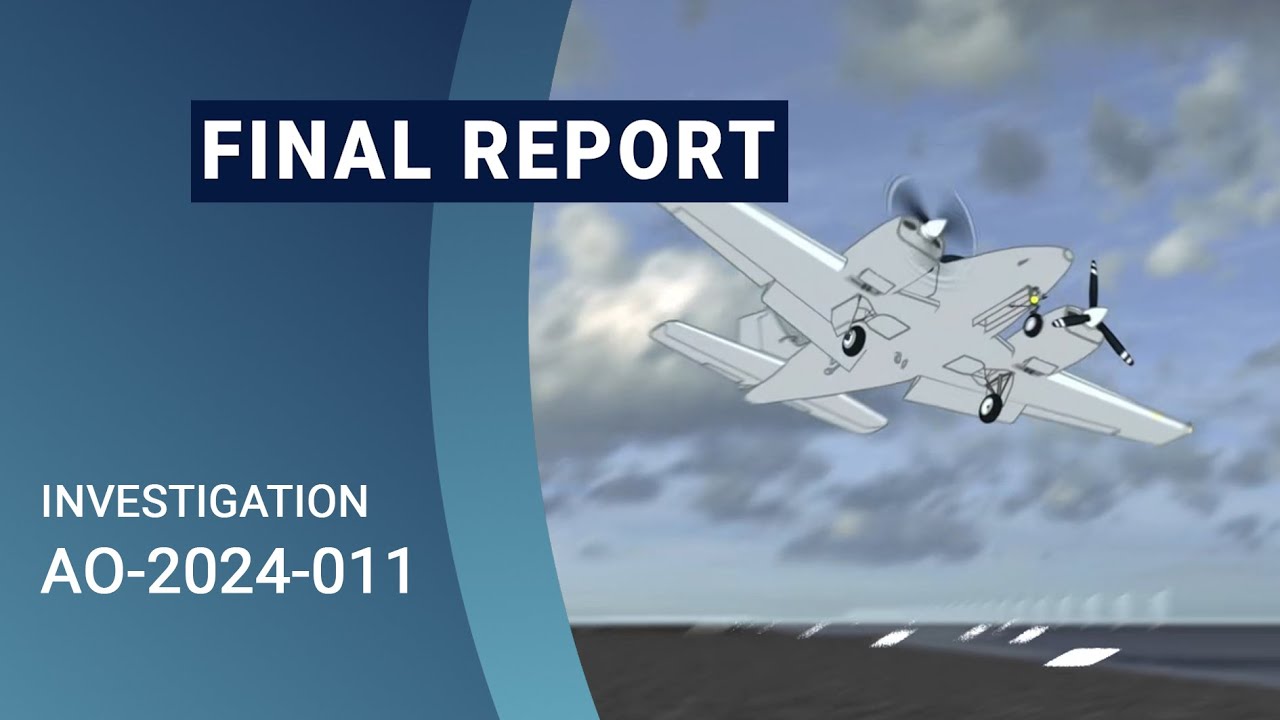
Instead of powering up and climbing when the throttles were pushed forwards, the Beechcraft baron rolled inverted and dived into the ground. In a highly unusual outcome for this type of crash, both occupants survived with minor injuries.

The dramatic accident happened at Cowra, NSW, in April 2024 on an IFR training flight.

The Australian Transport Safety Bureau investigation found the instructor had simulated engine failure by pulling the mixture lever back to idle cut-off, rather than reducing the throttle. During the landing flare, the instructor initiated a go-around, and the aircraft rapidly yawed and rolled to the left, hitting the ground in an almost vertical nose-down attitude, before coming to rest inverted.

The one-engine go around had been initiated near or below the aircraft’s minimum control speed, VMC. ‘At speeds below the actual VMC, with one engine inoperative and the other at take-off power, the aircraft will lose directional control – yaw, roll towards the inoperative engine and descend steeply,’ the ATSB report said.

ATSB Director Transport Safety Stuart Macleod said simulating engine failure by reducing mixture was in accordance with the operator’s relevant procedure at the time, but differed from Beechcraft’s aircraft flight manual.

CASA guidance [in Civil Aviation Advisory Publication 5.23-1(2) Multi-engine aeroplane operations and training, September 2015 ] recommends using the throttle rather than the mixture to simulate an engine failure when at low level – such as asymmetric instrument approaches. This ensures power can quickly be restored if needed.

After the student had reacted to the simulated engine failure, the procedure involved the engine being set for zero thrust, to simulate a dead engine with a feathered propeller.

“When attempting to set zero thrust during the downwind leg of the final circuit, it was likely the instructor unintentionally did not move the left engine’s mixture lever back to rich, to ensure it was available for instant use if needed,’ McLeod said.

Despite this, ‘the observed (and expected) variation of manifold pressure with throttle movement supported an assessment that the engine had been restarted and was capable of normal operation,’ the ATSB report said.

The student and instructor both reported that the student’s normal downwind checks included checking both mixture levers were in the fully rich position, but neither could recall when the checks were done

The pilots survived with minor injuries, even though ATSB analysis found the impact deceleration likely exceeded 30 G, principally in a forward direction, with the stable collapse of the airframe structure forward of the cabin and crash-resistant fuel cells aiding their survivability. The crew seats came off their mountings in the impact but the four-point harnesses worn by instructor and student helped save them from more serious injury. The aircraft’s low height, about 20 feet during the failed go around, also contributed to their survival, the ATSB said.

Since the accident, the training operator has amended its multi-engine training procedures to simulate engine failures by closing the throttle rather than the mixture at any altitude. Setting the engine for zero thrust is now required as soon as the student has identified the failed engine. In its new procedure, confirming that the pitch, power and mixture controls are set back to normal two‑engine configuration is now a call-out item during checks on final.

Conspiracy theory

A pilot learns a valuable lesson in taking responsibility and control.

Conspire –verb. 1. to agree together, especially secretly, to do something reprehensible or illegal.

That word, conspire, went through my head for days after this particular close call. It did so because it accurately described an accumulation of factors leading to the incident. And it also helped me shift blame away from things I could have done, and back onto the events themselves.

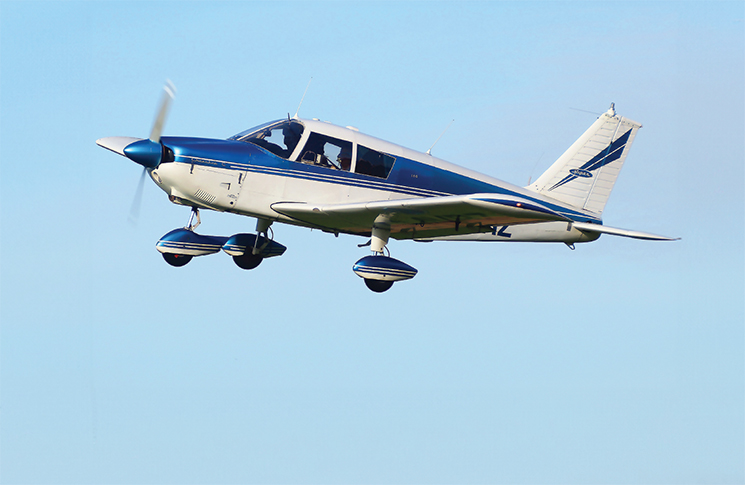
It was a blisteringly hot day in the Sydney basin. The forecast said the temperature was due to flirt with 40 °C by late afternoon. It was already climbing towards the mid-30s as my passengers and I were ready to board a Piper Cherokee at Bankstown. The plan was for a scenic flight to Katoomba and the Three Sisters in the Blue Mountains, before returning to Bankstown via Camden.

We were heavy – 3 POB, full fuel and some hefty camera bags. Knowing this, I diligently completed the weight and balance and performance charts, to find out we were just within limits. With the flight plan in hand, we headed out to the aircraft and I enjoyed showing my passengers the walk around.

The departure from Bankstown was uneventful, so I relaxed as we set course for the Blue Mountains. The Three Sisters appeared and water was glistening in the sunlight as it cascaded down the magnificent Wentworth Falls. It was one of those moments you relish as a pilot: when your passengers are beaming at the experience you are providing. With photos complete, we set course for Camden, planning a touch-and-go before heading home.

As we descended back into the Sydney basin, my thoughts turned to the Camden approach. It’s always impressive for passengers if you fly the low-level entry to the zone, following the river, and then a touch-and-go on runway 10, which is grass. I thought about the climb performance we had achieved earlier at Bankstown and decided the shorter grass runway at Camden would present no problems, especially during a touch-and-go. So, this was what I requested from ATC and they told me to proceed.

However, now that we were down low, it was clear the air had become more turbulent since we left Bankstown. We passed through areas of rising and descending air which required active altitude maintenance and my passengers were noticeably quieter than earlier.

I remember seeing a tinny on the river and being able to make out the name on the front of the boat – that is how low we were.

The approach looked great until about 300 feet when we entered a smooth, wide thermal. It wasn’t as rough as the others, almost imperceptible as we first entered it, but steadily it reduced my rate of descent and the grass runway appeared to fall away beneath me. No problem I thought – reduce power to idle, lower the nose to maintain airspeed, a little sideslipping – and we were almost back on the ideal descent path. Almost.

We landed long, floating more than I liked and eventually touched down a few metres to the right of the centre. Regained the centreline, flaps up, full power –we began to accelerate again. Slowly. Perhaps too slowly?

I looked at the ASI and the needle was creeping clockwise. Not so slowly that I thought about aborting the take-off, but slower than felt comfortable, or normal. Finally, after what felt like an eternity, we hit the magic 60 knots and I squeezed back on the yoke, teasing the Cherokee back into the air.

To say the climb performance was below par was an understatement. I checked my airspeed – 79 knots for best rate of climb – and looked ahead to the end of the runway. The trees beyond it which were getting bigger by the second.

Why was the performance so different to the conditions I had at Bankstown? I couldn’t understand it. I checked the throttle, ramming it against the stops. I realised now had to establish best angle of climb if I wanted to avoid turning the 3 of us into a statistic.

I raised the nose to the correct attitude. The airspeed reduced to 63 knots and only then did I dare look to my left – the tops of the trees next to the Nepean River passed about 50 feet below us. I remember seeing a tinny on the river and being able to make out the name on the front of the boat.That is how low we were!

Once more my eyes scanned the instruments for any sign of trouble and then I saw it – carburettor heat ‘on’. My heart sank. I reached down and flicked the lever back up and immediately things improved – the engine note picked up and the rate of climb improved. I couldn’t believe the difference an extra 100 rpm was making on this marginal day. As we climbed away and set course for Bankstown, I began to see how it happened.

The approach was normal until 300 feet and then the smooth thermal began to conspire against me. It must have chosen that specific point as it knew I always do my final checks at 300 feet, including when I turn the carby heat off.

On any other day, I would not have allowed myself to end up with such a reduced safety margin, but the density altitude was also conspiring against me. The aircraft had conspired against me too, choosing this particular flight to be close to maximum take-off weight.

Then the runway conspired against me, being short and having a grass surface, thereby adding to the take-off roll that was already extended due to the float on landing, conspiring against me…

Lessons learnt

It took a few days to realise the only real conspiracy theory was in my mind. As I mulled over my close call that day, it was becoming clear that every factor was manageable:

  • I should have planned more carefully before requesting a short grass runway on a hot and humid day.
  • I should have gone around early, rather than continue with an unstable approach.
  • I should have initiated a best angle of climb sooner than I did.
  • I shouldn’t have allowed myself to be distracted from those critical 300-foot checks.

There is a quote which says, ‘Conspiracy theories are the refuge of the disempowered.’ While this incident was a valuable lesson in how a multitude of different threats and errors can quickly escalate into an undesired aircraft state, the biggest lesson of all was coming to terms with the fact that I was empowered to manage all of them better than I did.

Controlled aerodromes

Controlled aerodromes and operations is one of the special topics on our Pilot safety hub. Refresh your knowledge.

Have you had a close call?

8 in 10 pilots say they learn best from other pilots and your narrow escape can be a valuable lesson.

We invite you to share your experience to help us improve aviation safety, whatever your role.

Find out more and share your close call here.

Disclaimer

Close calls are contributed by readers like you. They are someone’s account of a real-life experience. We publish close calls so others can learn positive lessons from their stories, and to stimulate discussion. We do our best to verify the information but cannot guarantee it is free of mistakes or errors.

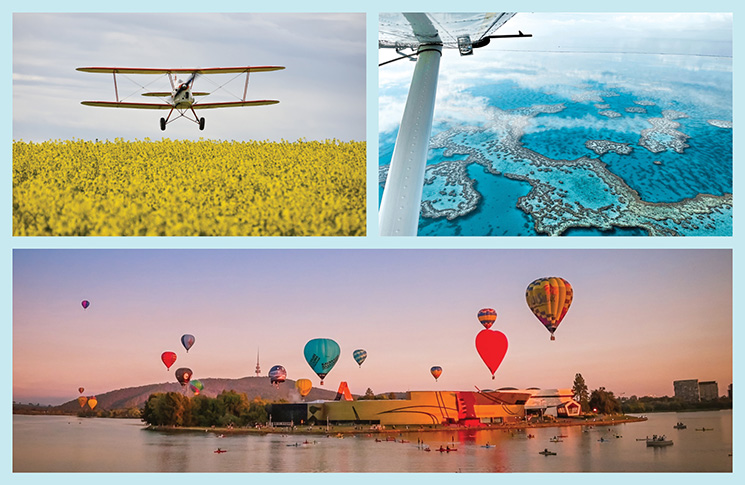
Shoot for the sky photo competition now open

Do you have a winning aviation-themed photo that you think others would enjoy?

Our Shoot for the sky photo competition is now open.

We’re calling on photographers to submit photos that meet one or more of the following themes to add to our image library:

  • against the Australian landscape
  • aircraft in flight
  • aircraft in the hangar/maintenance
  • drones
  • people in aviation
  • sport and recreation aircraft
  • vintage and historic aircraft.

We want you to shoot for the sky!  There’s over $3,500 in prizes to be won:

  • 2 first prizes – win a $500 gift card
  • 11 runner-up prizes – win a $225 gift card
  • 5 annual subscriptions to Flight Safety Australia magazine.

Winning photos will be featured in next year’s Flight Safety Australia wall calendar.

Enter up to 3 photos by 11:59 pm on Monday 30 September 2024.

Visit the CASA Consultation hub to find out more and upload your entry.

T&Cs apply

Jack be nimble

The widely misunderstood phenomenon of servo transparency – or jack stall – can turn a helicopter pilot into a passenger – without any warning.

It had been a full day of back-country-heli-skiing. The last ski run was complete and the ski guide signalled it was time to head back to base camp in Colorado.

The Squirrel AS350 helicopter landed in the deep snow and everybody climbed aboard.

There wasn’t much room and everyone was packed in. The guide secured the skis in the external basket. The helicopter took off and turned around, flying over the snow-covered trees, skimming over white ridge lines and higher over the valleys.

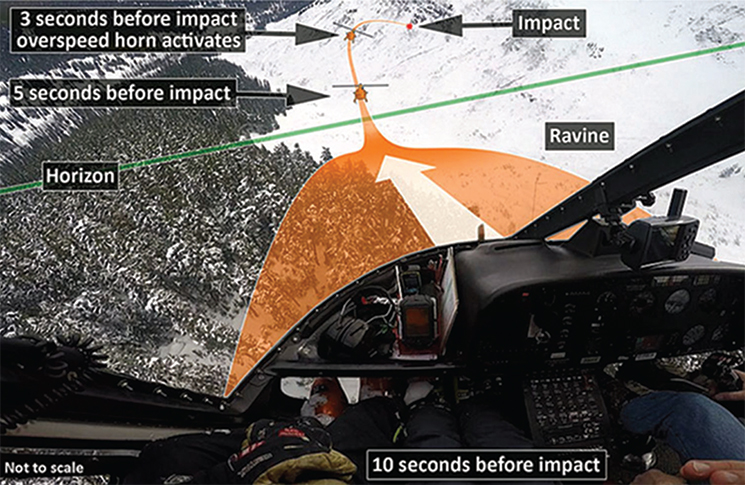
Initially, the altitude was 150 feet above the terrain, however, the pilot descended lower and lower. The pilot pushed over one ridge line and the passengers felt themselves float slightly as the helicopter experienced low G.

Down into the ravine the helicopter descended and accelerated as the passengers laughed and whooped while filming the fun. Now the opposite ravine wall approached. The pilot pulled back on the cyclic to climb, then some left cyclic to follow the ravine downhill.

Wait – the aircraft won’t roll left! The surprised pilot feels as if the cyclic control is jammed – a brief moment of confusion as this doesn’t make any sense. As the pilot tries to process what is wrong, the helicopter rolls right and pitches up – the rotor overspeed horn is going off.

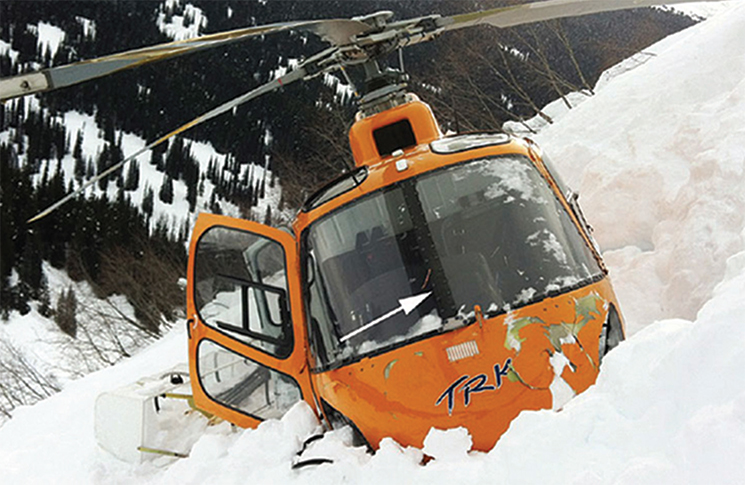
Some passengers are still whooping as if this is part of the fun. Too late, they realise the situation is serious. The helicopter is now too close to the far wall of the ravine and hits the snow-covered slope, ending up facing in the opposite direction.

The ski guide has the presence of mind to stop people leaving the aircraft until the engine is shut down and rotors are stopped. Fortunately, everyone survives with no injuries. All of this was captured on video. It was an unnecessarily dramatic end to what had already been an adventurous day of skiing.

Hydraulics and helicopters

Helicopters create lift and controllability by varying the pitch of the rotor blades. Varying the blade pitch is done by pitch control rods that act both collectively and cyclically.

As the blade pitch increases, the blade creates more total reaction as well as a pitching moment about the blade hinge line. This blade pitching moment acts against the forces applied through the pitch control rods and then back into the flight control system.

In small helicopters with small rotor blades, these forces are light. Some early helicopters had control systems that allowed the pilot to overcome these forces without hydraulic assistance. The Robinson R22 – the most popular helicopter type on the Australian register – still does without flight control hydraulics.

As helicopters became larger, the forces fed back through the control system became too tiresome for the pilot and so the flight controls had a hydraulic boost system added to prevent the pilot from feeling and having to work against these forces. Servo actuators were installed to allow hydraulic pressure to actuate the pitch control rods. This is known as an irreversible control system as the pilot does not feel the forces generated in the flight controls by the rotor blades.

If this single hydraulic system failed, the pilot could carefully fly the helicopter in a reduced envelope and overcome the feedback forces to make an emergency landing. As helicopters became even larger and heavier, a failure of a single hydraulic system meant the pilot did not have the strength to overcome these feedback forces; therefore, a second hydraulic system was added for redundancy.

Any flight condition that increases the blade-pitching moment will put the pilot closer to servo transparency – or frozen controls.

In this accident, the Squirrel AS350 had a single hydraulic boost system for the flight control system. (Some AS350s are fitted with dual hydraulic systems.) The manufacturer designed the hydraulic system so the flight controls cannot be over manipulated and exceed the helicopter’s certified flight envelope. This prevents overstress of the helicopter or its components. The hydraulic pressure is limited to just under 600 psi.

During aggressive manoeuvers, if too great a blade pitching is generated then the force that is fed back through the pitch control rods becomes large and exceeds the capacity of the 600-psi hydraulic system. This means the flight controls become heavy and, ultimately, momentarily frozen, until the helicopter manoeuvre aggressiveness is reduced either naturally or by lowering the collective.

Without further control manipulation, the blades will flap, slowing the aircraft and reducing the aggressiveness of the manoeuvre. This allows the hydraulics to resume moving the pitch rods again when the helicopter is back inside its certified flight envelope. However, this flap back can result in unusual attitudes in pitch and roll before the pilot regains control. The pilot could also reduce collective, decreasing the blade pitch on all blades at once, reducing the blade pitching moment and allowing the controls to move again.

If the helicopter is close to the ground or obstacles, then recovery from an unusual attitude may not be able to be completed before impact.

Transparent overload

Any flight condition that increases the blade-pitching moment will put the pilot closer to servo transparency – or frozen controls. High-pitch settings mean the blades are creating a lot of lift and a similarly increased blade-pitching moment that must be opposed by the pitch rods and hydraulic system. Heavy helicopter operating weights require more lift and, hence, higher-blade pitch angles.

Aggressive manoeuvring including pulling G will also increase the blade-pitch angle as more lift is required to roll and pull the helicopter through a manoeuvre. High-density altitude will require more blade pitch. High airspeeds require power to achieve and, as well as high pitch, there will be increased blade forces on the forward travelling blade due to the increased speed. All of these contribute to increased blade-pitching moments and reduced margin from servo transparency.

Airbus Helicopters has issued guidance on the servo transparency by a service letter and safety information notice. Servo transparency is also known as jack stall or servo reversibility. In this guidance, it says servo transparency can occur on any single hydraulic system helicopter if operated beyond its design flight envelope. It states specifically, ‘This aircraft phenomenon occurs smoothly and is not dangerous if properly anticipated by the pilot during an abrupt or high- load manoeuvre such as a high-positive G-turn or pull-up’.

In a clockwise-turning rotor system, the right-hand servo is the most highly loaded servo when aggressively manoeuvring. The pilot will introduce left cyclic to counter the loads and feel increasing forces to the point where they may feel the controls are jammed or frozen. Eventually, the helicopter will roll right and pitch up; the collective will reduce as the pitch-rod loads on the swashplate force the collective down.

This natural response is self-correcting and decreases the severity of the manoeuvre within about 2 seconds. This returns the control forces to normal allowing the pilot to fly a recovery. If the helicopter is close to the ground or obstacles, then recovery from an unusual attitude may not be able to be completed before impact. The pilot’s actions on encountering servo transparency are to immediately reduce the severity of the manoeuvre, allow the collective to reduce and smoothly correct the roll, while anticipating an increasing roll response as the servo transparency reduces. Some helicopters now have a sensor in the servo that will illuminate a LIMIT caution in the cockpit to indicate impending servo transparency.

Good airmanship would dictate that a pilot should understand whether servo transparency is a characteristic of the helicopter they are flying and allow sufficient margin to avoid frozen controls or ensure there is sufficient room to recover from the subsequent unusual attitude. Even if there is sufficient room to recover before hitting the ground, a large, unusual attitude recovery could be mishandled and result in mast bumping, drop-stop pounding or even excessive blade flapping that may contact the tail boom.

The surprised pilot feels as if the cyclic control is jammed.

A case in point

So back to the accident described in the introduction. The aircraft was heavy with a full passenger load. It was skimming over ridgelines and then bunted into a ravine. Speed was high and it accelerated even further as it descended into the ravine. The rate of descent was high – in the order of 5,000 feet per minute.

Now the helicopter was approaching the opposite side of the ravine and needed to alter its flight path to avoid terrain. A pull up and roll left to turn downhill at heavy weight and high speed was required. Probably an abrupt pull up considering how high the rate of descent was. However, the helicopter did not respond to the flight control inputs. Instead, it turned right, pitched up, flaring and over-speeding the rotor.

image: Crash site | TSB

Miraculously, the helicopter presented itself to the terrain in an attitude that roughly matched the slope of the hillside, with the snow cushioning the collision. A classic case of servo transparency in both the conditions leading up to it and the response of the helicopter. The passengers weren’t the only people in the helicopter along for the ride – because the helicopter was low and close to the terrain, the pilot could do little to regain control of the helicopter before it impacted. The airspeed indicator was showing significant discrepancies from the GPS ground speed. This was postulated as possibly due to the static ports under the fuselage becoming temporarily blocked when previously landing in the deep snow to pick up the passengers.

By the time the pilot dived into the ravine, the 2 readings were almost aligned. The pilot stated this airspeed discrepancy had occurred previously and went away after a period due to the snow melting out of the static ports. Did the pilot really appreciate how fast he was flying the helicopter?

So, what would the next-day analysis from the armchair experts tell us the pilot should have done?

Everyone had a good time skiing. The passengers were obviously adventure seekers and enjoyed flying low and fast over the snow-covered wilderness below them. However, there are legal minimums for how low you can fly. Most people enjoy helicopter flights above these minimum heights and the people who want to fly lower don’t understand the risks they are asking the pilot to accept on their behalf.

However, being at low level, diving into a ravine and requiring a turning pull up to avoid terrain does not leave much room to prevent occurrence of a known characteristic of the helicopter. Thankfully, no one was injured.

image: Helicopter position at 10, 5 and 3 seconds before impact | TSB

A key question remains: how much transparency did the passengers have of the risks the pilot was accepting on their behalf when the helicopter conducted some low-level aggressive flying?

Uprising in the regions

1

Peter Smith: strategist

One of the minds that built Australia’s modern aerospace industry says the benefits and opportunities of the next aviation boom are potentially huge, but are not where you might think.

Visit the biennial Australian International Air show at Avalon, near Geelong and you’ll notice 2 things. Most of the fully assembled aircraft come from overseas, but there’s also a huge and thriving Australian industry in aviation products, structures and systems, ranging from electronic flight bags to CANBUS wiring harnesses and composite airframe components. Peter Smith is one of the people who made possible this $A4 billion industry (in 2021) consisting of more than 800 firms, up to 16,000 direct and indirectly related jobs and Boeing’s largest manufacturing centre outside the US.

Smith can’t remember a time when he wasn’t fascinated by aircraft. His first solo was in a de Havilland Tiger Moth although he protests, ‘I’m nowhere near as old as that would suggest! I was in the Air Training Corps in Queensland and there was a state-based scholarship for cadets to learn to fly. We were brought down to Archerfield where we learnt on these already ancient biplanes. So I have about 50 hours on the Tiger Moth.’

He chose the life of an engineer rather than a pilot but ended up as an executive with a reputation for clear thinking and sharply focused foresight. He spoke to Flight Safety Australia in his capacities as strategic advisor to Swinburne University of Technology Aerostructures Innovation Research Hub and interim strategic advisor to the Australian Advanced Air Mobility Cooperative Research Centre.

How did your career bring you to where you are today?

Smith: I started, as all aircraft-obsessed kids do, with the fantasy that I was going to be an aircraft designer. I did a degree in aeronautical engineering but realised that while I would be OK as a designer, I would be lousy as an engineer because I was more interested in the overall concepts of the aeroplane rather than the detail of how you build it economically and efficiently.

I first worked in the agricultural aircraft business where there were a couple of small manufacturers in Australia. But it became obvious that these manufacturers were being swamped by Cessna and Piper, who were coming out with specialised aircraft. So I got a job as a project officer at Hawker de Havilland, one of 3 major aerospace companies at the time. With them I progressively drifted from technology-based activities to planning and strategic activities. It was a time when the industry was in transition from the World War II model of build-to-blueprint for the military – by the 1970s, the military didn’t need so many aircraft.

It turned out that predicting future needs, looking at Australia’s capabilities, putting together proposals and presenting them to the right people was what I was best at. I was part of a younger generation that got kicked upstairs quickly (into management) and we started doing things like getting into the international aerospace marketplace, as specialists in aerostructures, rather than building airframes that the rest of the world was also making.

I was one of the people who were pushing the concept that we had to get out of build-to-blueprint. We had to move from just being manufacturers to participating in design for efficient manufacture, then moving to co-design so we work on the basic design. The final stage would be taking responsibility for research, materials and manufacturing techniques so that we became joint venture partners rather than just subcontractors. And that’s what happened: by the late 1990s early 2000s, there were handshake agreements with Airbus and Boeing for projects worth $A5 billion.

How did you get involved with uncrewed air systems?

In the early 2000s, I was headhunted to run AWA Defence and later BAE Systems Australia. After that phase I set up as a strategic consultant and independent director – I know lots of people say that, but I made it work. I became chairman of Aerosonde, at that time Australia’s largest maker of uncrewed air vehicles (UAV). And how time flies; I’ve been in this ‘new’ field for more than 20 years. In that time it has spawned a new technology – advanced air mobility (AAM) – using the technology of uncrewed aircraft for a new form of passenger air transport.

As a strategist, what do you make of the predictions about AAM, particularly as we are now in the time when the original boosters of this idea were saying we would be using these futuristic vehicles as everyday transport?

In 2015, somebody at Uber decided that because more and more road-based Ubers were getting hung up in congestion, then maybe you could have flying Ubers going over the congestion. There were sufficient advances in aerodynamics, propulsion, lightweight materials and ATC so you might be able to do that. There were wonderful Jetsons-like images of air vehicles taking off and landing on skyscrapers with a cost and efficiency of operation that helicopters couldn’t match.

By 2016, the concept of eVTOL (electric vertical take-off and landing) as it was called launched in an incredible fashion. Momentum built to the stage that by the early 2020s, there were over 400 eVTOL projects around the world, 99 per cent of them by start-ups. But when you are talking about thousands of air vehicles in every city – there was talk of 2,000 of them in Los Angeles – at 400–500 feet, in among the buildings, taking off and landing every few minutes and, therefore, acting as fatigue creating devices, it becomes a problem beyond the technological ability of any start-up.

Uber were the right people to sensitise the world to this possibility, but they were utterly the wrong people to handle what was a complex, multisystem challenge. [Uber sold its Elevate division to air vehicle start-up Joby for a loss in late 2020.]

Australian AAM needs to be longer range and able to operate into basic strips, or stops.

So where do you see the future of AAM developing?

Ninety per cent of the people I talk to about AAM think immediately about the air vehicle, as I do too, because I’m a prisoner of my background – and we don’t think about the total system. It’s not just the air vehicle but the air operations, air traffic management and ground infrastructure. That’s like thinking about trains without considering tracks. Much of the work that has to be done is about building tracks in the skies and building the equivalent of railway stations. Because the vehicles are VTOL, there will be stops, more than strips. When you think about the whole system, like a railway, the answer that emerges is different from what’s being anticipated in larger more compact nations. They’re thinking urban, we’re thinking regional.

Why do you think regional AAM will happen first?

One of the reasons I think Australia should be going into regional AAM is not only the need, but the greater simplicity of the safety case.

My growing concern was that the initiatives in AAM were all about high-density complex city canyon operations, and the safety cases were multiple – air, ground comms, cybersecurity. It became obvious that air traffic management and certifying and operating criteria would take the authorities years to develop. That’s not because the authorities were slow, it’s because everything was so different from everything before, not only in character but in potential volume.

The other factor is how the status quo of regional aviation is vulnerable, looking at the age of fleets, the age of LAMEs and the increasing poaching of pilots from regional to national to international airlines. At the same time, operations like AMSL (See Flight Safety Australia Autumn 2024) are starting to emerge.

It’s a great opportunity to imaginatively use emerging technology to provide a better, safer future for regional and remote Australians.

Does this represent a threat or an opportunity to the Australia aerospace industry?

Absolutely an opportunity. Australian AAM needs to be longer range and able to operate into basic strips, or stops. There will be engineering challenges of dust, monsoonal rain and heat. Almost all the world’s AAM projects are urban, very few are looking at longer range – by our aerospace developers working with our regional aviation operators, we can do this.

Other countries that would have a similar need for regional AAM, Canada, for example, don’t have anything near the combination of capabilities Australia has – we’ve got people who can build the air vehicles, people who can do the air traffic management and we’ve got regulators who are thinking strategically about the future. So we have the opportunity to do something that is not just good for Australia but look at international marketplaces for economies of scale. It’s not just distance, it’s difficulty of travel. Think of all the archipelagos – Indonesia and the Philippines – and of Africa, where uncrewed aeromedical has been adopted very quickly.

What does AAM mean for Australian regional aviation?

There was a eureka moment on 7 September last year with the Federal Government’s Aviation Green Paper to 2050. All the way through, particularly when it talks about regional aviation, simplification of operations and industry development and skills, it keeps bringing up AAM, saying it is potentially a solution. There’s a chapter saying this is an opportunity to build and operate a new aviation industry for Australia with export potential. Since then, the concept of a Cooperative Research Centre to integrate regional AAM development has accelerated. I’ve been very involved, going to roundtables listening to potential users – aircraft operators, airport operators. We went around Australia, making sure we weren’t drinking our own bathwater, talking to regional airlines, charter, aeromedical. One of the things that becomes very clear is when you look at a map of regional airline routes, they’re not really regional – they’re hub and spoke from regional centre to state capital. AAM could change that by introducing genuinely regional routes, from centre to centre.

The first generation is going to have 4 passengers and a pilot, be short range and changing batteries a lot – it will be a bit like Qantas in the 1920s – but it will gather experience, and technologies will mature into a second generation, with better propulsion systems using hydrogen, better batteries and adoption of remote piloting blending into air traffic management. Instead of one pilot for every AAM, there will be someone on the ground flying, or managing, up to 30 aircraft. This system will be more economic and safer. The third stage is at the point where artificial intelligence, cybersecurity and quantum computing come together and the whole system becomes autonomous. It’s a great opportunity to imaginatively use emerging technology to provide a better, safer future for regional and remote Australians.

Instead of one pilot for every AAM, there will be someone on the ground flying, or managing, up to 30 aircraft.

The sky’s the limit for colour vision deficient pilots

1

A new colour vision assessment will allow more pilots to fly safely

Luke Zaccaria grew up dreaming of a career flying high above the clouds.

Since he was young, Luke had a clear vision of what he wanted to do in life and that was flying for an international airline.

Over the years, Luke’s passion for aviation flourished. He joined the Air Force cadets where he learnt the basics of flying, got to fly gliders, and eventually gained his Gliding Federation of Australia C certificate.

As his skills and experience grew, Luke moved from challenge to challenge. He worked hard and was eventually accepted into the Qantas Group Pilot Academy in Toowoomba.

He was over the moon, but there was something that caused constant worry for him.

Luke always knew he was colour vision deficient (CVD) – specifically deficient in perceiving the colour green (known as deuteranopia).

Luke had been able to acquire his aviation medical to fly gliders. However, flying powered aircraft to obtain his commercial pilot licence (CPL) and air transport pilot licence (ATPL) was another story.

Due to his colour vision deficiency, there was always a real risk Luke’s medical certificate would have conditions placed on it relating to the types of flying he could pursue. And one day, that reality eventuated. It threw a spanner into the works of his plans. He wouldn’t be able to pursue his lifelong ambitions.

‘I was absolutely devastated,’ he says.

‘My whole career ambition was to fly for the airlines – I didn’t have a plan B! The uncertainty of not knowing if I could achieve all the things I wanted to achieve was such a confronting and scary thought’.

Colour vision and the aviation industry

Historically, pilots diagnosed with congenital colour vision deficiencies have had restrictions placed on their medical certificates, limiting their flying, depending on the severity of the condition. (But the good news is, that has changed).

These restrictions typically included rules limiting the size and type of aircraft, and night flying.

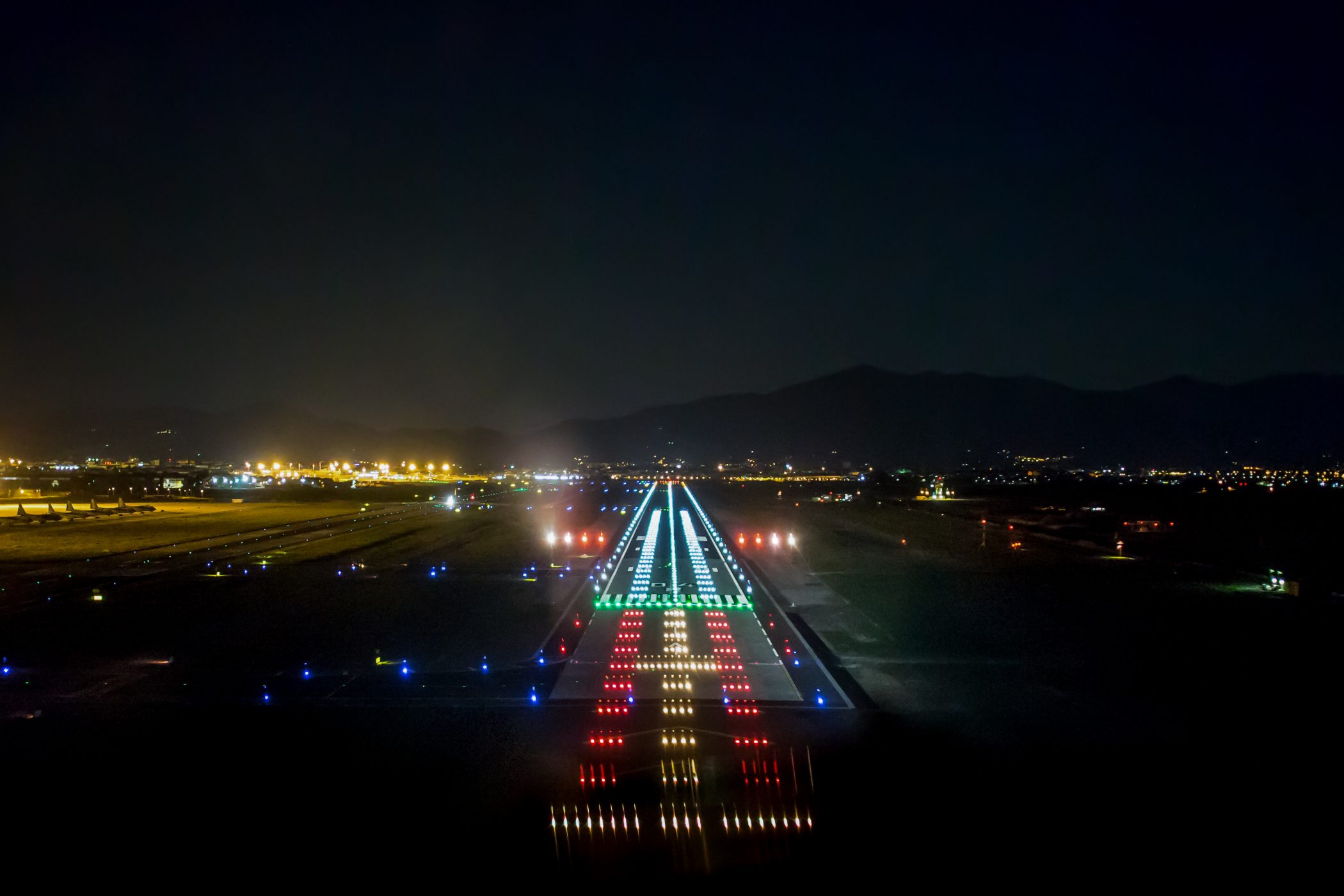
Much like traffic lights, aerodromes use coloured lights to indicate to pilots if it is safe to perform certain actions. For example, precision approach path indicator (PAPI) lights are installed at many airports and indicate whether a pilot is flying the aircraft on the correct slope. Runways also have coloured lights at the threshold and touchdown points.

Over the past half century, the prevailing thinking was pilots were required to have perfect colour vision. The terms ‘colour blindness’ or ‘colour vision deficiency’ became highly stigmatised, as well as being perceived as a threat to the safe operation of an aircraft.

However, as new research was conducted, new methods for colour vision testing were developed and gradually, different countries began changing their approach to colour vision testing, to consider the operational risks that such a condition introduced and how they could be managed.

These studies determined having a colour vision deficiency was not necessarily always a risk to the safety of the pilot, passengers or aircraft, provided an applicant can pass a prescribed operational test. However, it also acknowledged that severe colour vision deficiency may require additional consideration of the risks and operating environment.

National aviation authorities that have adopted this approach include the United States, New Zealand and South Africa.

Ishihara colour plates (Pseudoisochromatic plates (PIP)) are used during clinical medical assessments to determine if an applicant is colour vision deficient. Image: Iris

CASA reviews its policy

In Australia, CASA began exploring ways to acquire a medical certificate while managing any potential operational risks.

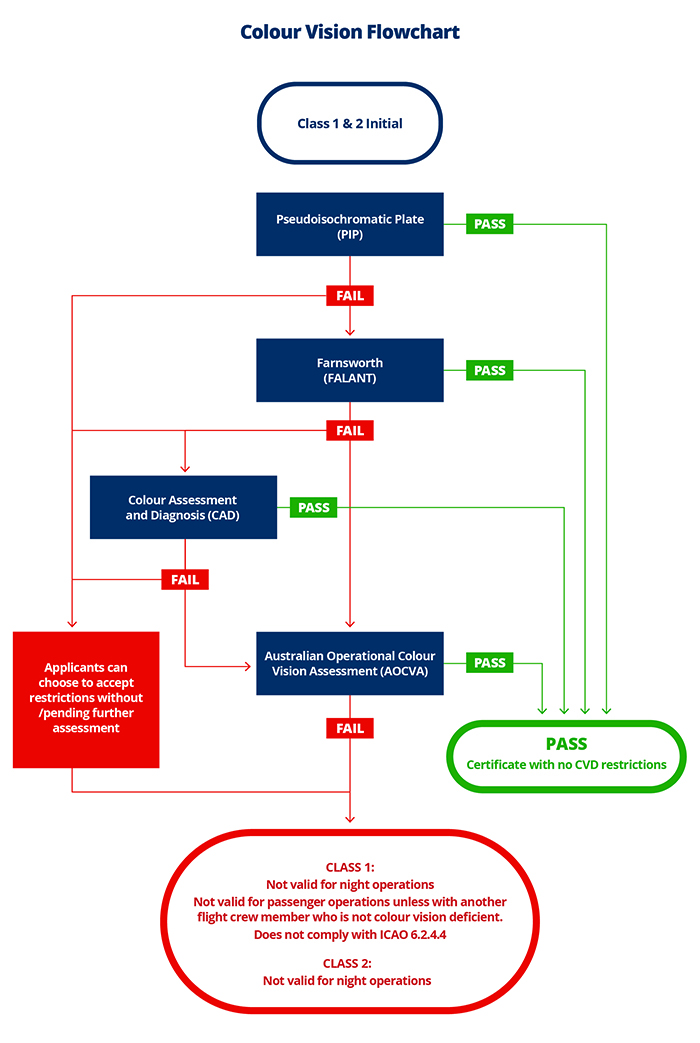
Last month it introduced the Australian Operational Colour Vision Assessment (AOCVA), an operational examination to test applicants in 3 practical components which imitate a scenario that would allow pilots to demonstrate they can fly safely in all kinds of circumstances, particularly safety critical ones, such as:

  1. A ground component that tests pilots on their ability to read aeronautical charts, flight instruments and displays
  2. A flight component that tests pilots on their ability to interpret precision approach path indicator (PAPI) lights in day conditions
  3. A second flight component that tests pilots on their ability to recognise and interpret aerodrome lights, aircraft lights and other colour-based aeronautical signals in day and night conditions.

If a pilot passes all components, they are issued a Class 1 or Class 2 medical certificate, with no colour vision restrictions.

CASA’s Principal Medical Officer Dr Kate Manderson says, ‘the new examination standardises operational colour vision testing and provides greater opportunity for prospective pilots to get into the industry.

‘The AOCVA operational assessment is beneficial for colour vision deficient pilots as it provides them with a genuine pathway to receiving a clean medical certificate, where they have demonstrated that they can do so safely.’

CASA’s colour vision testing pathway. Image: CASA.

Change of policy welcome

Allowing colour vision deficient pilots the opportunity to demonstrate their abilities in an operational test has been a goal of John O’Brien’s for many years.

John is the co-director of the Colour Vision Defective Pilot’s Association (CVDPA), a body that advocates and promotes the rights of existing and aspiring pilots to get into the aviation industry.

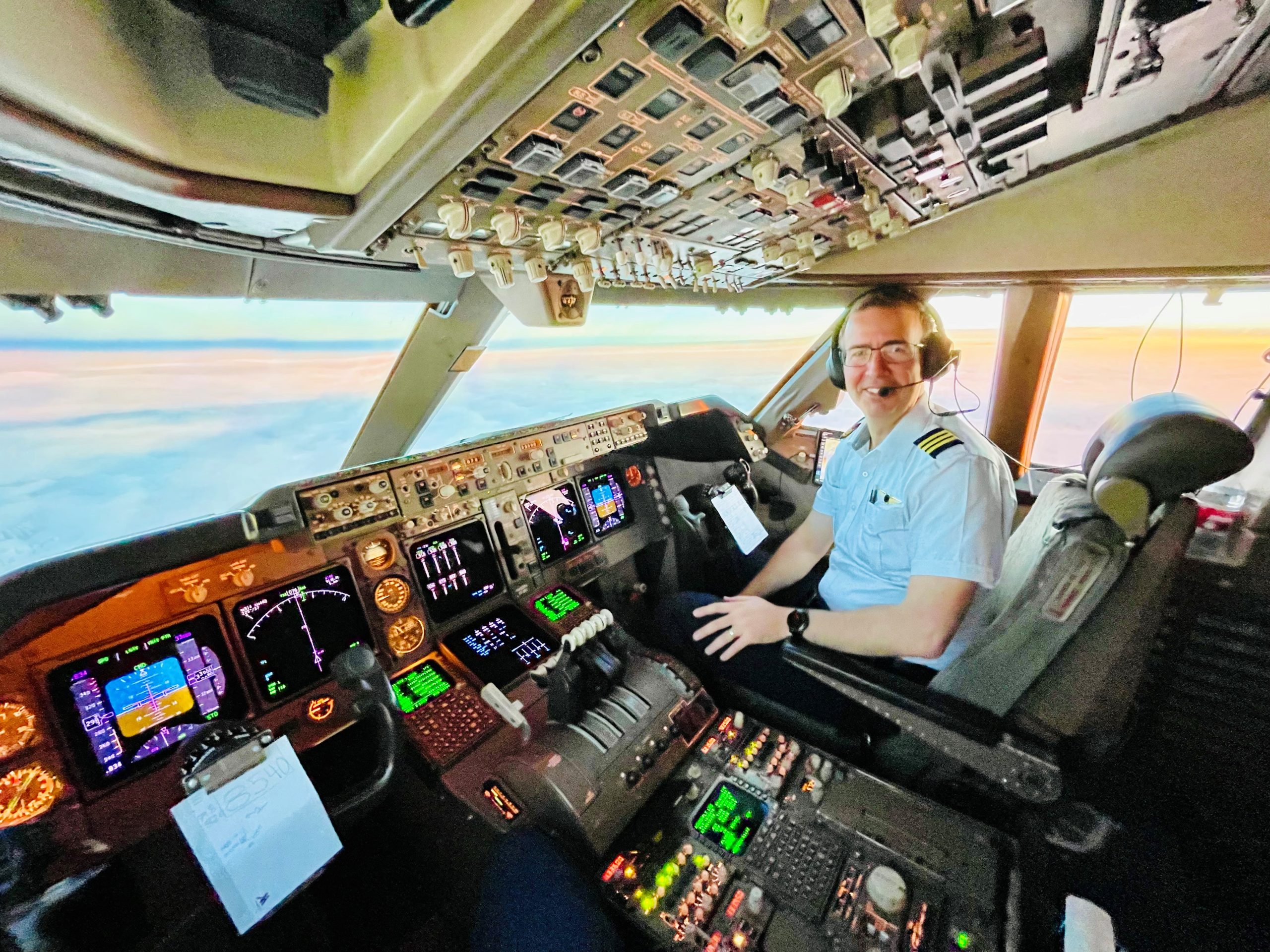
As John is colour vision deficient himself, he knows firsthand the challenges aspiring pilots face during their medical examinations. With over 22 years in the industry and over 10,000 flight hours, John is an experienced airline pilot, having flown Dash 8, A320, and currently B747 aircraft. He is also a qualified flight examiner and instructor and was a member of the CASA Technical Working Group (TWG) that provided industry insight and helped develop a pathway forward for CVD pilots.

‘Due to the stigma around what being colour vision deficient means within the aviation industry, when a prospective pilot is diagnosed as CVD, it can be a soul-crushing experience, and can wreak havoc on their mental health,’ he says.

‘Thankfully, after many years of advocacy, CASA has improved their policy and reintroduced a standardised operational test that offers fair opportunity for CVD pilots.

‘For too long, clinical eye examinations have been used to preclude people from pursuing a career as a pilot. This is why having an operational test is so important – so pilots can demonstrate their proficiency practically to operate an aircraft in the same way as non-CVD pilots.’

John says that even though the new policy has been implemented, there is still work to do to eliminate the stigma around colour vision across aviation industry.

‘As strange as it sounds these days, once upon a time, female pilots couldn’t become airline pilots due to archaic assumptions. That was until a landmark legal victory finally allowed them to,’ he says. ‘Over time, women proved they could perform the job safely in the same manner as men doing the same role.

‘The same thing needs to happen with colour vision pilots.’

‘It is incumbent upon all of us to educate and inform industry that having a colour vision deficiency isn’t a career-stopping condition, and that pilots who have it can operate and fly aircraft safely.’

John O’Brien at the flight deck of a Boeing 747. Image: John O’Brien

Onwards and upwards

Luke recently passed the operational test at Toowoomba Wellcamp airport.

‘I was a bit nervous before the test began but at the end of the day, you just need to treat it like any other flight,’ he says.

‘You can’t necessarily control how an examination will go, but you can control your preparation for it. As long as you are prepared, you will be fine.’

This is only just the beginning of Luke’s journey. In the immediate term he plans to pursue working for a turboprop operation. Longer term, he plans to gain an aerobatic rating, become a gliding instructor for the Air Force cadets to give back to the organisation that provided him his start in the industry, and has his eyes set on working for Qantas mainline.

Asked if he recommends fellow pilots who have a colour vision deficiency take the new test, Luke says it’s worth it.

‘Do it, because the sky’s the limit!’

Further information

For more information, visit CASA’s Colour vision assessment for medical certificates webpage.

Interpreting precision approach path indicator (PAPI) lights form part of the Australian Operational Colour Vision Assessment (AOCVA). Image: Avlite

Helicopter quiz: Winter 2024

  1. Servo transparency is also known as:
    1. jack stall
    2. servo reversibility
    3. retreating blade stall
    4. both (a) and (b)
  2. Servo transparency is more likely to occur when:
    1. the helicopter is heavy
    2. the density altitude is high
    3. the airspeed is high
    4. above 1 G
    5. all of the above contribute and are compounding
  3. Servo transparency occurs because:
    1. the intake for the hydraulic system is exposed to air during an unusual attitude
    2. the loads fed back into the flight control system from the rotor blades exceed the hydraulic pressure in the flight control system
    3. the pilot overpowers the hydraulic forces in the flight control system
    4. the hydraulic system runs out of fluid
  4. The helicopter will respond to jack stall by:
    1. reducing collective due to the pitch rod down force on the swash plate
    2. slowing down due to flap back
    3. rolling towards the retreating blade
    4. all of the above
  5. The pilot will feel servo reversibility by:
    1. the controls forces getting lighter
    2. the controls operating in their opposite sense
    3. the controls forces getting heavier or feeling frozen
    4. large aircraft vibrations
  6. The recovery actions for jack stall are:
    1. reduce the severity of the manoeuvre, increase collective and adjust cyclic as control is regained
    2. reduce the severity of the manoeuvre, lower collective and adjust cyclic as control is regained
    3. increase the severity of the manoeuvre to get back to straight and level more quickly, lower collective and adjust cyclic as control is regained
    4. increase the severity of the manoeuvre to get back to straight and level more quickly, increase collective and adjust cyclic as control is regained
  7. The best way to avoid servo transparency is to:
    1. slow down and fly smoothly when you are at heavy weight and high density altitude
    2. slow down and fly smoothly when you are at low weight and near sea level
    3. fly fast to spend the minimum time in the susceptible region
    4. allow enough altitude to recover from it
  8. Servo transparency is found on helicopters with:
    1. dual hydraulic systems
    2. dual engines
    3. a single hydraulic system
    4. single engine
  9. If a pilot is required to operate a single hydraulic system helicopter at heavy weight, fast and at high density altitude, they should:
    1. smoothly and slowly manoeuvre the helicopter
    2. mentally rehearse the recovery actions for servo transparency
    3. allow sufficient room between the helicopter and the ground to recover from a sudden unusual attitude
    4. all of the above
  10. If the pilot experiences jack stall during a manoeuvre and has to recover from a large, unusual attitude, they should:
    1. terminate the flight and let the maintenance crew look over the aircraft
    2. tell your flying supervisor what happened after the day’s flying is over
    3. continue flying as if nothing happened and tell the passengers not to say anything
    4. repeat the manoeuvre to confirm it really was jack stall that caused the unusual attitude

To view the answers, go to the next page using the page navigation buttons below.

Enjoy the open spaces

0

These 5 simple tips will help you fly safely in uncontrolled airspace.

Watching a feature film about how to safely and legally fly in non-controlled airspace could take a month. Bursting with high-octane enthusiasm, the pilots in command will display the full gamut of flying skills, ranging from seriously proficient to very seriously not.

Operating in controlled airspace is defined; it’s legislated; ATC calls the shots and we comply. Easy. But let us loose outside the boundaries (OCTA), the curtain rises and, batten down the hatches, here comes Jesse James and Calamity Jane.

But just because the shackles are off, it doesn’t mean that mayhem reigns. CASA and Airservices have, in my opinion, laid out a workable, easy-to-understand regime for us to follow when flying OCTA. We all just need to stick to the rules, and it works because we know what others are doing and what to expect.

Australia hands us a grand canvas for light aircraft flying. Once you get past the busy controlled airspace that defines a lot of our frankly gorgeous seaboard, there’s a whole lot of beautiful Class G and E airspace for us to use, handing us our passport into the best of regional and outback Australia.

I like to keep things simple. If you get these 5 disciplines stamped into your routine when flying OCTA, you’ll go a long way towards making our skies safer, and filling that logbook with irreplaceable memories.

1. Get the circuit right

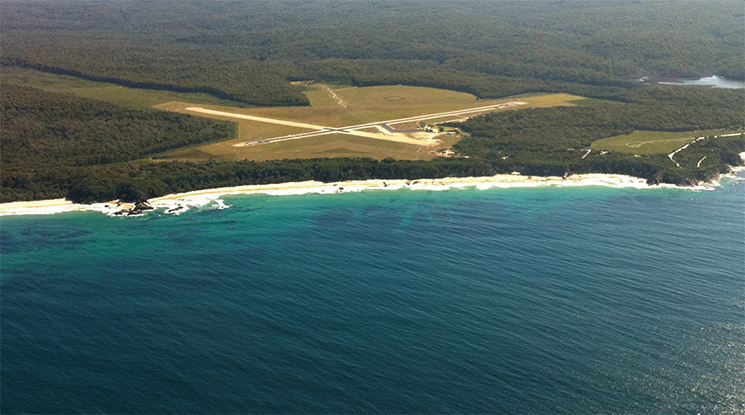
You’re going to have to land at some point. While a lot of non-controlled aerodromes may seem quiet, many of them are used by medivac, charter, agricultural and RPT operators, so there’s always the potential for substantial and varied traffic, often using different runways.

There’s also the possibility you may be the only aircraft in the circuit. Big tip: never believe that! Old mate in the ultralight at your 3 o’clock may have the radio turned down or may be on the wrong frequency and you won’t hear a peep out of them.

Tip: Get ready early! By at least 20 nm out, you should be able to get the wind information for your destination. Then orientate yourself with the logical circuit join for your preferred runway, well before you reach the aerodrome.

Listen out for the position and the type of other aircraft you hear inbound. GPS means everyone can give a pretty accurate ETA. If you hear an inbound QantasLink jet, for example, with an ETA a minute later than yours in your little Jabiru, think about how that’s going to pan out.

Have a look at the runway layout (please tell me that’s on your lap by now) and you might find there’s a long backtrack involved in vacating the runway. Even though there is no requirement for you to do so, in this case, consider taking the pressure off yourself and offer to land second.

Don’t just listen to radio calls – turn them into a visual picture for yourself of where that other aircraft is and what they’re doing. Unsure? Ask them to repeat it.

2. Golden rules of radio calls

I’m going to spend some time on this topic because it’s so important. I don’t know what’s going on with pilots that they think they’re calling the Melbourne Cup every time they hit that press-to-talk button, but it comes out in Swahili. I literally get beyond excited when a call comes through in which I’ve heard every word.

Brief and clear: It’s all a waste of everybody’s time if your transmission is not easily readable. Think about what you’re going to say before you transmit, make it slow enough to be understood and project your voice so the words are clear. Use the IMPAIR format (look it up). Basically, other pilots will want to know what type of aircraft you’re in (to assess speed), how high you are (altitude), where you are and what your intentions are.

Another thing: try not to clog up the frequency with unnecessary calls. Once you’ve made any calls needed to deal with possible conflict, we don’t need to hear the life story of your circuit.

And use some airmanship – if you can see that a landing aircraft is about to touch down, delay your call for a few seconds, if possible, to minimise the distraction for that pilot.

Correct radio frequency, volume UP: sounds pretty basic, right? How about including it in your CLEAROFF check? When you get to ‘radio’, check both the frequency and volume. If it’s a quiet day with few transmissions, listen to the ATIS if it’s available, to check the volume.

Wording: In a CTAF environment, you are required to commence and end your call with the name of your location. Often the first word of a transmission is missed, so be careful you don’t clip your transmissions.

image: Channel Country, Qld | Shelley Ross

This is particularly helpful in many areas around Australia where there are multiple CTAFs in close proximity to one another all sharing the same radio frequency. Example: Gulf of Carpentaria coast where we routinely hear lots of calls from aircraft inbound or outbound at Normanton, Burketown, Karumba, Kowanyama and Pormpuraaw, all of which require careful attention to the location stated so we can determine which operations are of consequence to our flight.

The ‘numbers’ channel, 123.45 MHz, is designated in the AIP as the air-to-air VHF communications channel.

Tip: It’s not a chat channel for discussion with your mates about the awesome fuel consumption you just got on your last leg.

Remember the radio frequency rule that catches a lot of pilots out: ‘When operating at aerodromes not depicted on aeronautical charts, pilots should monitor and broadcast their intentions on the relevant Area VHF.’ So, let’s all read from the same song book here – if the aerodrome isn’t on the Airservices chart, use Area VHF! Check that out before you go flying. If everyone sticks to this rule, it means we all get a picture of the local traffic and are at least talking to each other.

If you have 2 comms, always monitor the Area frequency as well as the local frequency. You don’t know when ATC might be trying to contact you.

Be smart about using your radio! Well placed calls can make the difference between mayhem and relaxed order in a multi-aircraft environment.

Reliance on technology can creep up on you, which is unsurprising if you use it all the time.

3. Over-reliance on technology

We all know how reassuring that unwavering magenta track is on our GPS or EFB screen. But there’s a lot of us out there potentially flying along the same track if it’s between 2 popular waypoints. Despite hemispherical rules, I still feel like I’ve got a target on my back sometimes, so I fly a mile or 2 to the right of track. Eases the blood pressure.

But let’s just say that bright shiny GPS or EFB screen suddenly turned very black, mid-flight. There’s a good chance you’d know vaguely where you are, but that’s not really good enough in this game. Reliance on technology can creep up on you, which is unsurprising if you use it all the time. Don’t get me wrong – use all the technology that’s going, but at the very least, keep a flight log – position fixes on your map and waypoint times on your flight plan – and factor in lots of redundancy. Use paper charts as a backup and practise map-to-ground and ground-to-map techniques.

4. Nav over featureless terrain

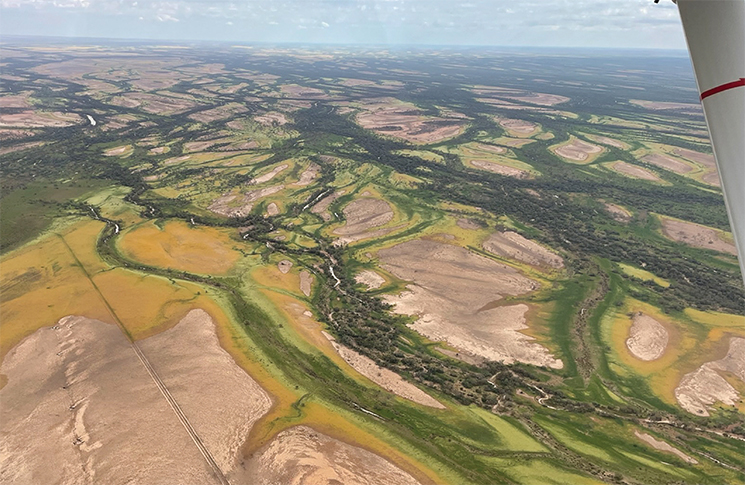
Featureless terrain and non-controlled airspace often go hand in hand. It doesn’t get much more sparse than the Simpson Desert, but it’s comforting to know that, even though you are out of controlled airspace, you are never on your own. You can always call ATC on the area frequency for assistance.

Tip: If you’re flying low or reception is poor, try contacting any other aircraft on the frequency for help. Their higher altitude may enable them to pass on a request to ATC for you. I have yet to experience anything but a helpful reply in these situations. If there’s a separate frequency for Flightwatch, use it.

There are a few reasons why it pays to fly high out here: it improves the radio range for comms with ATC, provides a better vantage point for picking out landmarks, and it’s more economical for fuel consumption.

If you have 2 comms, always monitor the Area frequency as well as the local frequency.

image: Bullo River station, NT | Shelley Ross

5. Fleet flying

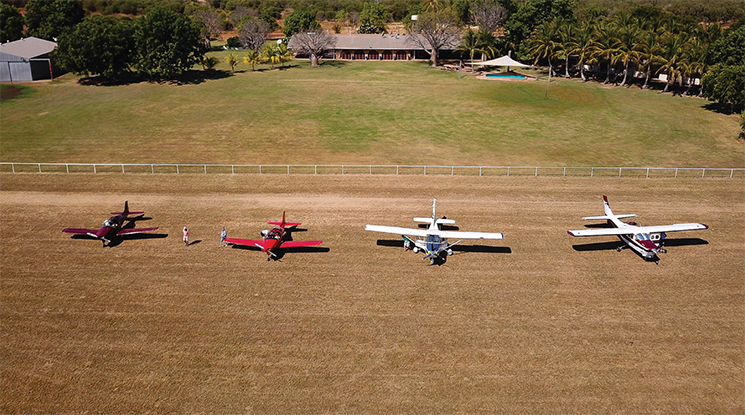
When you’re on a flyaway with friends, there’s usually a lot of non-controlled airspace involved. It doesn’t matter whether you’re in a fleet of 2 aircraft or 10, these tips should help you keep those friendships well into happy hour:

  • Do all your own homework. By all means listen, but don’t follow others’ plans just because they’re the loudest and they look terrifyingly confident.
  • Make your own weather assessment before you hit the breakfast table. Your comfort in the air today will be all about your personal minima.
  • Organise a logical order of departure, depending upon aircraft speed. Fastest first. Why? It reduces overtaking when you’re all on the same GPS track or magenta line and spreads out the arrivals at your destination.
  • Talk about using different altitude levels for the various aircraft on each leg.
  • Before departure, confirm everyone has the same destination frequency noted.
  • Do not be intimidated by aircraft behind you. You have right of way.

This is the best country in the world for light aircraft flying. Put the work in, get it right and you’ll be rewarded in spades. If you’re anything like me, you’ll learn something every single time you leave the ground, and isn’t that a good thing.

It’s all a waste of everybody’s time if your transmission is not easily readable.

image: Mallacoota aerodrome | Shelley Ross

Non-controlled operations

Non-controlled operations is one of the special topics on our Pilot safety hub.
Drone flyer diary – Rebecca Ludgate

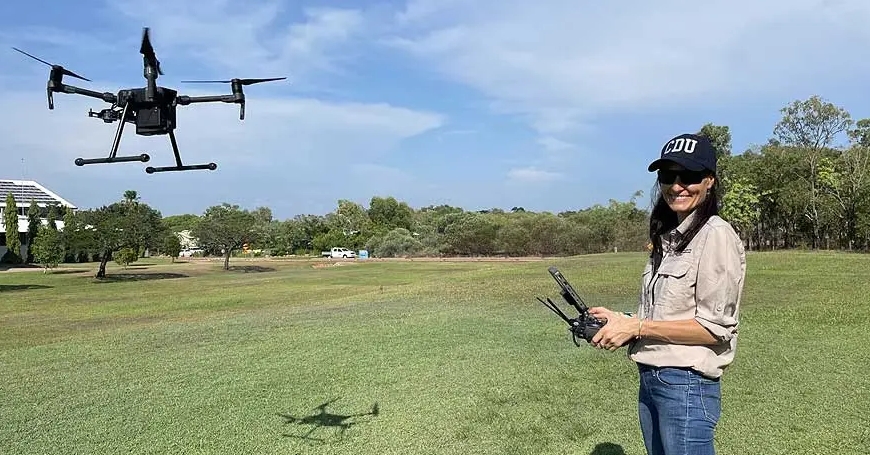
Rebecca Ludgate’s aviation journey was inspired by her father, a Qantas pilot. She decided to learn to fly too and, after obtaining her commercial helicopter pilot’s licence, began flying in some of Australia’s most challenging regions, including the Kimberley, Far North Queensland and the Torres Strait.

Her introduction into remotely piloted aircraft systems (RPAS) began by working with the Boeing subsidiary Insitu Pacific, where she operated the uncrewed aircraft ScanEagle. This experience paved the way for her current role as chief remote pilot at the North Australia Centre for Autonomous Systems (NACAS) at Charles Darwin University.

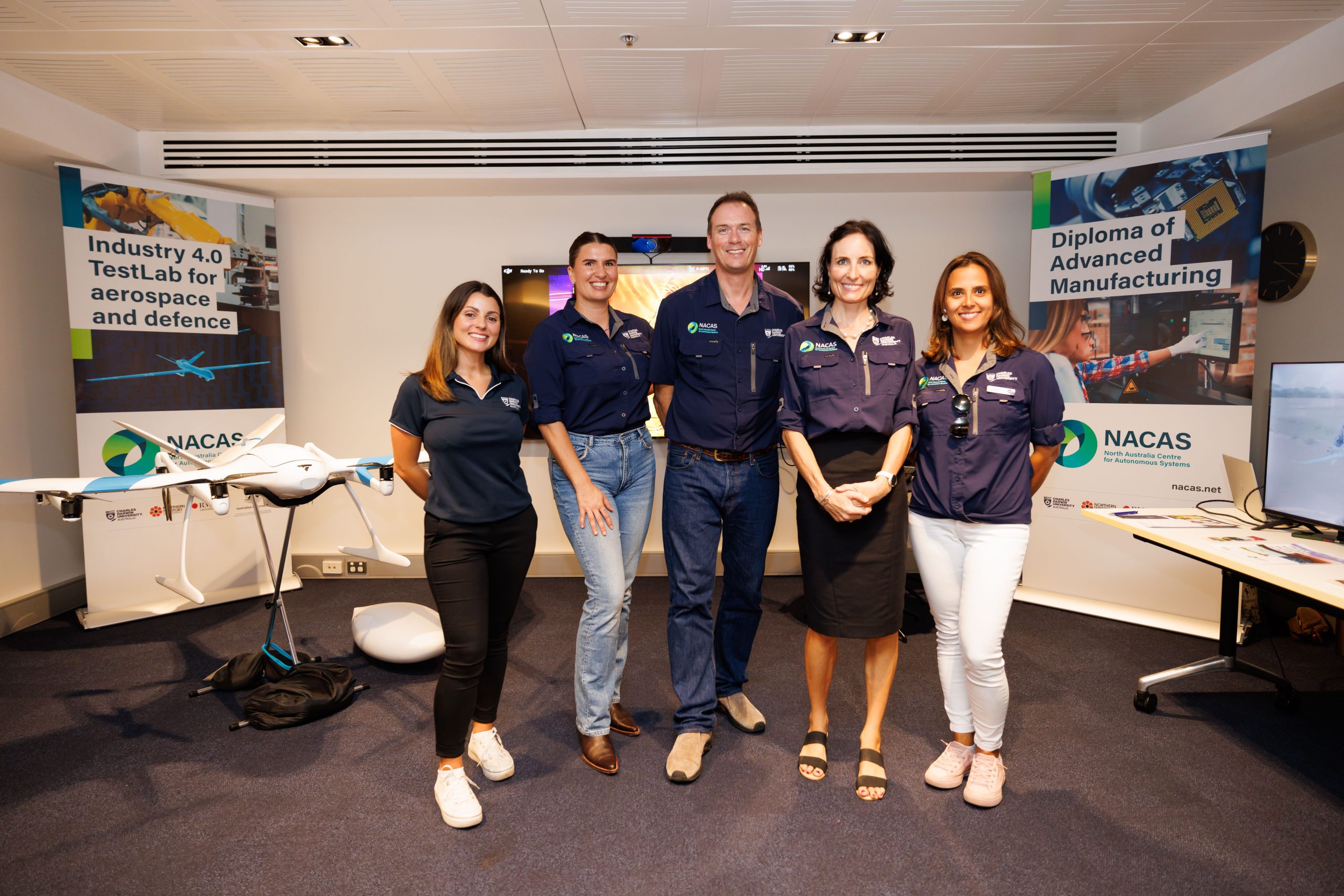
Some members of the NACAS team at a drone consultation in Darwin (Source: NACAS)

NACAS aims to bridge the gap between industry needs and the practical integration of RPAS technologies. Rebecca and her team collaborate with aviation RPAS companies, research institutions and universities to address the unique challenges of deploying RPAS in remote areas of northern Australia. Through these partnerships, NACAS helps develop solutions that enhance the effectiveness and safety of RPAS operations.

Safety is the top priority for Rebecca’s team. Before every operation, they conduct site surveys, perform detailed risk assessments and hold pre-flight briefings to ensure everything is in order to proceed with the flight.

‘Collaborating with industries like agriculture, conservation and land management, and healthcare to introduce drone technology is highly rewarding,’ Rebecca says. ‘This work has allowed our team to test and select drones that perform safely in challenging conditions and problem-solve communication limitations when operating in remote areas.’

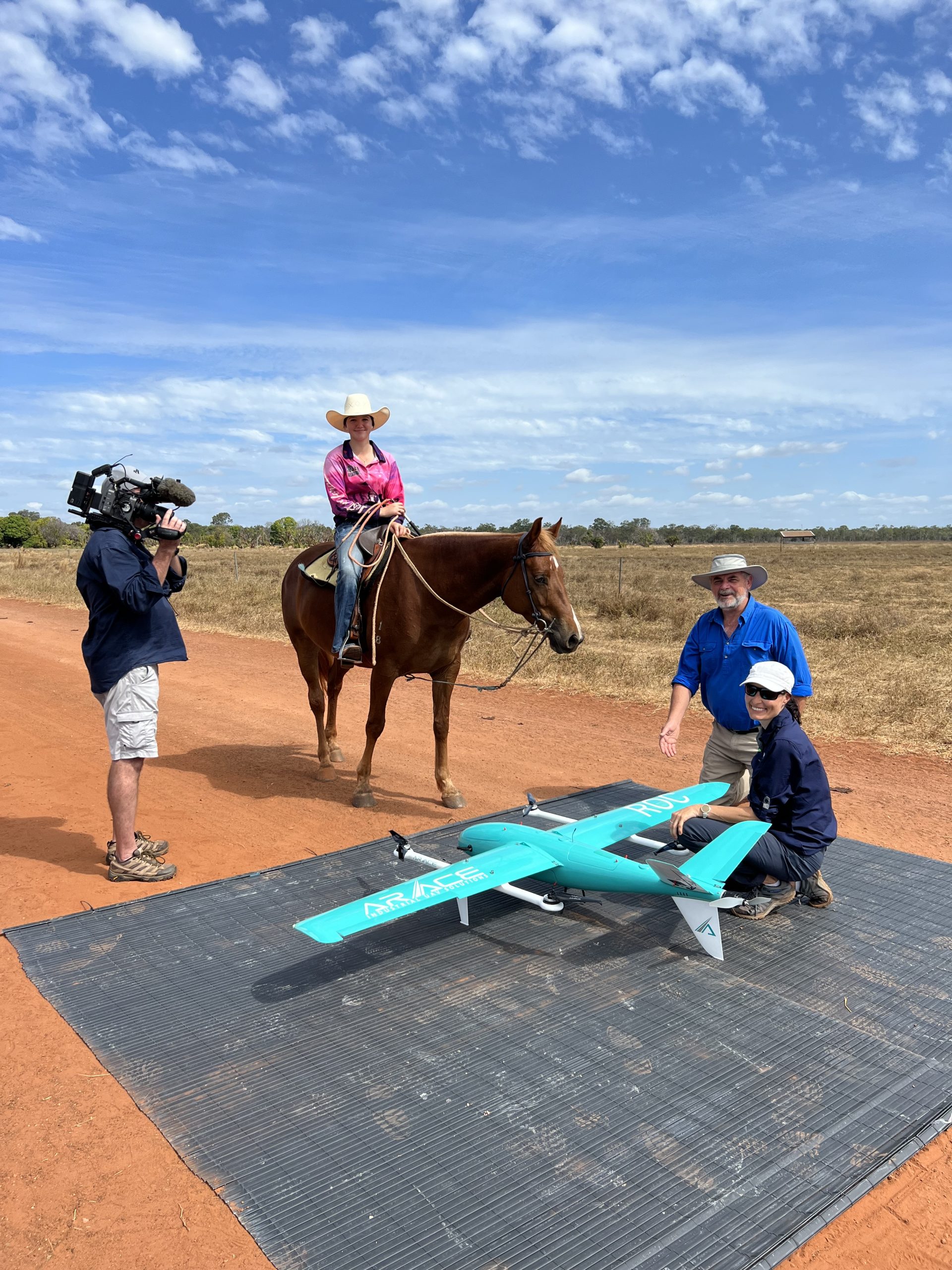
In 2023, her team was invited to fly a drone for the project Twenty to the Mile, assisting historian Derek Pugh.

A lot of the team’s drone operations involves seeking permission and permits to fly in national parks and reserves, as well as landowner approval. Fortunately, filming for this documentary was done at the university’s Katherine rural campus, meaning landowner approval was not an issue, although they do make sure not to interfere with the staff of the college as they muster the cattle.

Rebecca and team filming, Twenty to the Mile – The Overland Telegraph Pole, documentary with Derek Pugh at the Charles Darwin University campus, Katherine, NT (Source: NACAS)

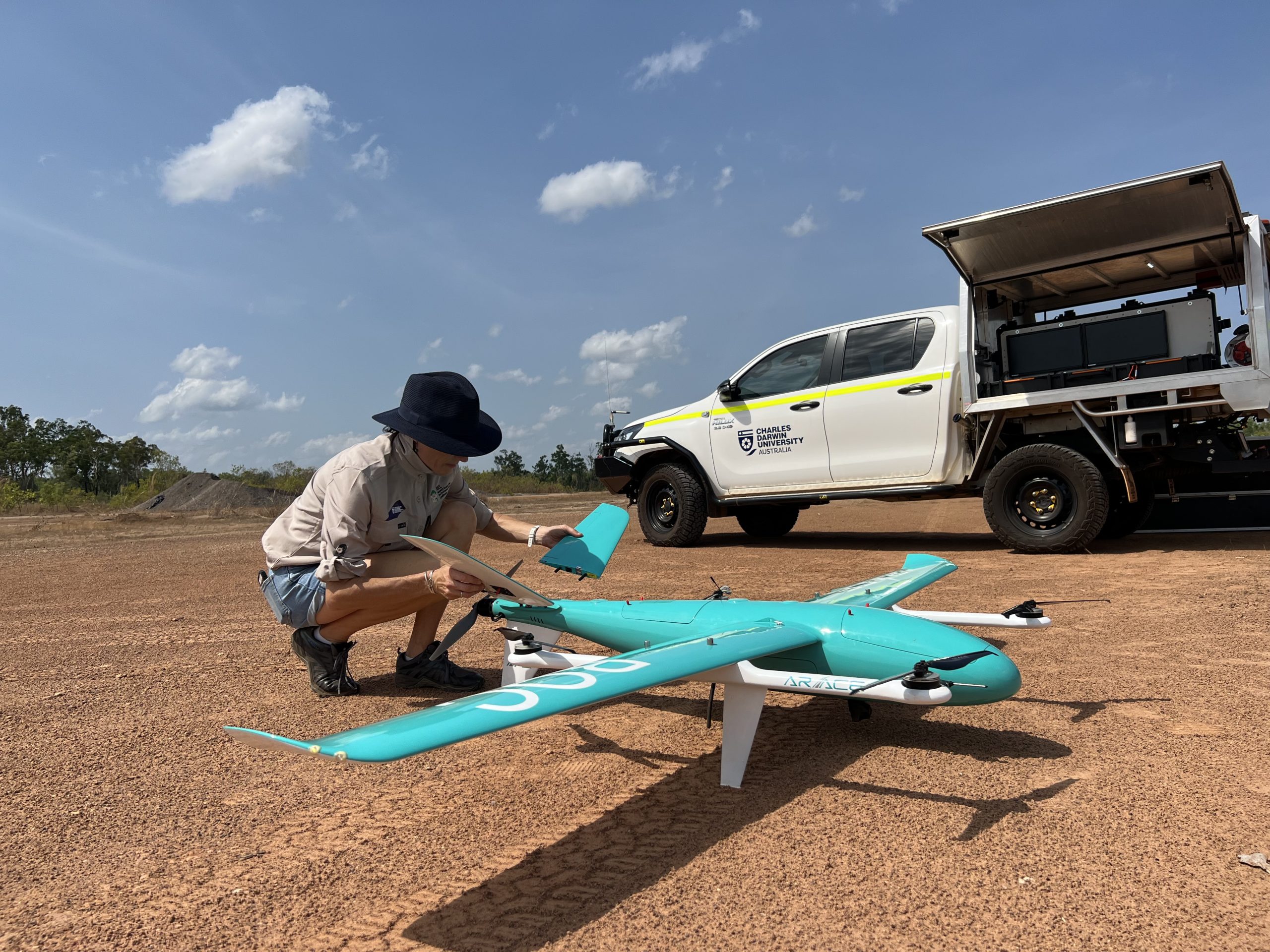
To do her job, Rebecca holds a remote pilot licence for fixed-wing, power lift and multi-rotor (sub-25 kg) drones, as well as an IREX instrument rating. Her team utilises a suite of DJI drones for training, on top of more specialised drones from Arace and SenseFly as remote sensing platforms and the RigiTech Eiger for delivering medical supplies to remote communities.

‘The rapid technological advancements in the industry are interesting. It’s a growing industry and it’s great seeing what comes out next in terms of capabilities,’ Rebecca says.

Rebecca conducting a daily pre-flight check on the Arace ROC drone, Darwin (Source: NACAS)

In addition to her role as chief remote pilot, Rebecca also works as a vocational education and training (VET) lecturer, instructing on the Certificate III Remote Pilot in Aviation. ‘The Certificate III courses are an excellent platform for me to share my aviation knowledge,’ she says. ‘I emphasise the importance of adhering to drone safety rules to promote safe flying practices from the start. These programs have advanced students into careers in mining, conservation and land management and real estate.’

Rebecca offers this advice to those interested in the drone industry: ‘Join a VET course or seek out work experience opportunities with industry professionals. It’s all about making connections and showing interest.’

Looking ahead, Rebecca anticipates an increase in the number of women entering both the drone and the broader aviation industry. ‘In crewed aviation, there are still relatively few women. However, in the drone sector, there seems to be a growing presence. More women are enrolling in Certificate III courses and flying drones professionally in both industry and research sectors. It’s encouraging to see more women joining the industry, I think it’s great.’

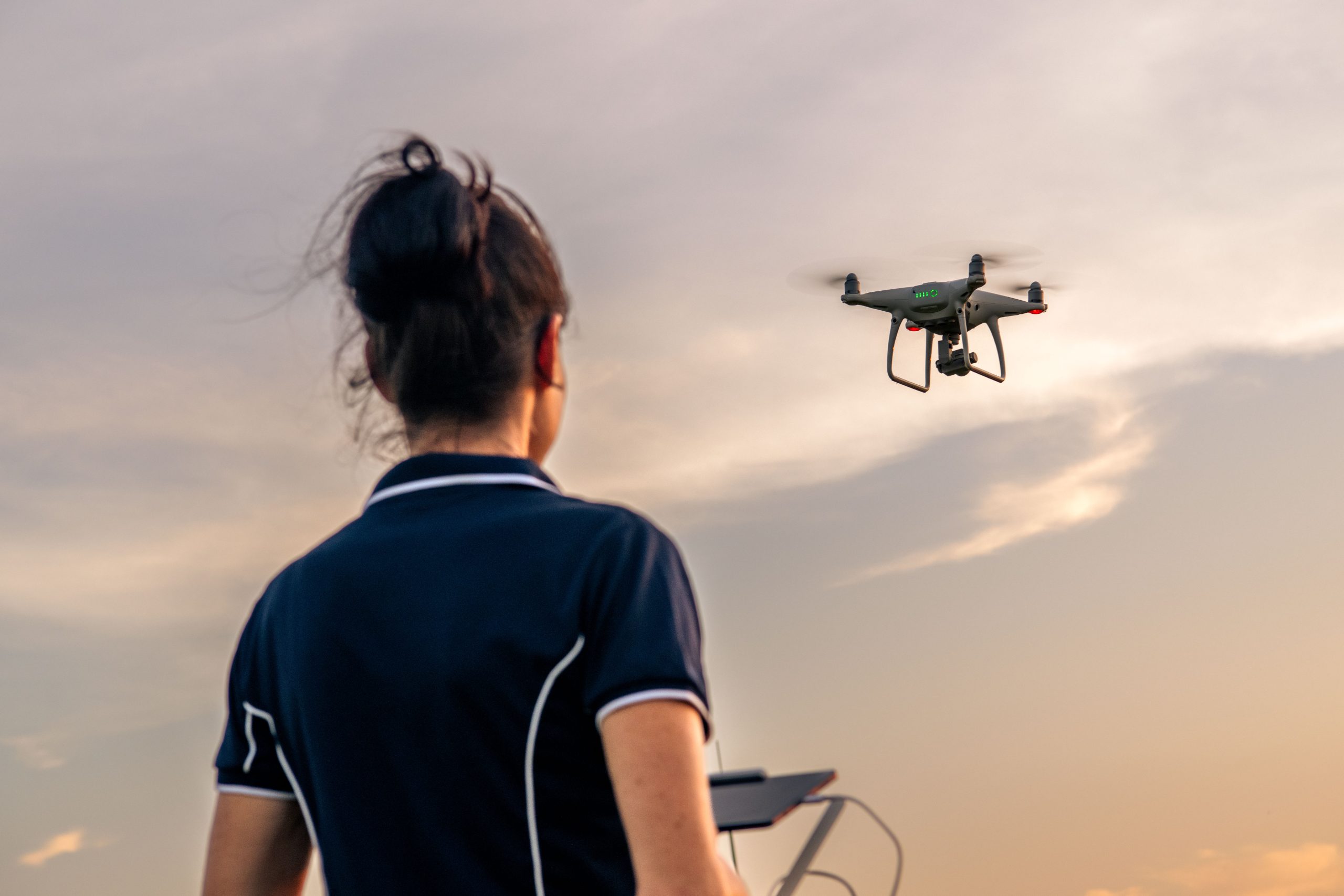
Rebecca flying a Phantom 4 in Darwin, (Source: NACAS)